Wednesday, July 21, 2010
ScopeRoller Going Forward

Sunday, July 18, 2010
Manufacturing in Aluminum

It is gorgeous--and all I had to do was to hold some 150 emery cloth to it while it was turning it on the lathe!
The first happy customer for the aluminum version for the new Losmandy Lightweight tripod sent me these pictures.

This picture emphasizes how well the Deluxe wheels work in high grass.

Friday, June 18, 2010
Finally! Clear Skies!
Nonetheless, I was able to get the optical system reasonably well collimated. Still, I think the structure is still not quite stiff enough, and collimated in one position meant that it wasn't so well collimated in another position. Unfortunately, stiffer would mean heavier, and it is already pushing the upper limits of the CI-700 mount. This expensive beast is about what it needs to properly support it.
Short (f/4.5) focal ratio mirrors tend to not do so well at high power compared to longer focal length mirrors, and it does show. There wasn't much point in going up above 160x on the Moon (although some of this was the burbling of the atmosphere). Still, the resolution is pretty amazing, even at 160x. (Telescope resolution improves inversely with diameter of the objective, so a 17.5" telescope at the same magnification will show at least twice the detail of an optically comparable 8" telescope.)
Saturn was a bit disappointing--and at least partly because of the collimation issues. Where Big Bertha really shines is on faint, deep sky objects, where magnification is far less important than the amount of light it gathers. I could not quite get the telescope pointed at M51, partly because of the odd angle required from my ladder. The Ring Nebula, however, was quite satisfying.
Sunday, January 3, 2010
If You Have To Ask The Price...
You can't afford it. The latest print catalog from Orion Telescopes arrived, and offered 36", 40", and 50" reflectors. And no, the print catalog coyly avoided listing the prices. The price tags vary from $55,600 to $123,000--and curiously enough, shipping is promised directly from "the North American factory."
Yes, a little out of my price tag.
If you want evidence that America is a wealthier country than it was when I was young--telescopes this size used to be considered world class research tools that only the very largest and most well-funded universities would own.
Thursday, November 19, 2009
Clear Skies
Last night was something of a rarity: a crisp clear night. And let me emphasize how crisp it was.
I rolled Big Bertha 2.0 out a bit late--around 8:30 PM--and by then, the target that I had originally planned to go after, M101 had dipped too low in the sky for a decent view. After spending some time collimating the mirror, I decided, "It is just too cold out here!" and went back inside.
I am pleased to report that the diagonal mirror holder and mirror cell that I made for Big Bertha 2.0 are very easy to adjust for perfect collimation.
Thursday, October 8, 2009
Watch NASA Make Things Go Boom
From October 8, 2009 CNN:
Assuming I wake up early enough, I'll roll Big Bertha 2.0 out for a look see.NASA's Lunar Crater Observation and Sensing Satellite is scheduled to drop its Centaur upper-stage rocket on the lunar surface at 7:31 a.m. ET.
NASA hopes the impact will kick up enough dust to help the LCROSS probe find the presence of water in the moon's soil. Four minutes later, the LCROSS will follow through the debris plume, collecting and relaying data back to Earth before crashing into the Cabeus crater near the moon's south pole.
The LCROSS is carrying spectrometers, near-infrared cameras, a visible camera and a visible radiometer. These instruments will help NASA scientists analyze the plume of dust -- more than 250 metric tons' worth -- for water vapor.
...
"We expect the debris plumes to be visible through midsized backyard telescopes -- 10 inches and larger," said Brian Day at NASA's Ames Research Center at Moffett Field, California. Day is an amateur astronomer who is leading education and public outreach for the LCROSS mission.
Wednesday, July 15, 2009
Suerrier Truss Again
I can't find a formula that exactly does the job, but I can use a worst case scenario to solve my problem, I think.
Unlike the current design for Big Bertha 2.0, where the load is about 1/4 of the way up the channel that is the primary support, here the deflection on the tubes that position the upper optical cage is just its weight on the end of the round tubes. For a single round tube, the worst loading will be gravity pulling the upper optical cage when the telescope is horizontal. (This is a position that it isn't in very often.)
There are a total of six tubes in a typical Suerrier truss, but I'll do the math here for a single tube holding the force. The reason is that this is by far the worst case--so whatever I come up with for an answer will be more than adequate.
The deflection for a beam supported at one end with a force at the other end is computed by the formula:
D=FL^3/3EI
where D = deflection
F = force
L = length
E = Young's modulus for the beam
I = moment of inertia for the beam
The moment of inertia (or second moment of area) for a tube is calculated by the formula:
I = pi/4 * (RO ^4 - RI^ 4)
where RO = outside radius of the tube and RI = inside radius of the tube
For the 1" OD, .050" wall aluminum tubes that Moonlite Telescope Accessories sells, I = 1.12 x 10⁻⁷.
For aluminum, E is approximately 70 gigapascals. For my application, I need 62 inch long tubes, so that I can use the existing bolt holes for the square tubes that I am currently using. (If I went a bit shorter, it would reduce deflection very slightly, but put a bunch of unsightly holes in the lower cage.)
I'm assuming that the entire ten pound load of the upper cage (including possibly having a camera in the eyepiece focuser) is carried on one tube. Converting everything to metric, this gives us a length of 1.57 meters, a force of 4.55 kg, and a worst case deflection with the telescope horizontal of .00075 meters, or about .03" inches. In practice, with six tubes carrying the load, and the upper cage providing additional stiffness, I suspect that I will get down into the thousandths of an inch of deflection.
Here's where it gets a little more tricky. While each tube by itself only weighs 0.41 kg (because they are hollow), six of them gets the weight up to 2.46 kg, or a bit under five and a half pounds. My goal was to knock at least ten pounds off the weight of the scope, by removing the square tubes, the turnbuckles, the guy wires, and most of the aluminum channel that provides both the mounting base for the telescope, and the bottom stiffness member. That aluminum channel right now weighs 10.22 pounds; cutting most of it away, so that it only connects the lower cage to the saddle for the mount, knocks off 6.25 pounds. Losing the turnbuckles and guy wires probably gets me another pound. Losing the two square aluminum tubes gets me another 0.44 pounds--so perhaps this would gain me about two pounds--hardly worth the effort.
A couple of possibilities:
1. Skeletonize the aluminum channel to reduce weight, since even it flexes slightly, that doesn't matter much--the upper and lower cages will be rigid relative to each other, and that's what matters.
2. Find some way to reduce the number of tubes, since it looks like one is barely sufficiently.
3. Use carbon fiber composite tubes. These are about three times as stiff, and even at the same size, about 1/2 the weight. There are commercial sources for carbon fiber composite tubes of these dimensions, and instead of five pounds, we're talking 2.5 pounds. Or look for some way to use even smaller carbon fiber composite tubes instead to get the same stiffness as aluminum, and get the weight down to perhaps 1.5 pounds. (And the price of carbon fiber composite tubes is such that going smaller both saves money, and increases the number of suppliers.) Unfortunately, as you shrink the diameter of the tubes, the stiffness declines rapidly, so you can't really go below 0.75" outside diameter--and that takes away much of the weight savings.
The temptation is to look at ways to replace that aluminum channel completely--and this might be a place where using carbon fiber composite could be most cost effective--if I could find an off the shelf carbon fiber composite channel of the right dimensions.
UPDATE: Here's a supplier of carbon fiber composite tubes that are small enough that they would probably give me the right stiffness, and would only weigh .24 pounds for all six. My concern is that the deflection for one tube would .1". If the load was evenly distributed, that would be .016" deflection--just barely acceptable. And they have carbon fiber channel--at a typical hefty price.
UPDATE 2: Yet another possibility is to remove the aluminum channel completely, and replace it with a a cradle that supports the lower cage where it needs to be supported--but is otherwise flat. The reasons for the channel were:
1. Stiffness.
2. To prevent the lower cage from rocking back and forth.
If the Suerrier truss provides all the stiffness, I can start with a flat piece of aluminum, and add some supports where the lower cage will be. (If I had a big vertical mill, I would start with a 1/2" thick piece of aluminum, and mill away everything else!)
I also notice that DragonPlate is quoting 138 gigapascals for the Young's modulus for their carbon fiber. I've had to adjust my calculations accordingly.
UPDATE 3: I took a nap this evening--hence, I'm full of energy late into the evening. If I dispense with the aluminum channel completely, I could use a 4" wide, 1/4" thick, 24" long piece of aluminum to tie the lower cage to the mounting plate. This would give me a half pound where I currently have more than ten pounds, and a maximum deflection of about .02"--in a place where that's a completely acceptable deflection, since it is outside the optical axis of the scope.
In combination with the other proposed changes above, using aluminum tubes, I could get it down by about six pounds. If I can find 1", .050" wall carbon fiber tubes at least 62" long, I can get the weight down by eleven pounds--so the whole telescope assembly would probably weigh about 45-47 pounds--light enough that the current mount should be sufficient. Of course, the price of the 1" carbon fiber tubes is horrifying. Finding them long enough is also a problem, but these splices let you epoxy shorter pieces together, and keeping the stiffness of the individual pieces.
Saturday, July 4, 2009
Calculating Serrurier Truss Deformation
If you don't know what this is, see here. I'm thinking of seeing if I can reduce the weight of Big Bertha 2.0 by replacing the current combination of aluminum tubes, turnbuckles, and guy wires, with a single Serrurier Truss design. Moonlite Accessories sells components; I need to figure out how to compute the deformation of a Serrurirer Truss design, to see if I can replace the current scheme with something that would be just as stiff, but lighter.
My intutive sense (which is often wrong), is that the deformation of any single tube will be the same as a tube parallel to the optical axis, but with cos and sin included as well! In addition, the top and bottom tube assemblies necessarily add some stiffness, so the total deformation of a six tube truss will be a maximum of 1/6th of the deformation of a single tube. (And in practice, of course, a bit less.) A book called The Design of Welded Structures has been recommended, but if I can find something online (or an expert in my readership--very likely!), all the better.
The current scheme where I have a single aluminum channel that runs the length of the telescope can be replaced with a single piece of channel that runs from the lower section (where more than 3/4 of the weight is located) to the mounting plate. This, by itself, will knock at least six pounds off the total weight. If replacing the current square tubes, the guy wires, and the turnbuckles, managed to knock another two or three pounds off the total weight, it would be worth it. (That would get Big Bertha 2.0 down to about 48 pounds.)
The other advantage is that I could disassemble Big Bertha 2.0 easily and quickly for vehicle transport, and it would simply putting on the mount, because I could put the lower assembly onto the mount as a somewhat lighter, and considerably less unwieldy structure, then put the tubes in place, and mount the upper cage on the tubes.
Thursday, July 2, 2009
Am I Being Unreasonable?
I received a ScopeRoller order on July 1. I emailed the customer back the same day, informing it that because we were waiting on wheels to ship from Missouri, it would be July 10 before we could ship. The response? A refund request because I couldn't ship immediately.
I'll make a refund--a customer this easily upset isn't likely a customer that I want that badly. But I don't think responding same day to an order with an anticipated production and ship date 10 days in the future is particularly absurd. Has the Internet bred a generation of hopelessly impatient sorts?
Saturday, June 13, 2009
New ScopeRoller Casters
I've just added several new tripods to the supported line of products:
ScopeRollerTM LXD55 for the Meade LXD55 tripod.
ScopeRollerTM VHAL110 for the Vixen HAL-110 tripod.
ScopeRollerTM VHAL130 for the Vixen HAL-130 tripod.
ScopeRollerTM OptMini for the iOptron Minitower tripod.
The sets for the Vixen HAL-110 and HAL-130 are actually more like a relaunch. I had grown too frustrated trying to machine these slightly complex parts before figuring out how to better grip the workpieces and how to select the right endmill for the job.
Sunday, April 19, 2009
No Longer Faded
I mentioned that I had acquired a used but functional Louisville Ladder for climbing to the top of Big Bertha. The paint was faded--and having a high visibility ladder in the dark is somewhat important. Problem solved!
Before

Click to enlarge
After

Click to enlarge
The joys of fluorescent orange spray paint!
Monday, April 13, 2009
Climbing To The Top of Big Bertha
Last July I mentioned that I was looking at Louisville Ladder's products for solving the problem of getting to the eyepiece of Big Bertha. (American made, by the way. We still make serious stuff in America, not just broken financial instruments.) In a number of positions, Big Bertha's eyepiece is either too high, or awkwardly placed (or both) to get to while standing on the ground--and the stepladder that I was using was a bit too scary to use in the dark.
While trying to decide whether to splurge on the more expensive but taller version of this rolling warehouse ladder, the layoff at HP happened, and I decided that I had more important places to spend my money.
I was looking through Craig's List recently, and I found a Louisville GSX2407 for sale, used, for $200. This is the really big version that I had not considered buying. New, they cost $920. Way too much money! But $200? A bargain.
So I went over to the shop of the guy who was selling it. He has a machine shop that would make my Sherline lathe and vertical mill feel like they had landed in Land of the Giants. This shop has two vertical mills that can easily turn five foot long, 24 inch diameter objects. It has at least one of the really big Bridgeport mills. Machine tool lust!
Anyway, the ladder was made in 1997, and the paint has faded, but everything works fine.
Click to enlarge
There's a brake at the bottom. You press a lever at the first step, and it lowers it down so that the wheels no longer turn. You press another lever to raise it. The wheels are squealing a little--probably in need of Break-Free--and I'll probably give it a fresh coat of safety orange paint to make it look better and protect it--but it works great. I can climb into positions with Big Bertha that would otherwise be difficult, or scary, and the railings mean that even in darkness, there's no real danger of falling off.
Oh yes: at the top landing, I can look into the roof gutters, and it is far more stable and safe than a ladder.
Saturday, January 31, 2009
Big Bertha Is Still Too Heavy
I mentioned back in June that I should clearly have used a Serrurier truss, instead of my own clever (?) design. While adding turnbuckles and wires gave Big Bertha sufficient stiffness to hold collimation, it is still too heavy for the Celestron CI-700 mount. The CI-700 had a nominal weight capacity of 60 pounds, and Big Bertha is right at 60 pounds--but that's part of why this is a nominal weight capacity.
When this became apparent a few months ago, I thought of selling the CI-700 mount, and buying a Losmandy Titan, which has a nominal capacity of 100 pounds, and should be more than sufficient. But a Losmandy Titan new costs about $6000. That was a sufficiently breathtaking amount of money that I didn't just run right out and buy one--and then my job at HP evaporated. So I went back to asking, "How can I knock some more weight off of Big Bertha?" Something closer to 50 pounds.
In the meantime, carbon fiber composite materials have become easier to find, and cheaper (at least for off the shelf components). Dragonplate, for example, sells square carbon fiber composite tubes from which I could construct a Serrurier truss. But the more that I looked at this, the more that I liked the idea of buying off the shelf parts for this. Moonlite Telescope Accessories sells connectors and poles for exactly this purpose. I did the math, and concluded that I could replace my current Frankenstein collection of parts with a total of six poles--keeping at least that part of the aluminum channel that bolts the telescope to the mounting plate (which also adds stiffness to that part of the telescope with the most deflection problem).
I'm not quite sure how to calculate the stiffness of a Serrurier truss, but I am quite sure that because of the diagonals, it is stiffer (probably substantially stiffer) than the same tubes parallel to the optical axis, as I have now. Even parallel to the optical axis, the six 1" aluminum tubes would give maximum deflection of 0.00251" for the heavy (mirror) end of the telescope--and the total weight would be about 52 pounds (which was about my original goal for Big Bertha).
Most attractive of using these off the shelf parts is that they are designed for quick assembly and disassembly. I could turn six bolts at the top of the scope, and six bolts at the bottom, and end up with two fairly short assemblies that could be put in the trunk of almost any passenger car. The six poles are five feet long, but can be put into almost any front seat without problem. It also simplifies putting Big Bertha onto a mount. The lower end will weigh about 35 pounds, and is small enough to pick up and handle by myself. Once located on the mount, I would bolt the poles in place, install the upper assembly (which should weigh less than ten pounds), and tighten down the bolts.
I'll scratch my head about this for a while, then look to see if I can find carbon fiber composite tubes that would be lighter than the aluminum tubes--even knocking 2-3 pounds off the total weight would be a win.
Thursday, January 22, 2009
Doing My Part For The Balance of Payments
ScopeRoller is shipping orders to Britain and Belgium tomorrow! That's my first customer in Belgium!
Friday, January 2, 2009
ScopeRoller Orders Flying In
Okay, not enough to quit the contract C# work, but suddenly I'm getting lots of orders, in the dead of winter. And lots of nice remarks from customers who have received their shipments:
Hi Clayton, Got the plugs in Wed mail. Thanks for the super fast shipping--it's amazing. Hat's off to you for running a real customer oriented business. You rank right at the top!and from someone replacing a Scope Buggy with my product:
The advantages are that the tripod now takes up less space in the garage, I frequently 'tripped' on or over the large wheels in the dark while using the scopebuggy, and I never quite felt completely comfortable with the 'fit' of the tripod legs in the rings provided. (Too much 'extra' room in those rings.)
Thursday, August 7, 2008
The World Wide Web: So Many Answers, Some Right
I needed the formula for calculating the sagitta of a spherical mirror (which is the depth of the hole you have to gouge out to make a flat mirror into a spherical mirror). Go ahead: search for the formula. There many different formulas out there--some of them right, some of them wrong.
This one is correct:
Now you are almost ready to start grinding. Before you start you need to figure out how deep the hole is that we are going to need. The formula for this is pretty simple. You need to know the diameter of the mirror (D) and the Focal Length (F) that you want to make and you get the Sagitta (S) which is the depth of the hole that you need to carve into the glass. The formal formula is:This one has the right answers in the example, but definitely the wrong formula:
The second way (an approximation) to calculate the sagitta with this formula which is probably a lot easier to calculate: S = 2F - sqrt( (2F)2 - (D/2 )2)
S = (D/2)2 / 4*F
"Sqrt" is the square root of the number inside of the brackets. Sagitta is how deep the curve of the mirror is going to be in the center of the glass. The more accurately you calculate and measure this dimension, the closer you will be to the Focal Length you want when you get done. Either formula should provide the same basic answer unless you're doing a fast mirror.
The World Wide Web is an amazing resource--but only slightly more authoritatively accurate than watching television news.SAGITTA This is the depth of the curvature of the primary mirror, measured at the center. The deeper the curve, the shorter the radius of curvature, and of course the focal length. The formula for sagitta is:
sagitta = R - Square root(R2 - d2/4)
R = Radius of Curvature d = diameter of mirror The following table ties it all together with some examples:
Mirror diameter F ratio Radius of Curvature Focal Length Sagitta 8" 7 112" 56" .071" 10" 7 140" 70" .089" 12.5" 6 150" 75" .130" 16" 5.5 176" 88" .182"


Saturday, July 19, 2008
Moon Over Bogus Basin; Jupiter
Unfortunately, I was so ga-ga over how beautiful the framing was, I didn't notice that I wasn't very sharply focused--on either Moon or trees (although they should be effectively identical focus). This is a prime focus at ASA 100 with the 17.5" f/4.5 reflector, 1/90th of a second.

Click to enlarge
I also tried to do eyepiece projection on Jupiter--still having a heck of a time getting a decent focus. You can tell that the cloud bands are there. Being still low in the sky, and with the Moon washing everything out, the cloud bands weren't dramatically more crisp in the eyepiece. This was 1/20th of a second, ASA 400, with an 18mm orthoscopic eyepiece projection.

Click to enlarge
I have also decided that whatever the limitations of Big Bertha's mirror, it is not clear that it has a turned edge. I am beginning to think that the problem was the lack of support of Big Bertha 1.0. I took the mirror mask off last night, and I couldn't see that there was any decline in image quality. I also tried to do the star test on Antares. While I couldn't get the diffraction rings (Antares was low in the sky, and there was a bit of turbulence), I didn't see any of the outside focus symptoms of turned down edge. It may not be a great mirror, but I can feel comfortable using the full aperture of the mirror now.
The big problem is that I need to get the telescope back down to Earth! I have the mount sitting on a 10.5" plus 12" column right now to get it high enough off the ground board to avoid collisions. What I need to do is is take out the 10.5" column, and build appropriate hardware to bolt the 12" column to the ground board. I still need a better stepladder than I am using, but even taking 10.5" out of the elevation would make a world of difference.
Tuesday, July 15, 2008
Taking More Weight Off Big Bertha
I mentioned a couple of days ago that the CI-700 mount just wasn't quite beefy enough to handle Big Bertha's weight. At the same time, the next step up--a Losmandy Titan or Mountain Instruments 250--would be $6000 to $7000--an enormous amount of money for what is, after all, a hobby.
I occurred to me that my original goal in slimming down Big Bertha was because the more weight you shave off the telescope, the less expensive of a mount you need. I would guess that every dollar you spend lightening the telescope saves you four or five dollars on a beefier mount. And maybe it is time to start looking at the use of carbon fiber composite components to take some more weight off Big Bertha. Even a ten pound reduction would probably get Big Bertha light enough for the CI-700 to handle well. It is certainly worth investigating.
Monday, July 14, 2008
Need A Suggestion For a Part
I have a screw that will be lifting a plate through about a 40 degree turn--but because of the angle that it will be at, the plate has to be captive. I can't just put a screw under the plate--I have to make sure that the upper plate won't go flying freely, and when I turn the screw back that it pulls the plate back down.

I had thought of using a ball joint or a clevis joint to allow the pivot. Ball joints in this size (like, 1/4" threads) don't have enough angle of motion. Clevis joints do, but clevis joints I can find are usually threaded, so turning the screw to move the plate up and down will be turning the joint round and round. Any suggestions? Is there a part intended for this? Perhaps something that might be used in model aircraft that allows a screw motion to move a part up and down?
UPDATE: One reader suggested a universal joint. A universal joint transfers rotation. In this case, I don't really want to do that. (Or need to--and since this might go into mass production, I'm looking for a cheap and simple way to do this.) Ideally, I want something that lets the screw coming up from the bottom move the upper plate up and down, while the joint allows the angle to change. This won't be moving quickly and very far.
UPDATE 2: Thank you for all the useful suggestions. I think I have enough now to figure out a solution!
Sunday, July 13, 2008
Balancing Big Bertha 2.0
Getting a telescope on an equatorial mount balanced is a bit of an operation--and I have not been completely happy with my efforts so far. One side effect of being unbalanced is that the motors just don't have enough power to move the telescope in either axis if they are unbalanced. You can disguise the lack of balance by tightening down the locks on both axes of the mount, but the motors still won't have enough power--especially when the telescope is up at the upper limits of the mount's capacity, as is the case with Big Bertha 2.0 and this Celestron CI-700 mount.
Balancing a telescope on a CI-700 mount involves loosening two clamps and moving the telescope back and forth--but that's harder than it sounds when the tube assembly weighs 55 pounds, and is 6 1/2 feet long. Even worse, when you replace a light eyepiece with a heavy eyepiece, or worse, a camera, the balance changes--again.
A common solution to this problem is to put a balance adjustment weight on a bar that you can move back and forth. I found a somewhat simpler solution. I took two pieces of scrap black nylon, cut them so that they were a bit wider than the bottom rail of Big Bertha, then used a 3/8" end mill to make two slots in each so that they would slide up and down on the bottom rail.

Click to enlarge
Sorry it is such a lousy picture--flash was too bright, and without the exposure dragged on too long.
And here's a full picture of it.
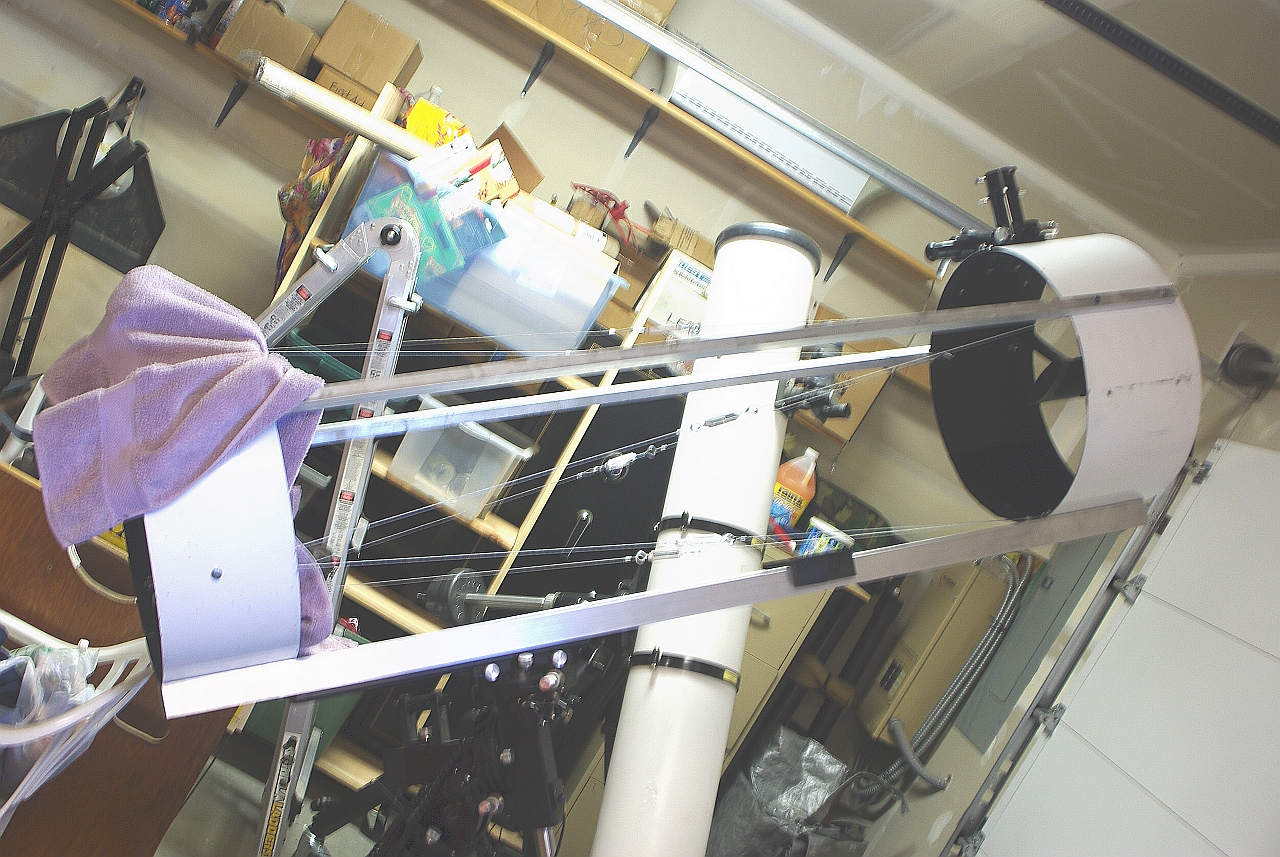
Click to enlarge
I had originally thought of using aluminum or Delrin, but the nylon has the advantage of:
1. It is scrap that cost me almost nothing.
2. Easy to cut and machine.
3. Because of its flexibility (even relative to Delrin), I didn't need to add a fastener to hold it on the rail. It is a friction fit, and I can move it back and forth with a wave of my hand.
I still think the CI-700 mount is too small for Big Bertha 2.0, but at least it tracks objects across the sky okay now. My big problem now is wind, which tends to whip it around a bit. There's less wind on the south side of the house--but perhaps a wind screen or a heavier mount makes sense. Unfortunately, from CI-700 size mounts to the next step up--the Losmandy Titan--is a leap of enormous size. (The Titan mount lists for $6000--far more than I can justify until I get the spare house in Boise sold, and even then, that's a lot of money.)