I Hate Wasps
We finally had a freezing night, and I was hoping that all the wasps were now dead. I'm working my way around the outside of the house, using the warehouse/telescope ladder to seal all of the openings in which wasps might be secreting themselves. (I am quite confident on this ladder, unlike a conventional ladder, where I don't think I would feel stable enough to do this without someone standing by to call 911 if needed.)
I pulled an ornamental piece of art off the wall, to seal the siding edges behind it--and there was about 15 of the little darlings, huddled together for warmth. I wasn't sure if they were still alive or not, but by the time I returned with the wasp spray, they were beginning to move their drowsy little bodies. Splat! Got 'em all in one burst!
One area where the old house was better than this house is the question of sealing. Anytime you build from wood, you are going to have expansion, contraction, and warping. When that happens, it opens up gaps. The old house, either because it was in a less extreme climate, or because the wood had aged longer, didn't have so many gaps--and all of the places where gaps could have developed had been sealed before painting. They probably used a very flexible sealant, because I never saw any of those gaps open up.
This house was not consistently sealed, and some of the gaps that have opened up over the last several years are large enough to let the little critters get inside. One place that I just found yesterday was up high enough that until I was on the ladder, I didn't see it. When I looked inside, it was like the hangar deck of an aircraft carrier, with more little wasp bodies than I could count. I've sealed that up. They won't be landing there in the future.
Showing posts with label house project. Show all posts
Showing posts with label house project. Show all posts
Thursday, October 1, 2009

Saturday, September 19, 2009
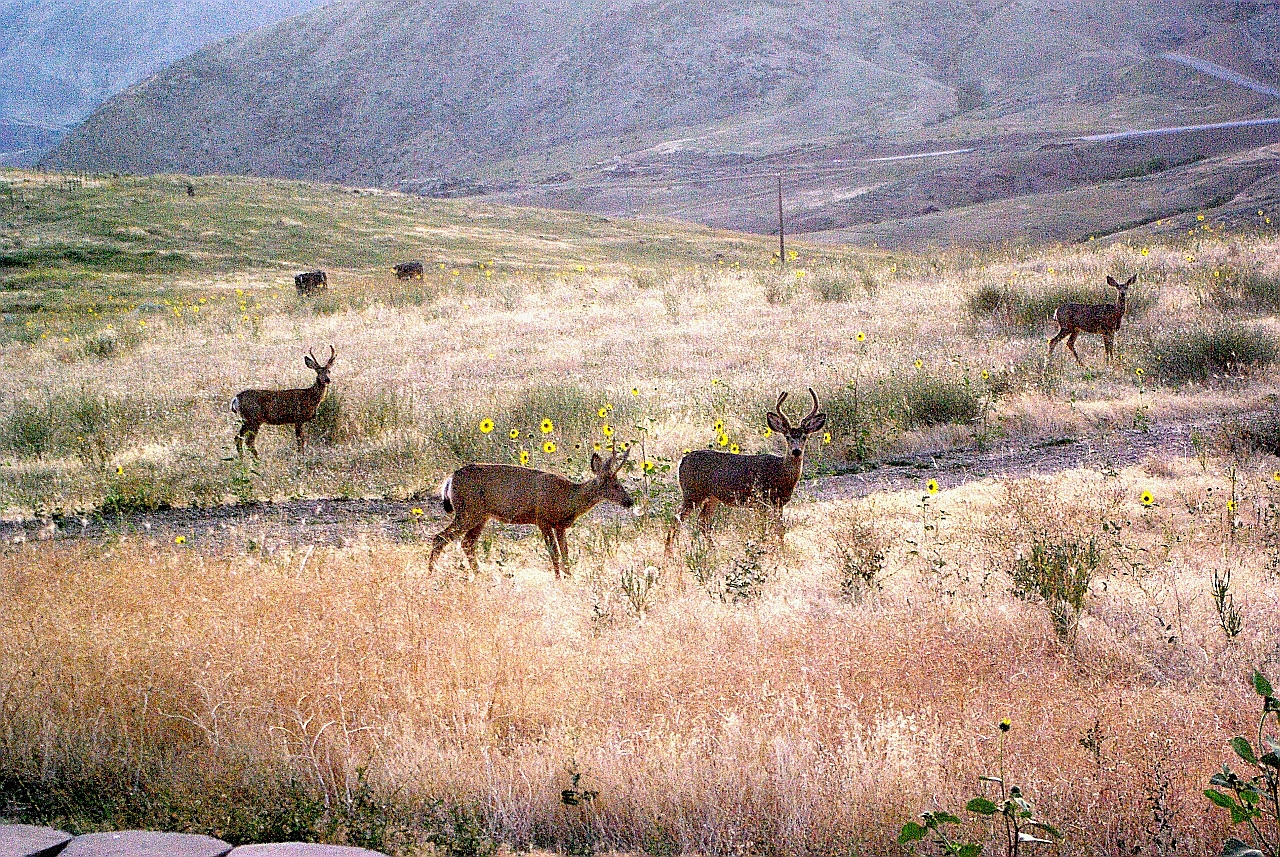
Lawn Ornaments
Lawn Ornaments
The picture's a bit grainy because the sun was barely lighting up the sky when I took this photograph.

Click to enlarge
The picture's a bit grainy because the sun was barely lighting up the sky when I took this photograph.
Click to enlarge
Wednesday, July 8, 2009
Doing My Best To Stimulate The Economy
Doing My Best To Stimulate The Economy
We've been planning a bit of work around the property--just in the interests of stimulating the local economy, of course! One of the projects was to complete the asphalting of the driveway. Due to a miscommunication with the paver last year, the asphalt stops about 130 feet from the front garage apron--and also stops about 10 feet from Sunburst Road on the other end.
Neither of these are particularly severe issues from a traction standpoint, even in heavy snow, because the driveway is pretty much flat in both places--but the reason to finish it, especially at the top, isn't just esthetics. It turns out that the snowthrower works really well on an even asphalt surface--but doesn't do so well on gravel. If we have asphalt from garage to the bottom of the hill, it's a heck of a lot faster to clear the snow--and once you have even a narrow piece of asphalt exposed to direct sunlight, it's amazing how fast that black surface absorbs infared, and melts the snow off the entire surface.
In addition, there are a couple of sharp curves coming up the hill where 8 1/2 feet wide really isn't quite wide enough--and we sometimes end up with tires over the edge. One consequence of this is, I suspect, a bit of cracking of the asphalt on one of those edges. Widening these two curves out to 10 feet would really help. It would also be nice to asphalt the back driveway, and complete the asphalt of the parking area in the front of the house.
I was putting off calling the pavers about this year's installment, hoping that either my wife or myself could get a full-time position with benefits--in which case, I would have been a lot more willing to spend the extra money on the back driveway and the front parking area. But our paver guy showed up at the front door this morning, and told me that his crew would be in the area shortly to do some other paving--so we reached an agreement to finish a strip to the front garage apron, widening the curves, and completing the section to Sunburst Road. If something works out about permanent employment before Thanksgiving, we'll have them come back and do some more work--otherwise, I guess that it will wait until next summer.
We also have another project that needs doing, and about which I am learning a lot. When we had the house built, we had a stamped, colored concrete done for the exterior sidewalks and garage aprons. It didn't come out spectacularly well (as previous postings have discussed), but the sun has bleached the surface enough that it is far less attractive than when it was completed 3 1/2 years ago.
Let me explain that from what I can gather, colored concrete seems to fit into one of three major color categories: acid etched, semi-transparent stain, and paint. The acid etch is somewhat artistic, and when all polished up, is pretty amazing. But the color choices are limited, because it is a chemical reaction on the concrete.
The semi-transparent stain is effectively a coloring agent that stains into the concrete, reinforicng the coloring agent added to the concrete. This is what we had done. On top of both the acid etch and semi-transparent stain you typically put a sealant, which provides a glossy finish, prevents water damage, and makes the color a bit more intense.
The third choice is a paint--which I don't think looks as good.
Anyway, sun exposure has pretty well taken away the sealant layer, and bleached the stain. I should probably have had it resealed the second year, but the change is so gradual that it is easy to not notice.
The first estimate we received to power wash the surface (which takes away any remaining sealant layer, in the sections not exposed to a lot of direct sun), restain, and reseal, was more than $1600. I found myself wondering if someone decided that we were richer than we are. But when I went to Sherwin-Williams to see what the cost of the stain and sealant was--the materials cost alone at retail was about $1100. (This is for the H&C Semi-Transparent Decorative Stain. I suspect that most of the other makers of this stuff are pretty much the same, but if you have experience, let me know!)
The actual labor involved doesn't seem so bad as to scare me offf. After you powerwash the concrete (about $25 a day to rent a power washer), you then roll the stain on the concrete, and let it dry. Then you spray the sealant on top. There's about 2500 square feet of concrete to do, so I suspect that we could get it all done over one very long weekend, or perhaps do front and rear on different weekends.
I've been hunting around; there are more reasonable prices available online for the same stain and sealant, which would get the materials cost (including shipping) down to about $700-$800. We have someone else coming out to give us an estimate tomorrow. If this second estimate is even close to the online materials cost, it would be tempting to let someone else who has the power washer, rollers, and sprayer, do the work.
Once we have it done, I'll stay on top of it in the future, and reseal every second year. With a little care, I think we can reseal for about $400, and not need to restain each time.
UPDATE: Another concrete guy came up to give us an estimate on restaining and resealing. His estimate was $5000. He insisted that the materials alone would be $2000 (even though I told him that I knew that the retail price of the materials at Sherwin-Williams was about $1100, and being a contractor, he probably got a better price), and his labor would be about $3000. This is, at most, a two day job. It is at most two hours to power wash the concrete; and about four hours to roll the stain. Come back the next day after the stain has dried, and perhaps four hours to spray the sealer. Even if I assume that the capital he has tied up in a power washer and painting supplies is worth $500 for two days (and that's quite a leap), that's $1250 per day for his labor.
I'm not seeing evidence of the declining economy that I was expecting. And no, I didn't have the garage open, so he didn't see the Corvette and the Jaguar.
We've been planning a bit of work around the property--just in the interests of stimulating the local economy, of course! One of the projects was to complete the asphalting of the driveway. Due to a miscommunication with the paver last year, the asphalt stops about 130 feet from the front garage apron--and also stops about 10 feet from Sunburst Road on the other end.
Neither of these are particularly severe issues from a traction standpoint, even in heavy snow, because the driveway is pretty much flat in both places--but the reason to finish it, especially at the top, isn't just esthetics. It turns out that the snowthrower works really well on an even asphalt surface--but doesn't do so well on gravel. If we have asphalt from garage to the bottom of the hill, it's a heck of a lot faster to clear the snow--and once you have even a narrow piece of asphalt exposed to direct sunlight, it's amazing how fast that black surface absorbs infared, and melts the snow off the entire surface.
In addition, there are a couple of sharp curves coming up the hill where 8 1/2 feet wide really isn't quite wide enough--and we sometimes end up with tires over the edge. One consequence of this is, I suspect, a bit of cracking of the asphalt on one of those edges. Widening these two curves out to 10 feet would really help. It would also be nice to asphalt the back driveway, and complete the asphalt of the parking area in the front of the house.
I was putting off calling the pavers about this year's installment, hoping that either my wife or myself could get a full-time position with benefits--in which case, I would have been a lot more willing to spend the extra money on the back driveway and the front parking area. But our paver guy showed up at the front door this morning, and told me that his crew would be in the area shortly to do some other paving--so we reached an agreement to finish a strip to the front garage apron, widening the curves, and completing the section to Sunburst Road. If something works out about permanent employment before Thanksgiving, we'll have them come back and do some more work--otherwise, I guess that it will wait until next summer.
We also have another project that needs doing, and about which I am learning a lot. When we had the house built, we had a stamped, colored concrete done for the exterior sidewalks and garage aprons. It didn't come out spectacularly well (as previous postings have discussed), but the sun has bleached the surface enough that it is far less attractive than when it was completed 3 1/2 years ago.
Let me explain that from what I can gather, colored concrete seems to fit into one of three major color categories: acid etched, semi-transparent stain, and paint. The acid etch is somewhat artistic, and when all polished up, is pretty amazing. But the color choices are limited, because it is a chemical reaction on the concrete.
The semi-transparent stain is effectively a coloring agent that stains into the concrete, reinforicng the coloring agent added to the concrete. This is what we had done. On top of both the acid etch and semi-transparent stain you typically put a sealant, which provides a glossy finish, prevents water damage, and makes the color a bit more intense.
The third choice is a paint--which I don't think looks as good.
Anyway, sun exposure has pretty well taken away the sealant layer, and bleached the stain. I should probably have had it resealed the second year, but the change is so gradual that it is easy to not notice.
The first estimate we received to power wash the surface (which takes away any remaining sealant layer, in the sections not exposed to a lot of direct sun), restain, and reseal, was more than $1600. I found myself wondering if someone decided that we were richer than we are. But when I went to Sherwin-Williams to see what the cost of the stain and sealant was--the materials cost alone at retail was about $1100. (This is for the H&C Semi-Transparent Decorative Stain. I suspect that most of the other makers of this stuff are pretty much the same, but if you have experience, let me know!)
The actual labor involved doesn't seem so bad as to scare me offf. After you powerwash the concrete (about $25 a day to rent a power washer), you then roll the stain on the concrete, and let it dry. Then you spray the sealant on top. There's about 2500 square feet of concrete to do, so I suspect that we could get it all done over one very long weekend, or perhaps do front and rear on different weekends.
I've been hunting around; there are more reasonable prices available online for the same stain and sealant, which would get the materials cost (including shipping) down to about $700-$800. We have someone else coming out to give us an estimate tomorrow. If this second estimate is even close to the online materials cost, it would be tempting to let someone else who has the power washer, rollers, and sprayer, do the work.
Once we have it done, I'll stay on top of it in the future, and reseal every second year. With a little care, I think we can reseal for about $400, and not need to restain each time.
UPDATE: Another concrete guy came up to give us an estimate on restaining and resealing. His estimate was $5000. He insisted that the materials alone would be $2000 (even though I told him that I knew that the retail price of the materials at Sherwin-Williams was about $1100, and being a contractor, he probably got a better price), and his labor would be about $3000. This is, at most, a two day job. It is at most two hours to power wash the concrete; and about four hours to roll the stain. Come back the next day after the stain has dried, and perhaps four hours to spray the sealer. Even if I assume that the capital he has tied up in a power washer and painting supplies is worth $500 for two days (and that's quite a leap), that's $1250 per day for his labor.
I'm not seeing evidence of the declining economy that I was expecting. And no, I didn't have the garage open, so he didn't see the Corvette and the Jaguar.
Saturday, June 27, 2009
The Maternal Instinct
The Maternal Instinct
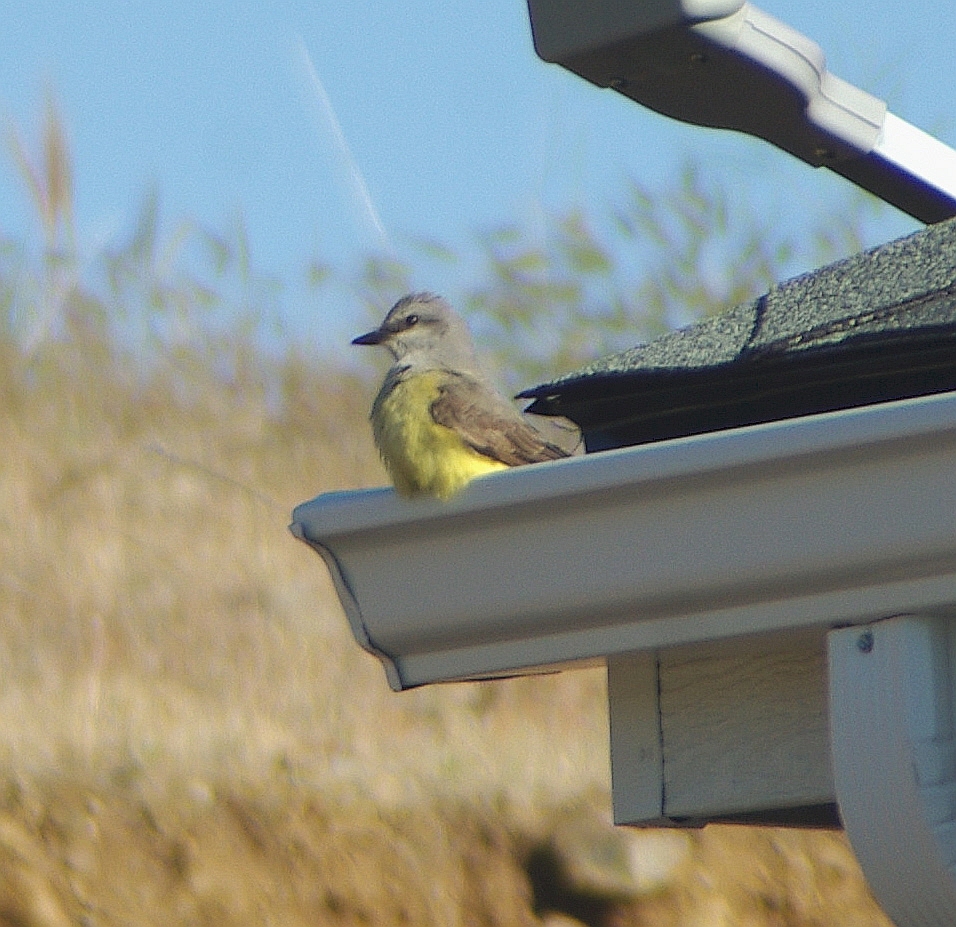
When we returned from the Grand Canyon trip, we had a new neighbor--a rather loud one at that.

Click to enlarge
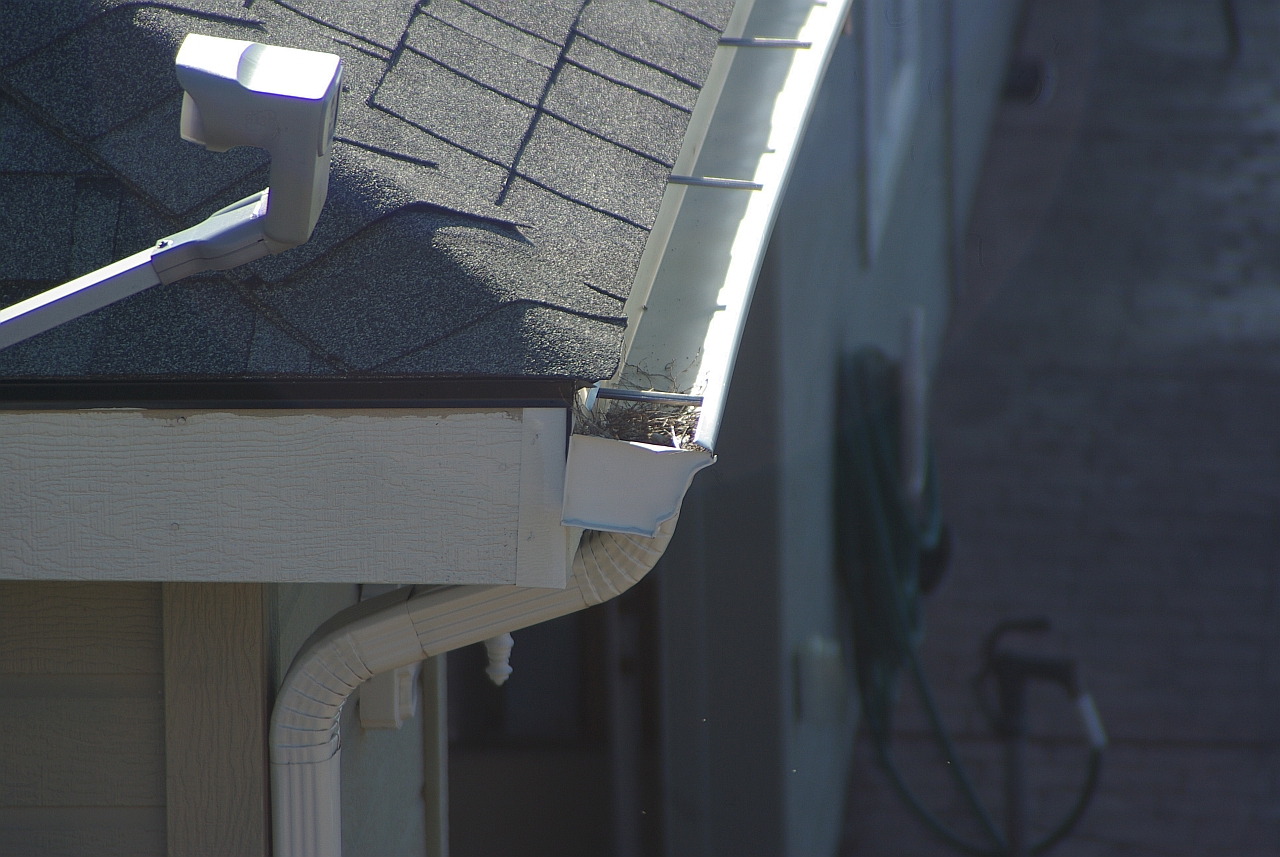
It appears to be a Western Meadowlark, with an astonishingly bright yellow coloration. And yes, when seen from above, it appears that she has picked one of our rain gutters to build a nest.

Click to enlarge
I suspect that in our absence, she decided that this would be a nice quiet place to lay her eggs, without worry about predators being able to get to it.
Of course, now we're back, and as soon as we open the garage door, or pull up in one of our cars, she zooms out of the nest, squawking loudly, hoping that we will chase her, and leave her eggs alone.

Click to enlarge
She'll take off on a great loop, and eventually land out in the brush.

Click to enlarge
Only when we have left the vicinity does she fly back home.
When we returned from the Grand Canyon trip, we had a new neighbor--a rather loud one at that.
Click to enlarge
It appears to be a Western Meadowlark, with an astonishingly bright yellow coloration. And yes, when seen from above, it appears that she has picked one of our rain gutters to build a nest.
Click to enlarge
I suspect that in our absence, she decided that this would be a nice quiet place to lay her eggs, without worry about predators being able to get to it.
Of course, now we're back, and as soon as we open the garage door, or pull up in one of our cars, she zooms out of the nest, squawking loudly, hoping that we will chase her, and leave her eggs alone.

Click to enlarge
She'll take off on a great loop, and eventually land out in the brush.

Click to enlarge
Only when we have left the vicinity does she fly back home.
Monday, March 16, 2009
Spring Is Coming!
Spring Is Coming!
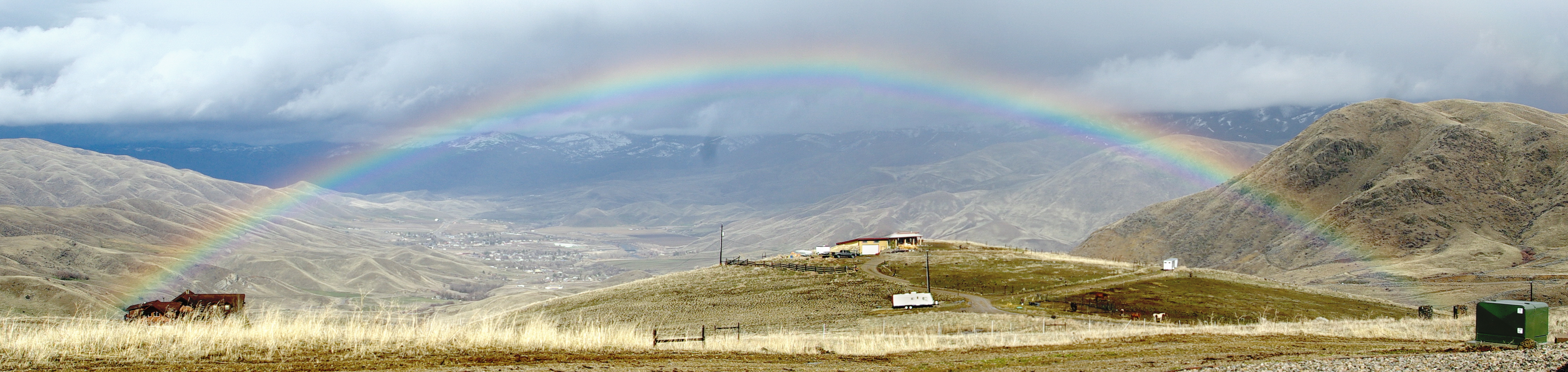
I can see it! It rained heavily and almost continuously today, but then, this!

Click to enlarge
And instead of a pot of gold at the end of the rainbow, there's a not quite leprechaun green transformer box.
I can see it! It rained heavily and almost continuously today, but then, this!
Click to enlarge
And instead of a pot of gold at the end of the rainbow, there's a not quite leprechaun green transformer box.
Sunday, March 15, 2009
Is Winter Almost Over?
Is Winter Almost Over?
I like to think so. Last Monday we had this beautiful rainbow.

Click to enlarge
But we still have these amazing icicles on the north side of the house.

Click to enlarge
We've got quite a storm going out there right now, but it's rain, not snow.
I like to think so. Last Monday we had this beautiful rainbow.
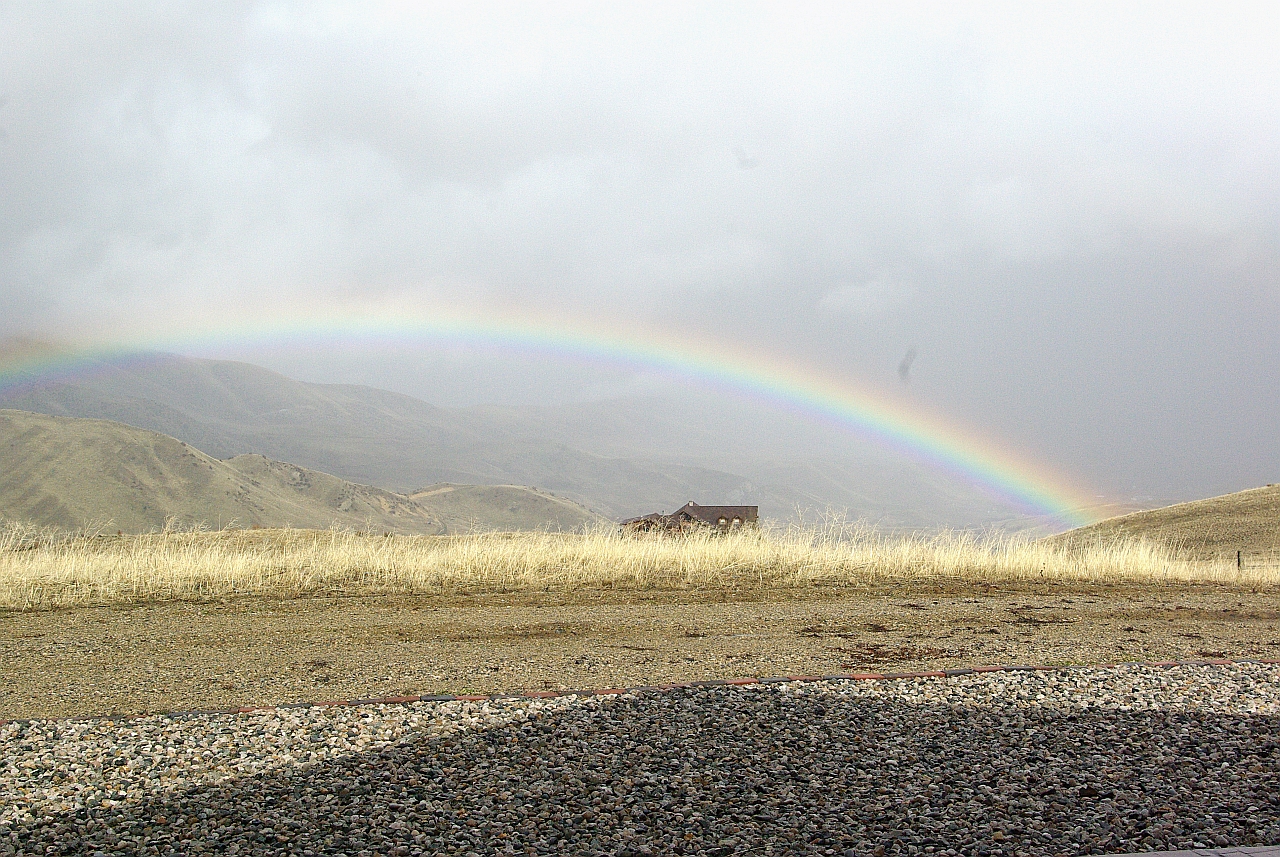
Click to enlarge
But we still have these amazing icicles on the north side of the house.
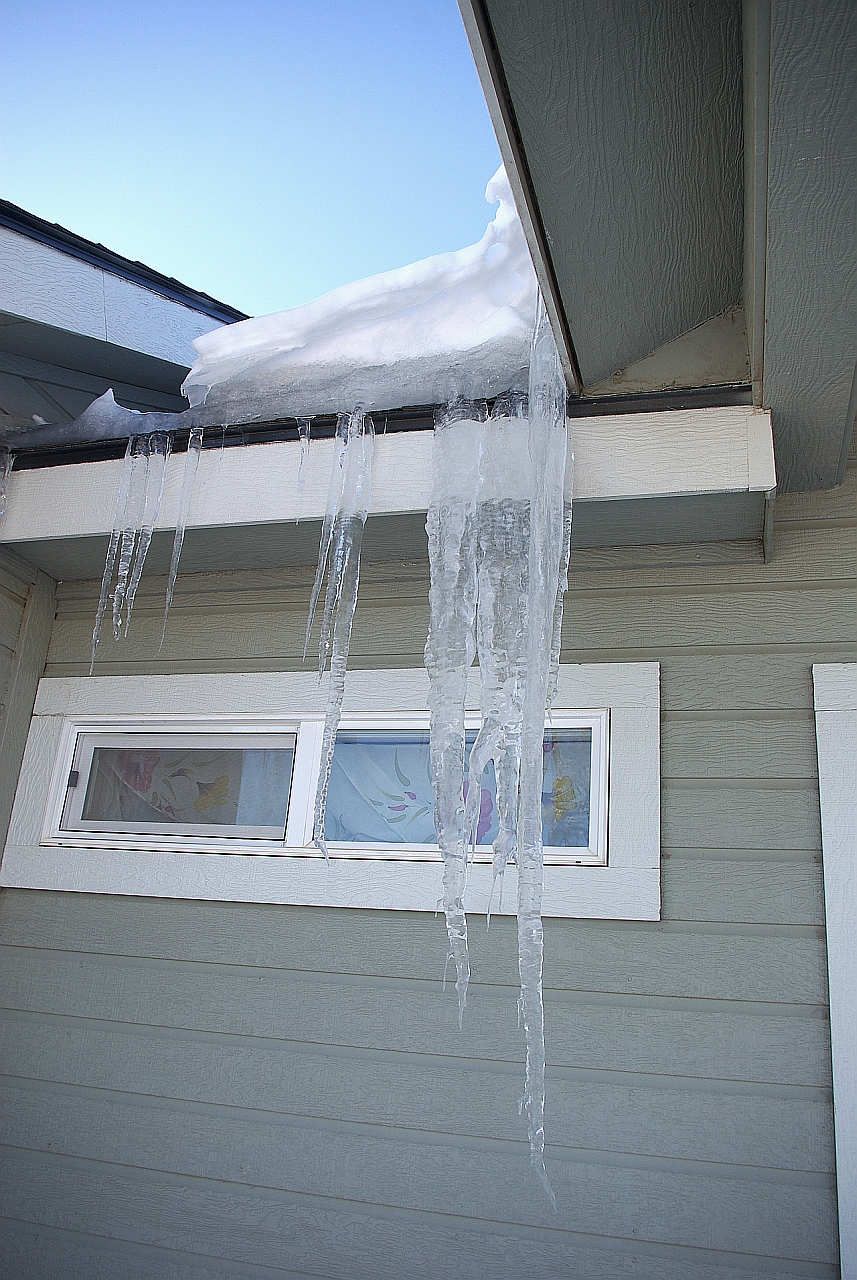
Click to enlarge
We've got quite a storm going out there right now, but it's rain, not snow.
Sunday, September 21, 2008
Those American Made Thresholds
Those American Made Thresholds
I mentioned last month that I had bought some rubber garage door thresholds from Harbor Freight to keep the rain out, and I was utterly shocked to discover that they were made in the USA. At that point, they looked like they would probably do the job, but without a real gully-washer, it was hard to say.
Well, we had the gully-washer over the weekend. Ordinarily after a rainstorm like that, we would have water under both doors--enough that it would take several hours to dry out. This time? We had just a little bit of water near the side of the south door--enough that if I hadn't been looking for it, I would not have noticed it.
In retrospect, the builder's solution of cutting drains in front of both doors, which did only a little bit of good on this, really was too expensive and too ugly. We should have just put the thresholds down instead.
I mentioned last month that I had bought some rubber garage door thresholds from Harbor Freight to keep the rain out, and I was utterly shocked to discover that they were made in the USA. At that point, they looked like they would probably do the job, but without a real gully-washer, it was hard to say.
Well, we had the gully-washer over the weekend. Ordinarily after a rainstorm like that, we would have water under both doors--enough that it would take several hours to dry out. This time? We had just a little bit of water near the side of the south door--enough that if I hadn't been looking for it, I would not have noticed it.
In retrospect, the builder's solution of cutting drains in front of both doors, which did only a little bit of good on this, really was too expensive and too ugly. We should have just put the thresholds down instead.
Monday, February 4, 2008
Dealing With Snow
Dealing With Snow
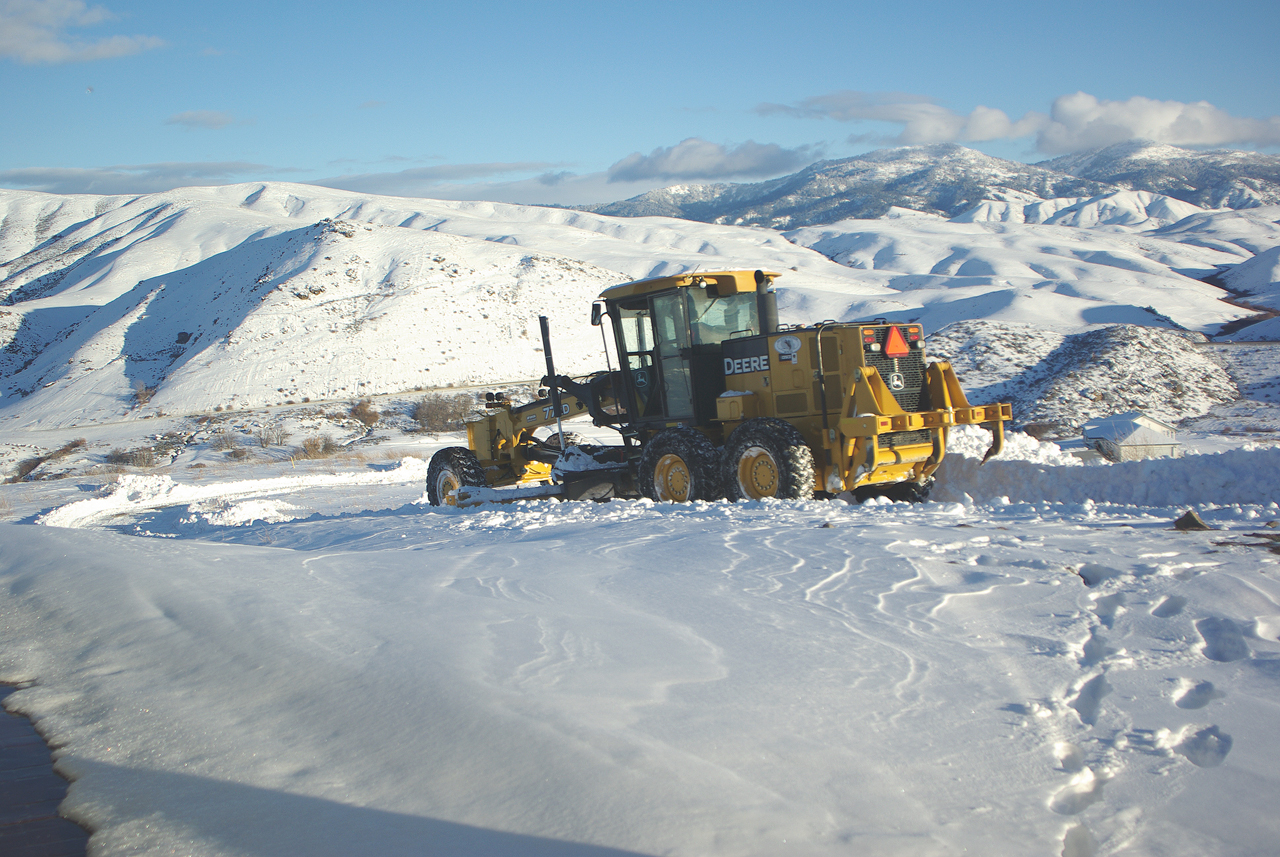
This morning my wife and I grabbed our snow shovels, planning to move enough snow to use the Trailblazer to crush down the remainder. As I was working my way down the hill, pacing myself to avoid snow shovel induced heart attack, our neighbor Dave called to me--and then I noticed someone using a Bobcat (a type of small earthmoving equipment) driving up the common road.
It turned out Mr. Helmick had brought his Bobcat over to help out one of his friends who lives in the same subdivision--and was quite to willing to do some snow removal for the rest of us for a very reasonable fee. Now, liberals would complain that he was taking advantage of our need because he had something that we didn't have. I would say that he had capitalized the equipment, and I was quite prepared to pay him $50 to make several passes over our driveway--a very reasonable price compared to shoveling it myself.
Anyway, you can see the results here.

Click to enlarge

Click to enlarge
The sun is out today, and we're beginning to get some melt.

Click to enlarge
One of our neighbors outside of the subdivision was feeling neighborly, and without asking for any money decided to clear the common road in--and our driveway.

Click to enlarge
That's one of the virtues of living here. A lot of people are prepared to work for a reasonable rate of pay, and others do things out of the goodness of their hearts.
This morning my wife and I grabbed our snow shovels, planning to move enough snow to use the Trailblazer to crush down the remainder. As I was working my way down the hill, pacing myself to avoid snow shovel induced heart attack, our neighbor Dave called to me--and then I noticed someone using a Bobcat (a type of small earthmoving equipment) driving up the common road.
It turned out Mr. Helmick had brought his Bobcat over to help out one of his friends who lives in the same subdivision--and was quite to willing to do some snow removal for the rest of us for a very reasonable fee. Now, liberals would complain that he was taking advantage of our need because he had something that we didn't have. I would say that he had capitalized the equipment, and I was quite prepared to pay him $50 to make several passes over our driveway--a very reasonable price compared to shoveling it myself.
Anyway, you can see the results here.
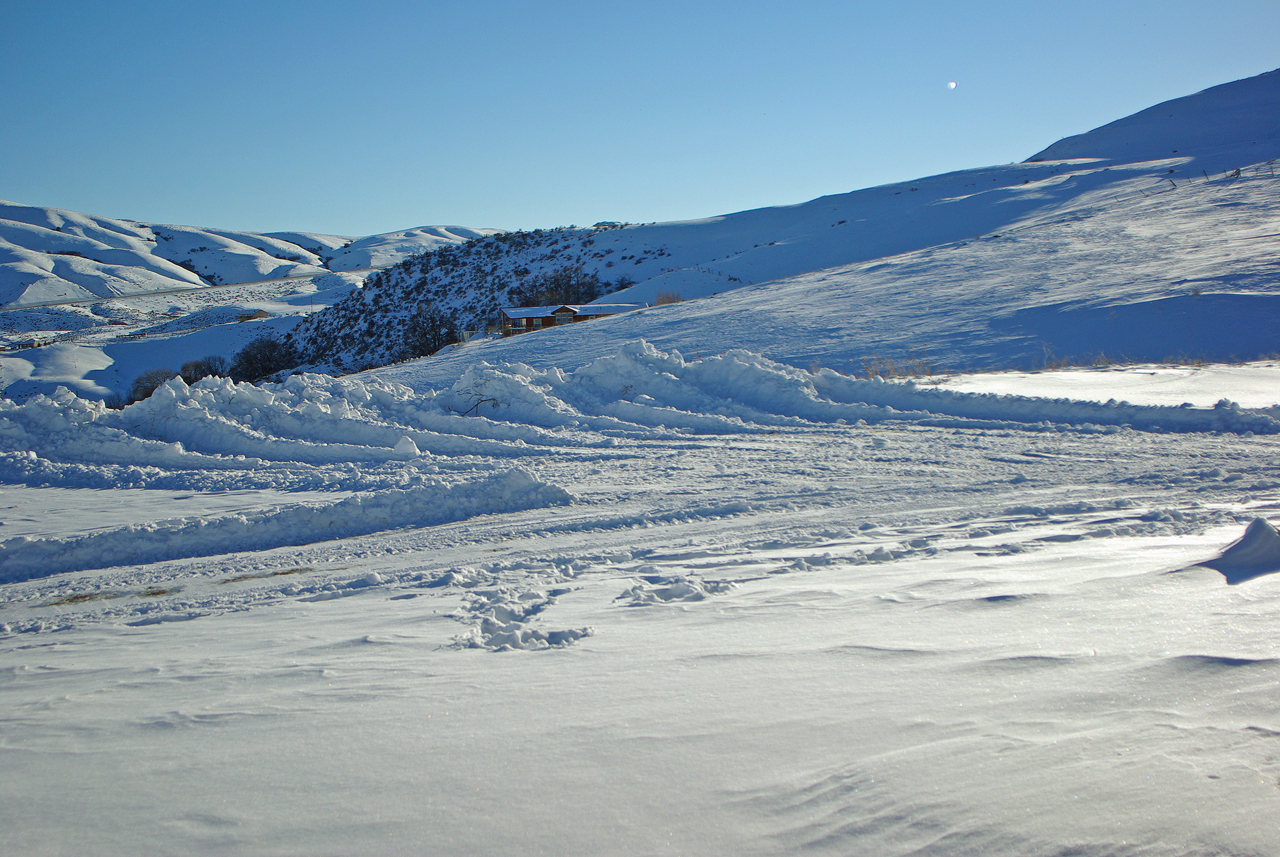
Click to enlarge
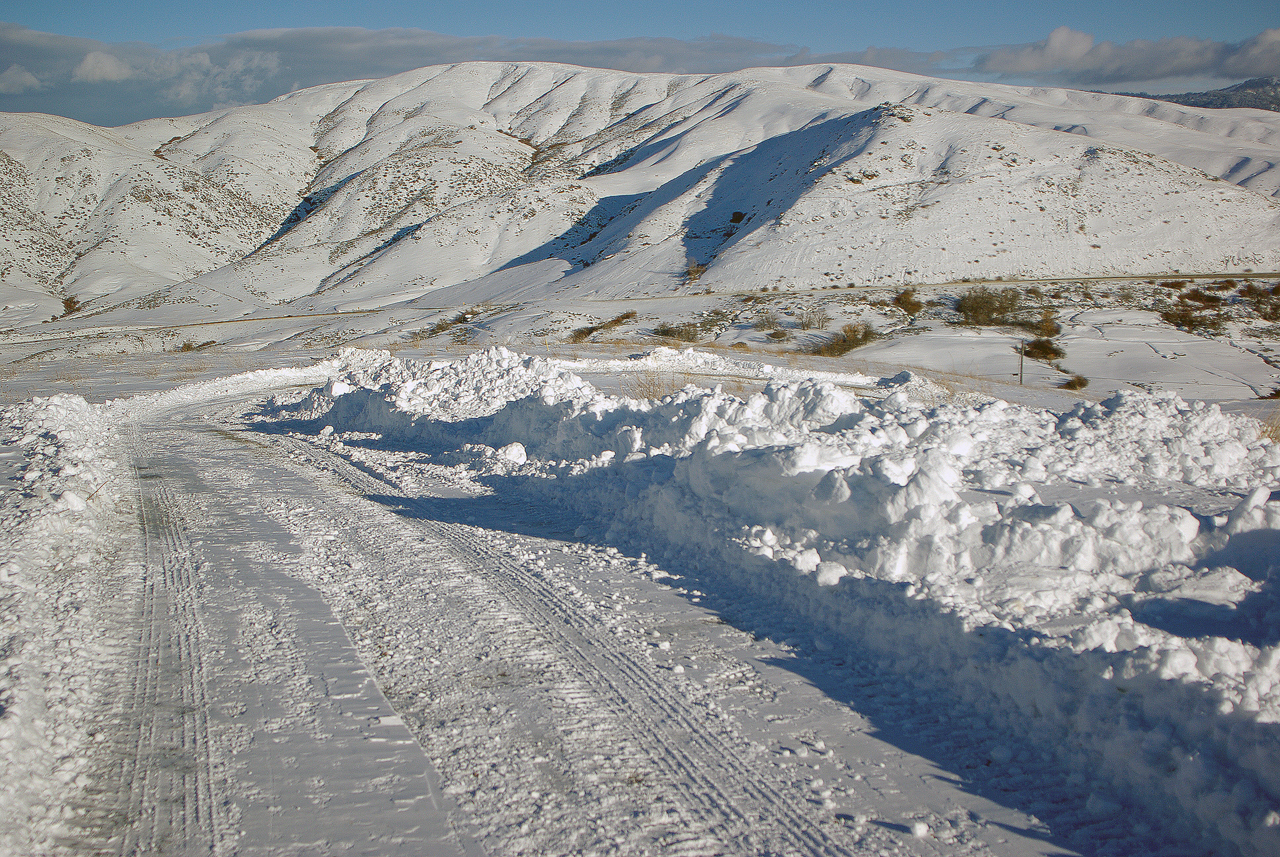
Click to enlarge
The sun is out today, and we're beginning to get some melt.
Click to enlarge
One of our neighbors outside of the subdivision was feeling neighborly, and without asking for any money decided to clear the common road in--and our driveway.
Click to enlarge
That's one of the virtues of living here. A lot of people are prepared to work for a reasonable rate of pay, and others do things out of the goodness of their hearts.
Friday, July 27, 2007
Predator and Prey
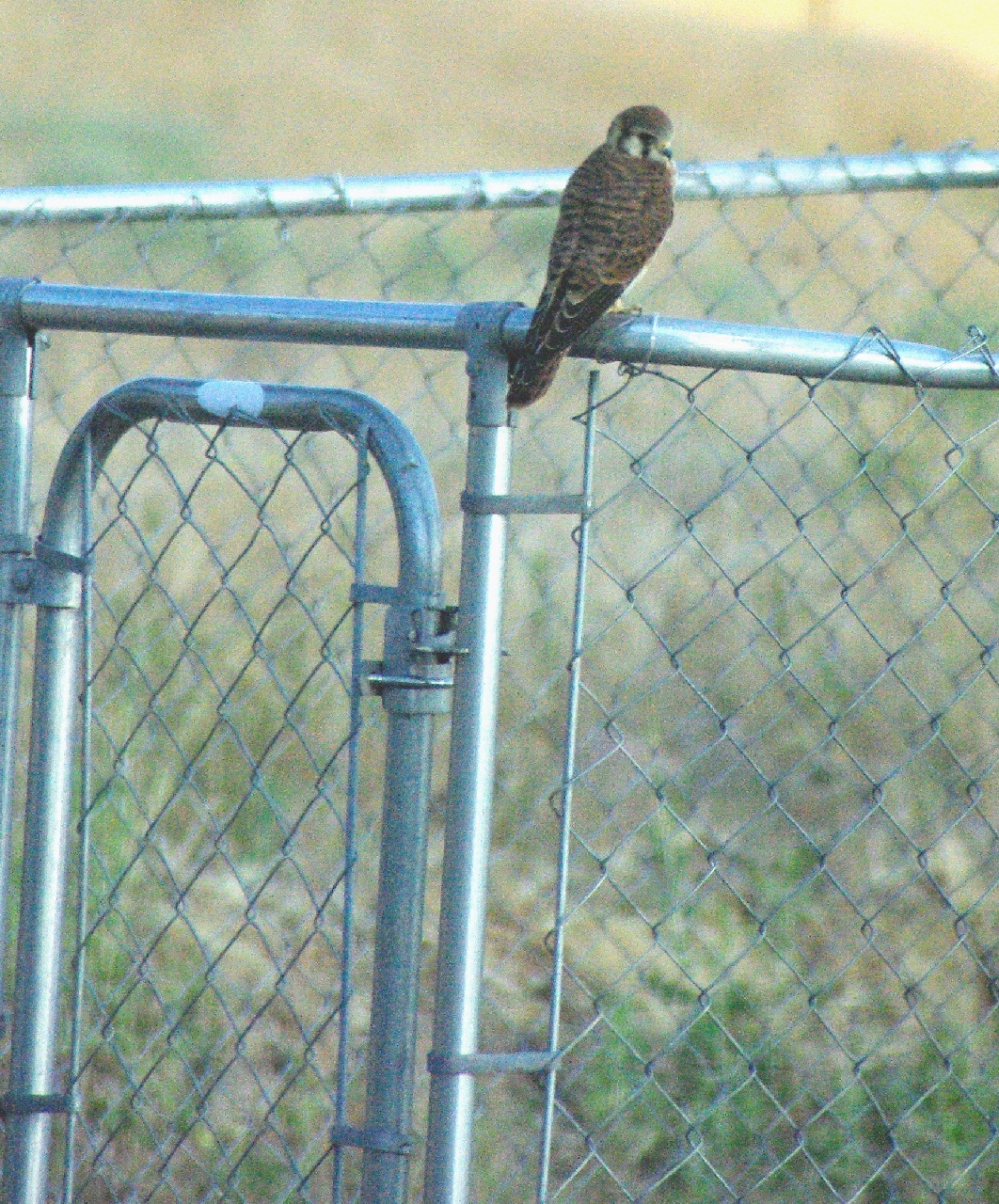
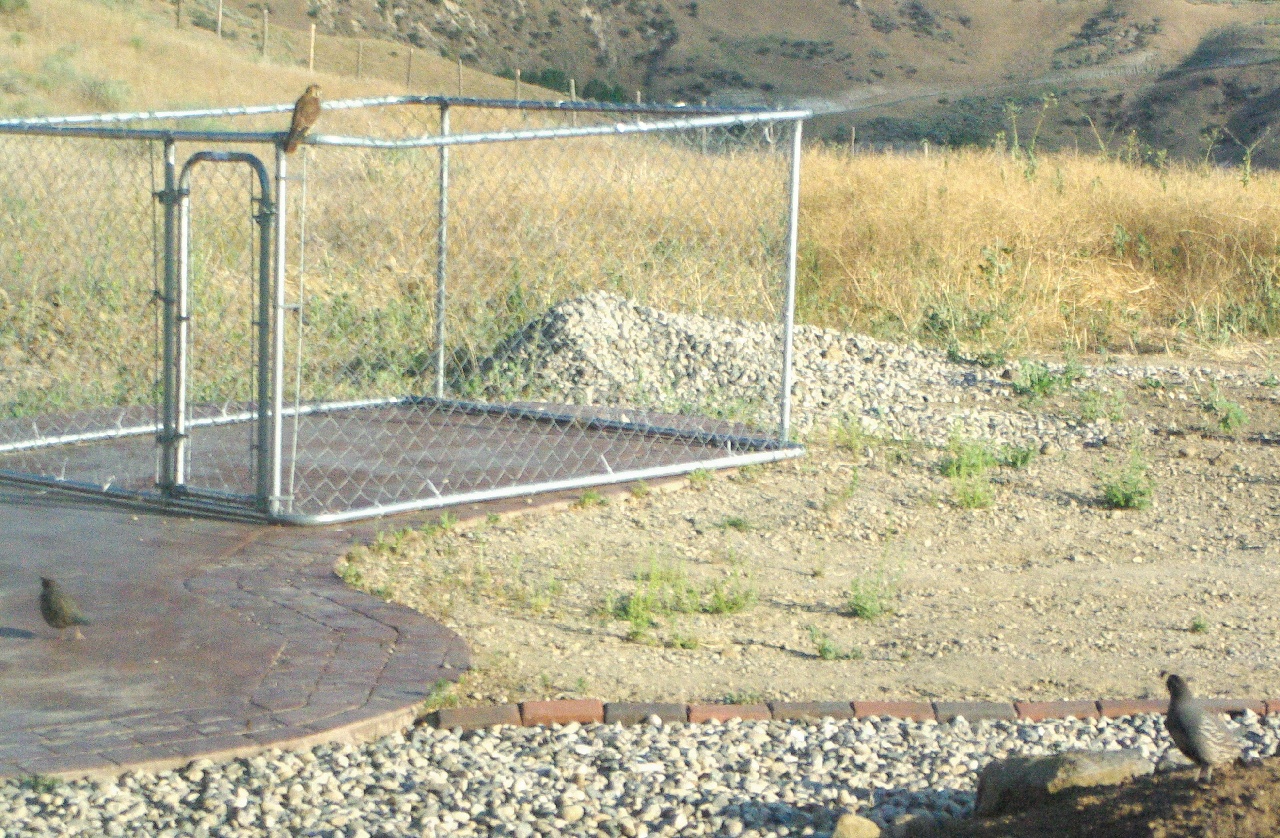
My wife noticed this raptor of some sort outside the back door a few days ago:

Click to enlarge
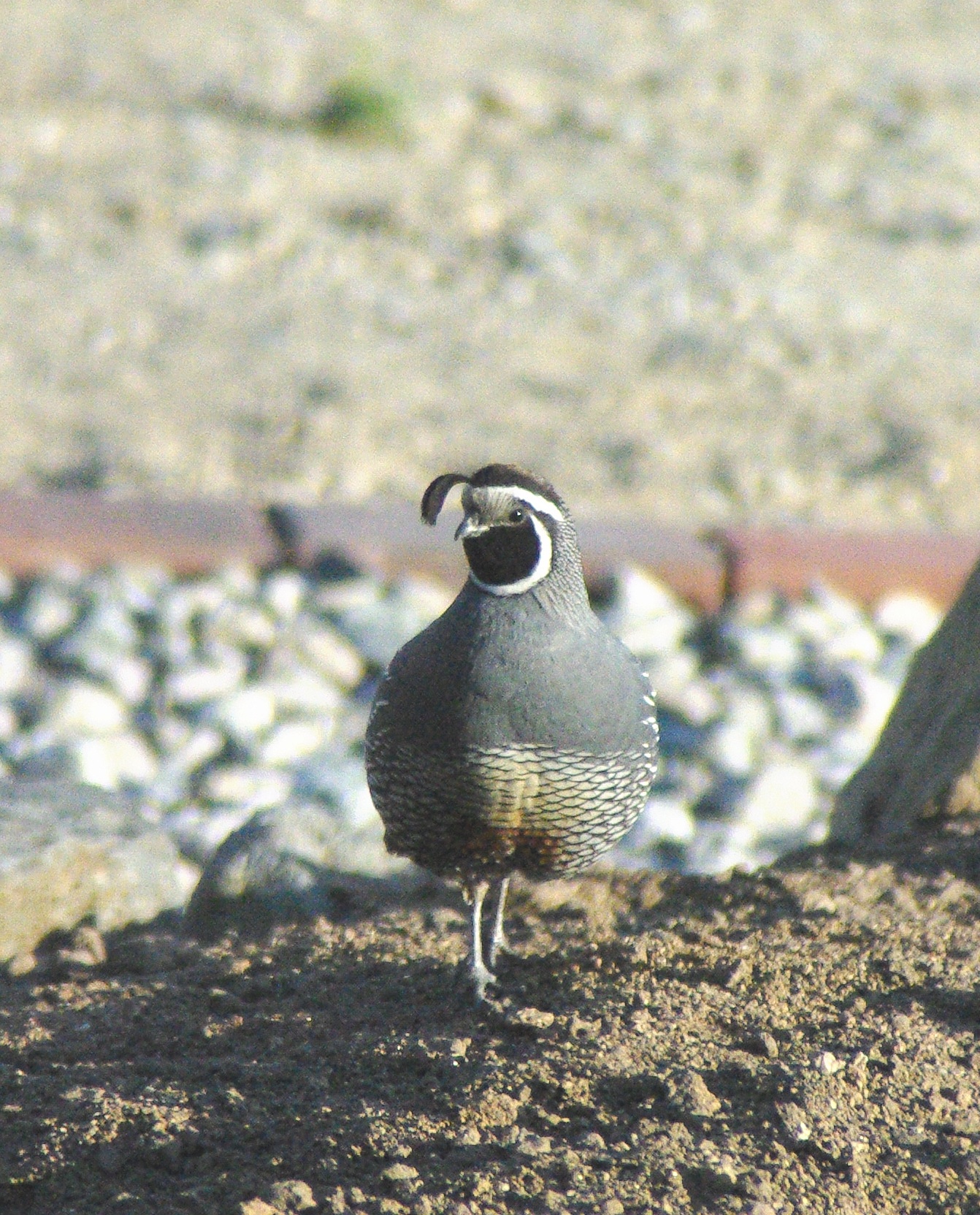
And then the reason why the raptor was sitting there:

Click to enlarge
This picture shows the larger geographic relationship of what Tennyson called "Nature, red in tooth and claw":

Click to enlarge
My wife noticed this raptor of some sort outside the back door a few days ago:
Click to enlarge
And then the reason why the raptor was sitting there:
Click to enlarge
This picture shows the larger geographic relationship of what Tennyson called "Nature, red in tooth and claw":
Click to enlarge
Bugs
If bugs bug you, cause hysterics, or otherwise make you uncomfortable, click here to skip to the next blog entry.
We have a lot of very interesting and sometimes beautiful insects up here. Along with the conventional enough praying mantis in a light green:

Click to enlarge
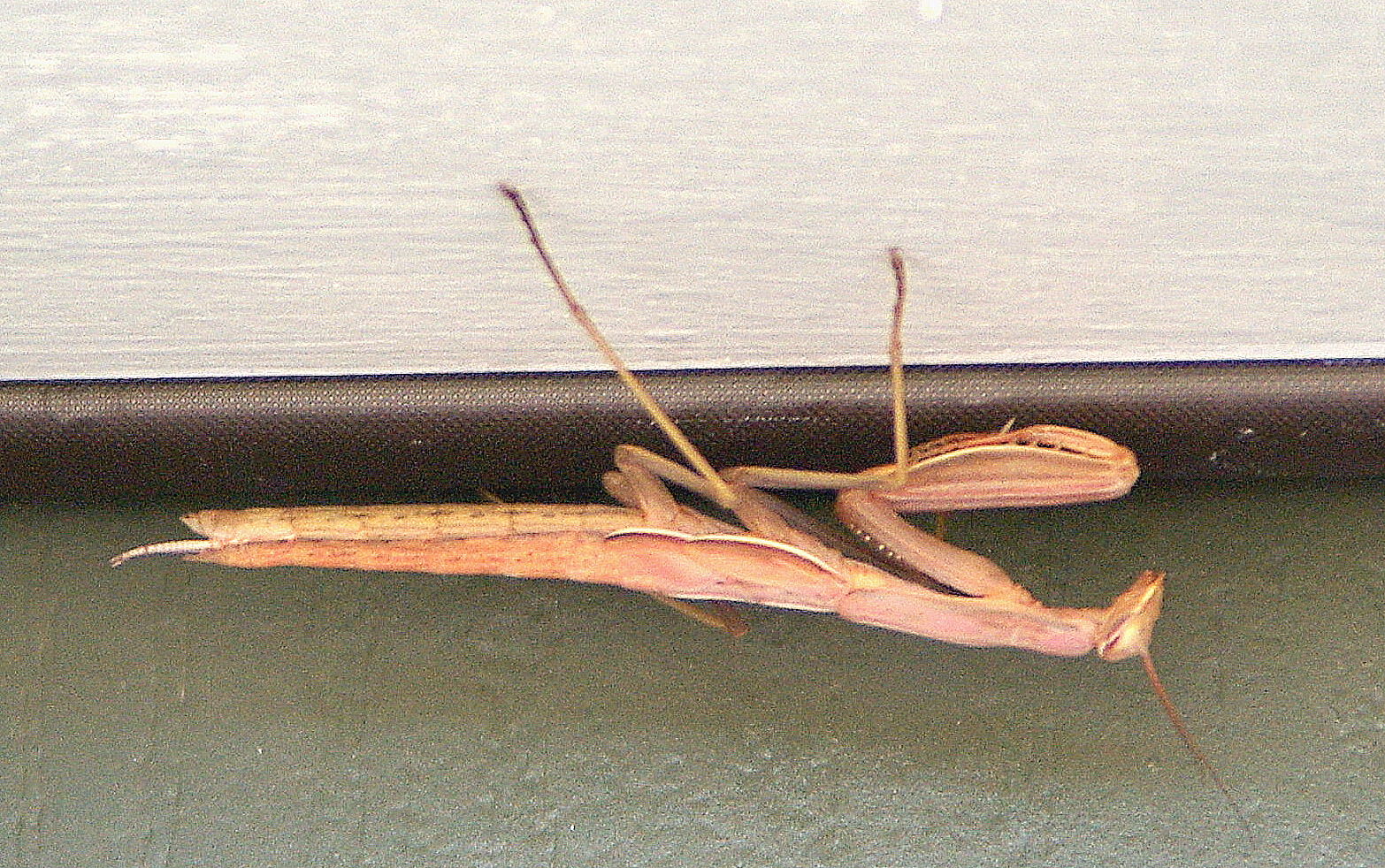
We also this praying mantis in a darling shade of pink! (Perhaps he prays with the Metropolitan Church.)

Click to enlarge
There seems to be as many patterns and colors on some of these critters as there are fingerprints. Sometimes, we aren't sure if we are seeing different species, subspecies, different diets, or just the insect equivalent of the diversity of human races.

Click to enlarge

Click to enlarge

Click to enlarge
If bugs bug you, cause hysterics, or otherwise make you uncomfortable, click here to skip to the next blog entry.
We have a lot of very interesting and sometimes beautiful insects up here. Along with the conventional enough praying mantis in a light green:

Click to enlarge
We also this praying mantis in a darling shade of pink! (Perhaps he prays with the Metropolitan Church.)
Click to enlarge
There seems to be as many patterns and colors on some of these critters as there are fingerprints. Sometimes, we aren't sure if we are seeing different species, subspecies, different diets, or just the insect equivalent of the diversity of human races.

Click to enlarge

Click to enlarge

Click to enlarge
Saturday, July 21, 2007
Wind Power
The difference in wind speed between the house, and the top of our hill is pretty impressive. I have seen wind speeds by the back door that ranged from 0 to about 5 mph. With no measurable wind at the house, at the top of the hill I was getting a pretty consistent 8 mph, holding the anemometer as high above my head as I could. As you probably know, wind speed increases as you get higher above the ground. The next step is to build a weathervane driven rotating gadget to hold the anemometer fifteen feet in the air, so that I can get a more reliable reading.
Skystream Energy offers a wind generator intended for low wind speeds--and which as an inverter built in, so it produces a 240 VAC output instead of DC. According to the chart here, it starts producing power at 8 mph, although the amount is pretty small. (Of course, around here, we get at least an 8 mph wind 24 hours a day. Somewhere around 25 mph, it is producing 2.4 kilowatts. If we ended up averaging 15 mph (which I suspect isn't too far off for the top of our hill), that would be a bit better than half of monthly energy use.
Most wind generators (all wind generators?) have a maximum speed, with various mechanisms for shutting off the blade when the wind speed gets too high. A generator like the Skystream 3.7 gets no benefit from wind speeds above about 25 mph--while generators intended to take advantage of high speed (and therefore, high power) winds usually don't start turning until the wind is already moving pretty briskly. It makes me wonder if, in a place like this, where we have continual winds of 10-15 mph--and at least monthly, hour after hour of 40-60 mph winds--whether it might make sense to have both a generator intended for the light breezes, and one of the larger generators that can take advantage of the high wind conditions as well. The light wind generator would be turning 90% of the time, producing a low but steady current--and the other 10% of the time, the wind would be moving 50 mph, and producing prodiguous output.
At least so far, when I look at products like the Air-X and Whisper wind turbines at this website, they all seem intended for relatively low wind speeds.
The difference in wind speed between the house, and the top of our hill is pretty impressive. I have seen wind speeds by the back door that ranged from 0 to about 5 mph. With no measurable wind at the house, at the top of the hill I was getting a pretty consistent 8 mph, holding the anemometer as high above my head as I could. As you probably know, wind speed increases as you get higher above the ground. The next step is to build a weathervane driven rotating gadget to hold the anemometer fifteen feet in the air, so that I can get a more reliable reading.
Skystream Energy offers a wind generator intended for low wind speeds--and which as an inverter built in, so it produces a 240 VAC output instead of DC. According to the chart here, it starts producing power at 8 mph, although the amount is pretty small. (Of course, around here, we get at least an 8 mph wind 24 hours a day. Somewhere around 25 mph, it is producing 2.4 kilowatts. If we ended up averaging 15 mph (which I suspect isn't too far off for the top of our hill), that would be a bit better than half of monthly energy use.
Most wind generators (all wind generators?) have a maximum speed, with various mechanisms for shutting off the blade when the wind speed gets too high. A generator like the Skystream 3.7 gets no benefit from wind speeds above about 25 mph--while generators intended to take advantage of high speed (and therefore, high power) winds usually don't start turning until the wind is already moving pretty briskly. It makes me wonder if, in a place like this, where we have continual winds of 10-15 mph--and at least monthly, hour after hour of 40-60 mph winds--whether it might make sense to have both a generator intended for the light breezes, and one of the larger generators that can take advantage of the high wind conditions as well. The light wind generator would be turning 90% of the time, producing a low but steady current--and the other 10% of the time, the wind would be moving 50 mph, and producing prodiguous output.
At least so far, when I look at products like the Air-X and Whisper wind turbines at this website, they all seem intended for relatively low wind speeds.
Friday, May 25, 2007
Determining Wind Speed From How Far Paper Blows
I know that there's a technique for estimating wind speed from the angle that a piece of paper takes on its way to the ground. If a 90 degree angle, there's no wind! A zero degree angle means the wind is exerting dramatically more force on the paper than gravity (not infinite, but enough that wind turbulence determines altitude more than gravity). I know that one of the scientists at the first atomic bomb test used this approach to make an approximate calculation of the energy release.
I suspect that somewhere there's a formula for doing this computation, based on the weight of the paper, its area, and the angle of fall. Do you know what it is? I have this suspicion that with enough time reading my physics text (Halliday and Resnick) I could probably derive it--but it has been enough time that I might end up deriving a formula that computed the wind speed at several thousands kilometers per second. (It's windy here, but not that windy.)
And yes, I've got the renewable resources bug again. It seldom stops blowing where I am--at least 15 mph right now, and often much higher. The question is how much higher? The wind sock at the airstrip up the hill from me would seem to indicate about 12 mph, because it isn't consistently horizontal. I also think we are getting a high wind here. My wife suspects we may be seeing Bernoulli principle at work, as the wind coming along the floor of the valley speeds up because of the constriction of the valley floor and walls where the valley rises to the pass. (The wind a bit higher up--where the windsock is located--doesn't have to speed up.)
I dropped a postcard from six feet up; it landed ten feet away. That's about a 30 degree angle.
I know that there's a technique for estimating wind speed from the angle that a piece of paper takes on its way to the ground. If a 90 degree angle, there's no wind! A zero degree angle means the wind is exerting dramatically more force on the paper than gravity (not infinite, but enough that wind turbulence determines altitude more than gravity). I know that one of the scientists at the first atomic bomb test used this approach to make an approximate calculation of the energy release.
I suspect that somewhere there's a formula for doing this computation, based on the weight of the paper, its area, and the angle of fall. Do you know what it is? I have this suspicion that with enough time reading my physics text (Halliday and Resnick) I could probably derive it--but it has been enough time that I might end up deriving a formula that computed the wind speed at several thousands kilometers per second. (It's windy here, but not that windy.)
And yes, I've got the renewable resources bug again. It seldom stops blowing where I am--at least 15 mph right now, and often much higher. The question is how much higher? The wind sock at the airstrip up the hill from me would seem to indicate about 12 mph, because it isn't consistently horizontal. I also think we are getting a high wind here. My wife suspects we may be seeing Bernoulli principle at work, as the wind coming along the floor of the valley speeds up because of the constriction of the valley floor and walls where the valley rises to the pass. (The wind a bit higher up--where the windsock is located--doesn't have to speed up.)
I dropped a postcard from six feet up; it landed ten feet away. That's about a 30 degree angle.
Monday, April 9, 2007
My Own Private Idaho
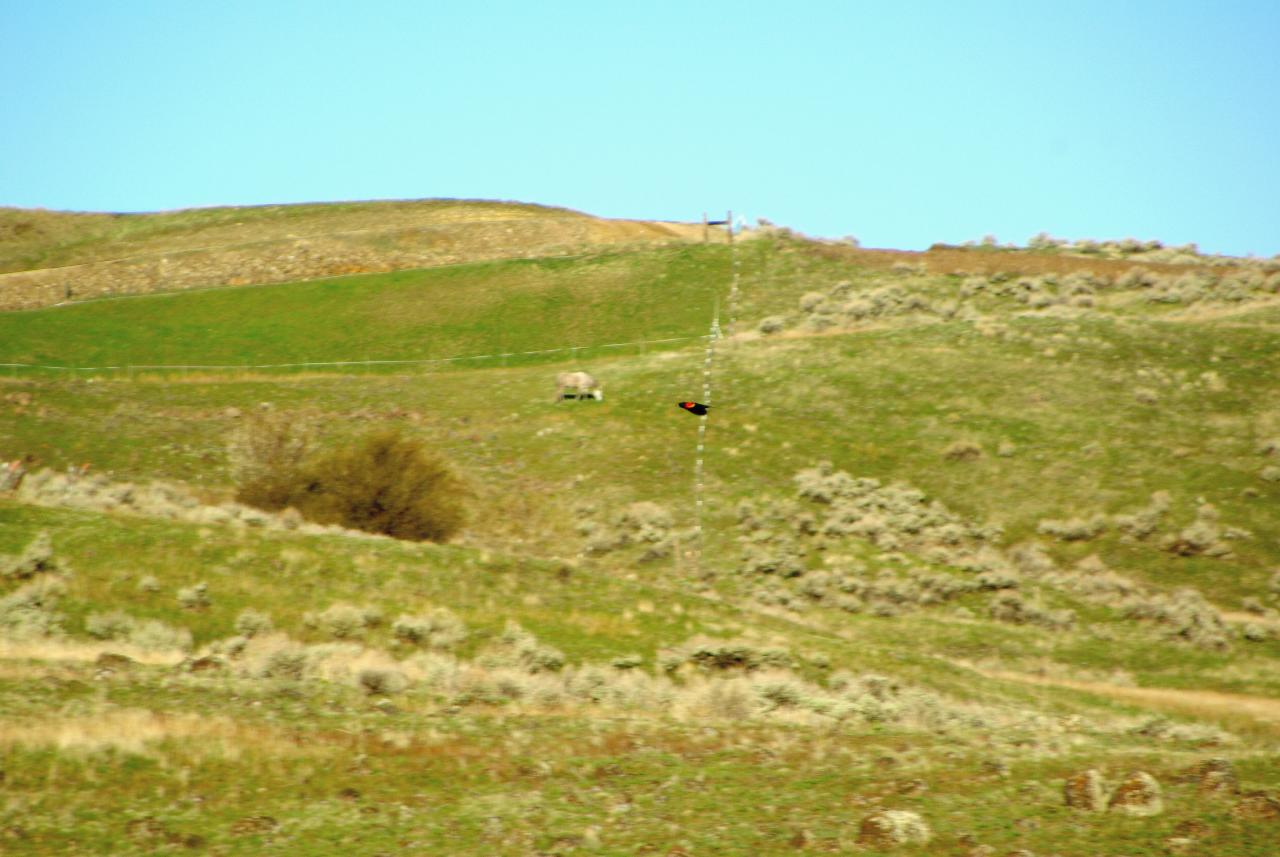
Okay, I never saw the movie, but the title fits these pictures so well. Saturday morning I woke up to the sound of birds singing and beautiful sunshine, so I walked up to the back half of the property, what I used to call "Rhonda's Nature Preserve." I could see a bird sitting on one of the fenceposts, singing up a storm--but until it took flight, I couldn't tell what kind it was. It was moving pretty quickly, so the background blurred--but the bird itself I managed to freeze in mid-air! Yes, a redwing blackbird.

Click to enlarge
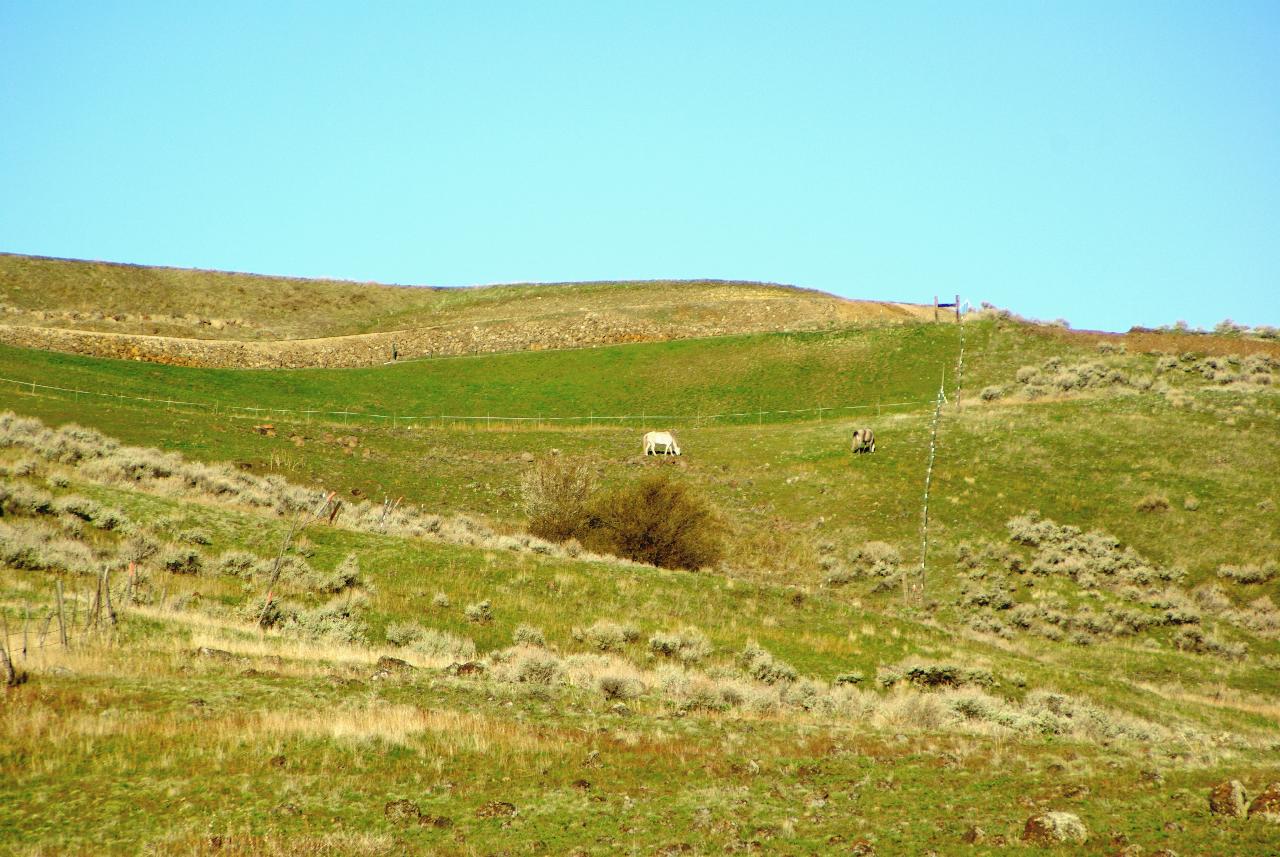
Here's looking up the hill to the parcel behind us on section 17.

Click to enlarge
Up close, you can see that the grasses are growing, but the thatch left over from last year is still there:

Click to enlarge
This picture I just took this evening as the sun set. It might look like a weird double exposure or a ghost picture, but the setting sun was illuminating the falling rain above one level, and not doing so below it.

Click to enlarge
Okay, I never saw the movie, but the title fits these pictures so well. Saturday morning I woke up to the sound of birds singing and beautiful sunshine, so I walked up to the back half of the property, what I used to call "Rhonda's Nature Preserve." I could see a bird sitting on one of the fenceposts, singing up a storm--but until it took flight, I couldn't tell what kind it was. It was moving pretty quickly, so the background blurred--but the bird itself I managed to freeze in mid-air! Yes, a redwing blackbird.
Click to enlarge
Here's looking up the hill to the parcel behind us on section 17.
Click to enlarge
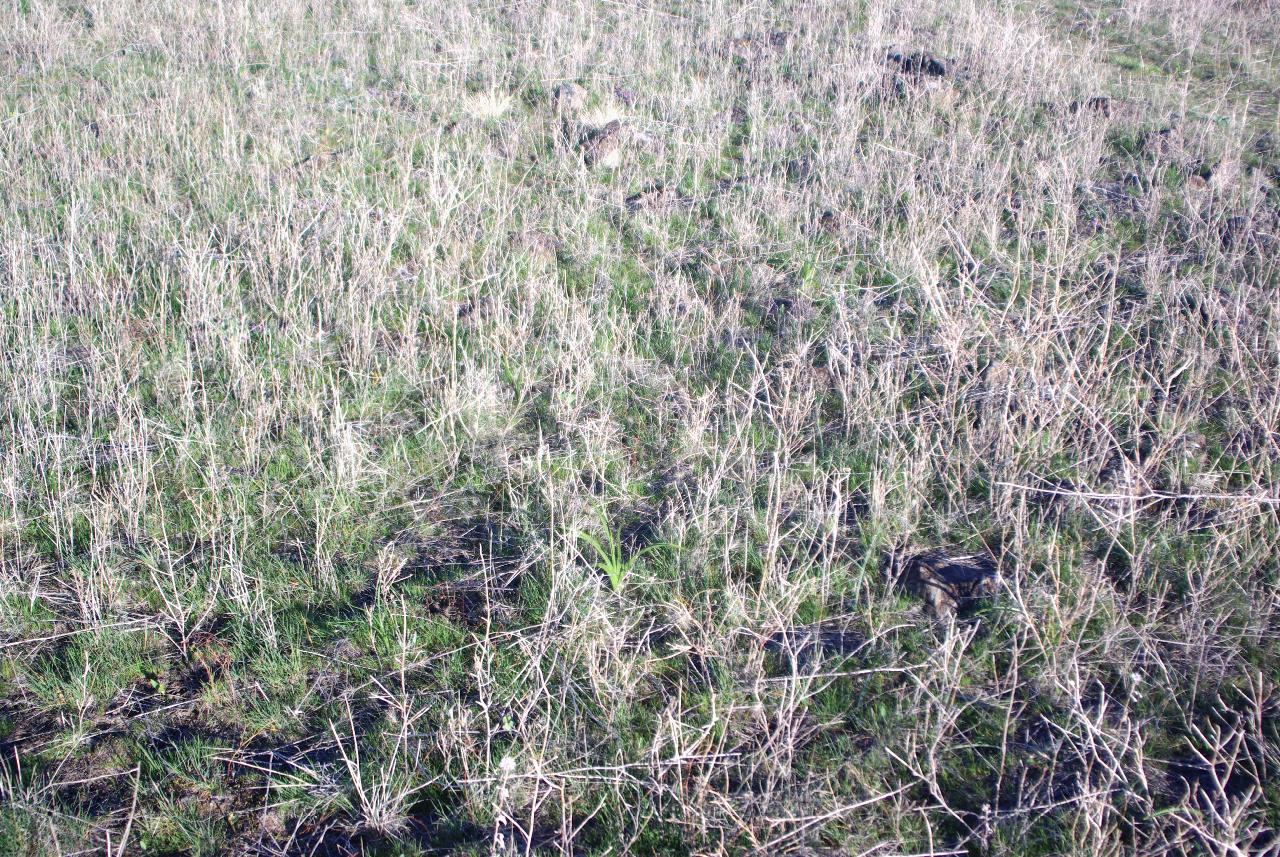
Up close, you can see that the grasses are growing, but the thatch left over from last year is still there:
Click to enlarge
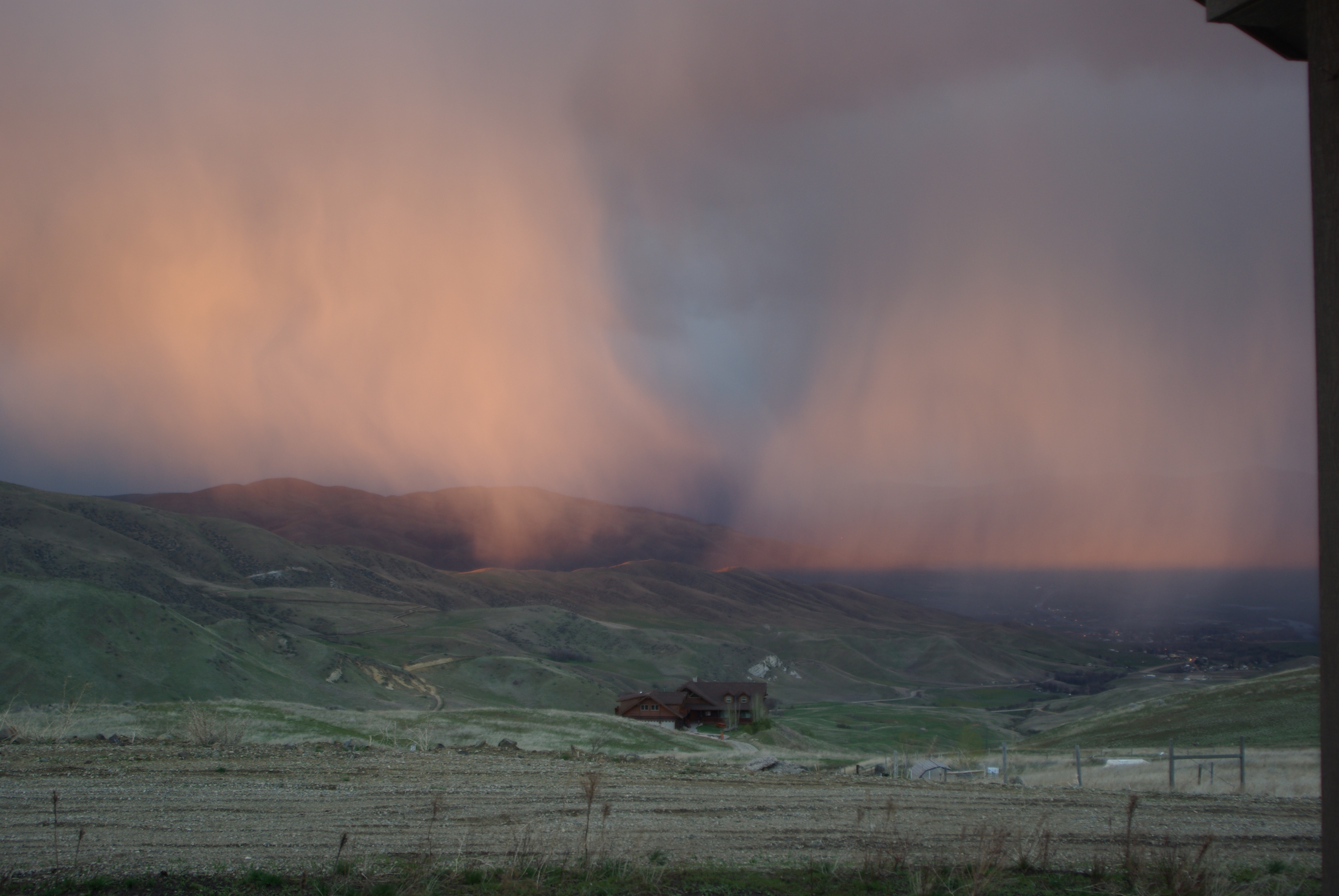
This picture I just took this evening as the sun set. It might look like a weird double exposure or a ghost picture, but the setting sun was illuminating the falling rain above one level, and not doing so below it.
Click to enlarge
Wednesday, April 4, 2007
Fun With Filters
We've been living here almost a year now, and my wife has noticed a bit of a decline in water pressure. The good assumption, since the pressure valve coming out of the pressurization pump is still showing 65 psi, is that the filters are getting clogged. Since we removed the big monstrous stainless steel housing with the one micron lead removal filters, all that was left was a 25 micron filter (5" x 10" cylinder), a 5 micron filter (a 5" x 20" cylinder), and a 1 micron filter (another 5" x 20" cylinder).
So, how hard can they be to change? I couldn't turn the filter housings by hand, so I bought a filter wrench--which still wasn't easy! Whoever put these in place probably has fur on his knuckles.
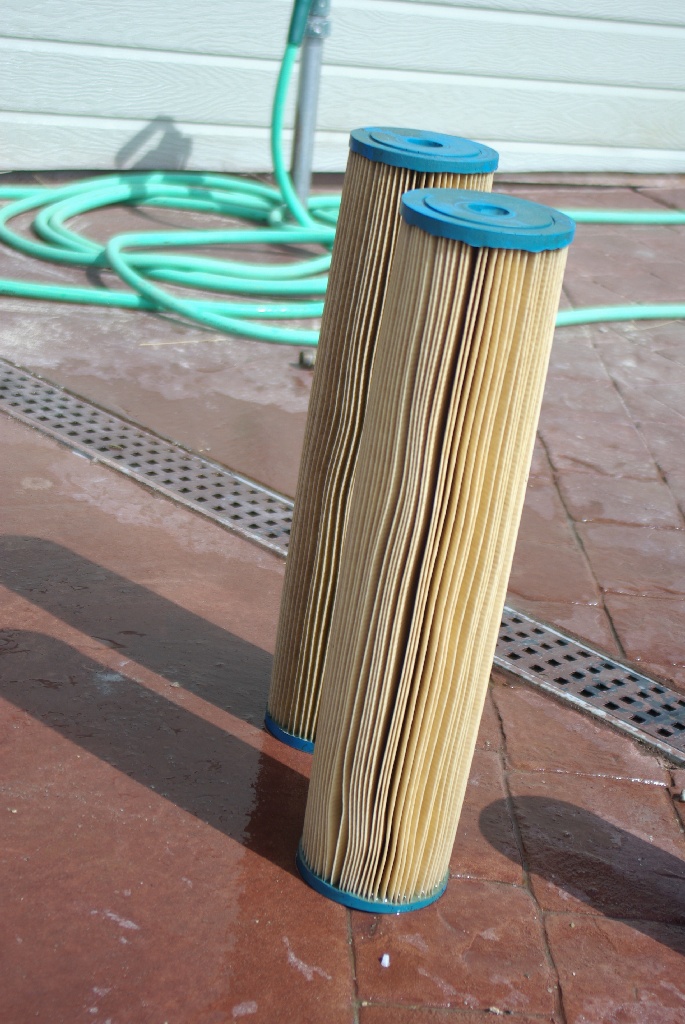
Here you can see what the new filter looks like, and the old filters.

Click to enlarge

Click to enlarge

Click to enlarge
The shade is sort of an iron mineral color. The 25 micron filter had more crud in it than the others, but the 5 micron and 1 micron filters were indistinguishable in shade and amount of junk contained in them.
When one of the housings came off, I couldn't figure out if the O-ring that seals it went in the little notch at the top, or around the top of the housing. By putting it in the wrong place, I stretched the O-ring to a point where it would not go back in position. Do you have any idea how hard it is to find 5 1/2" O-rings in Boise? Fortunately, it is the same size as the GE Whole House water filtration system. Lowe's did not have O-rings for sale--but the guy there took pity on me, and gave me the O-ring off their display unit.
Anyway, all is back together again, and we have full flow once more.
We've been living here almost a year now, and my wife has noticed a bit of a decline in water pressure. The good assumption, since the pressure valve coming out of the pressurization pump is still showing 65 psi, is that the filters are getting clogged. Since we removed the big monstrous stainless steel housing with the one micron lead removal filters, all that was left was a 25 micron filter (5" x 10" cylinder), a 5 micron filter (a 5" x 20" cylinder), and a 1 micron filter (another 5" x 20" cylinder).
So, how hard can they be to change? I couldn't turn the filter housings by hand, so I bought a filter wrench--which still wasn't easy! Whoever put these in place probably has fur on his knuckles.
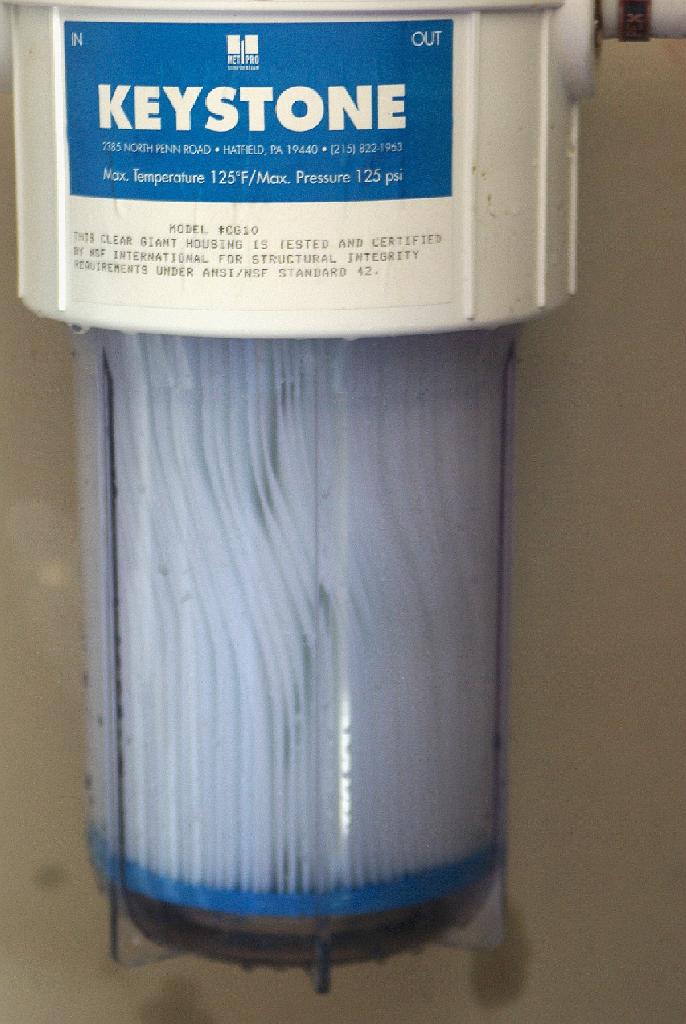
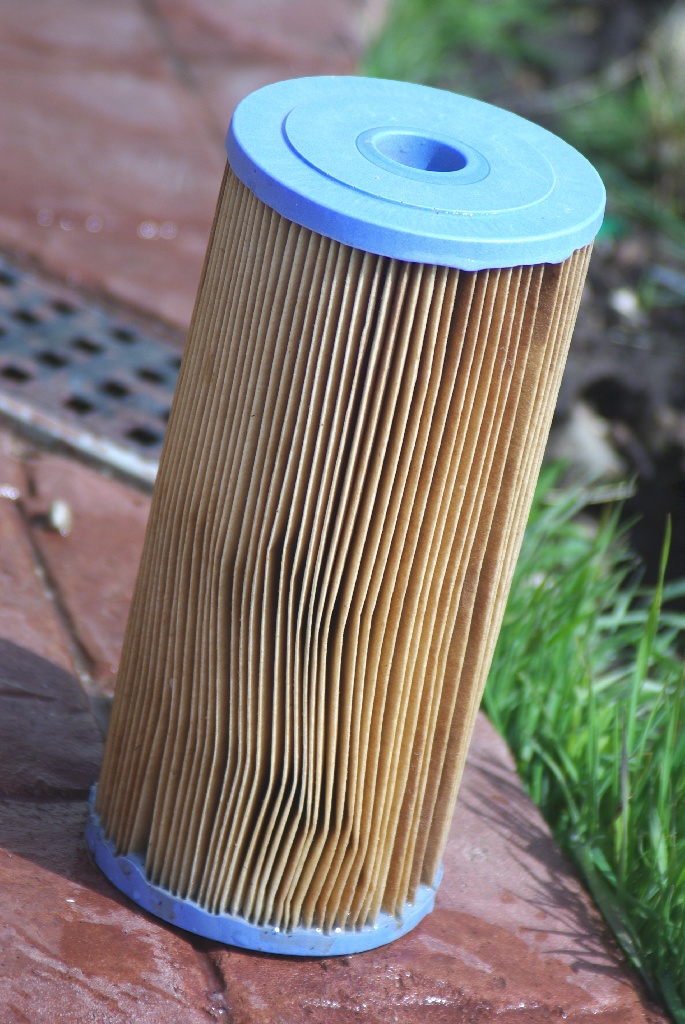
Here you can see what the new filter looks like, and the old filters.
Click to enlarge
Click to enlarge
Click to enlarge
The shade is sort of an iron mineral color. The 25 micron filter had more crud in it than the others, but the 5 micron and 1 micron filters were indistinguishable in shade and amount of junk contained in them.
When one of the housings came off, I couldn't figure out if the O-ring that seals it went in the little notch at the top, or around the top of the housing. By putting it in the wrong place, I stretched the O-ring to a point where it would not go back in position. Do you have any idea how hard it is to find 5 1/2" O-rings in Boise? Fortunately, it is the same size as the GE Whole House water filtration system. Lowe's did not have O-rings for sale--but the guy there took pity on me, and gave me the O-ring off their display unit.
Anyway, all is back together again, and we have full flow once more.
Wednesday, March 14, 2007
More Fun With Wasps
We had two in the master bathroom--so the assumption is that some of them got into the crawlspace above the house, and found an opening into the ductwork. It can't be a large opening, or we would have had more than two.
So we set off two bug bombs in the crawlspace.
No more in the house--but they are beginning to fly around outside. There's no visible nest--so we decide to seal off a couple of holes at the end of the house where the satellite dish cables enter the house.
Yesterday, my wife was out on a bug hunt, spraying them out of the air with an aerosol wasp killer--and she sees a couple of them crawl out of these gaps:

Click to enlarge
It turns out that the siding, presumably for appearance reasons, is scalloped at the top--and where it meets the vertical pieces, there is a triangular gap about .8" high, and .25" at the top end of the triangle.
We have also noticed a number of other gaps around the house where the builder didn't caulk over some sizable openings. Some of the larger ones we have carefully cut trim pieces to cover, and we have caulked the smaller ones. But these gaps in the siding--there's a lot of them.
One possibility is to use 1/4" and 3/16" dowel rods, inserted into the gap, so they aren't visible except by getting parallel to the wall. These will leave so little space that the wasps can't get in or out. I might squirt a small quantity of clear caulk in as well, to make sure that no other bugs can get in or out.
We had two in the master bathroom--so the assumption is that some of them got into the crawlspace above the house, and found an opening into the ductwork. It can't be a large opening, or we would have had more than two.
So we set off two bug bombs in the crawlspace.
No more in the house--but they are beginning to fly around outside. There's no visible nest--so we decide to seal off a couple of holes at the end of the house where the satellite dish cables enter the house.
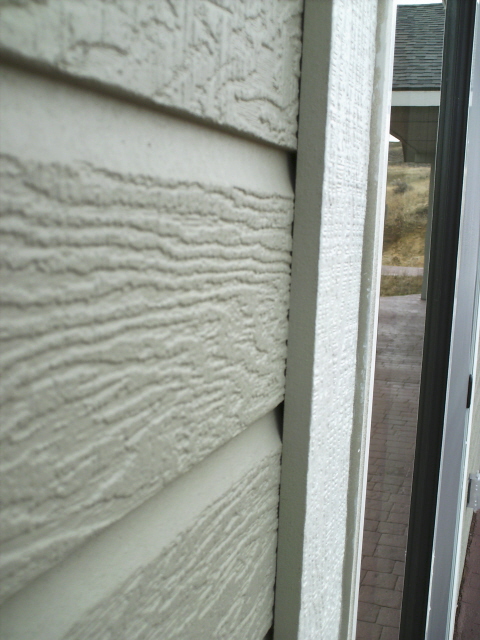
Yesterday, my wife was out on a bug hunt, spraying them out of the air with an aerosol wasp killer--and she sees a couple of them crawl out of these gaps:
Click to enlarge
It turns out that the siding, presumably for appearance reasons, is scalloped at the top--and where it meets the vertical pieces, there is a triangular gap about .8" high, and .25" at the top end of the triangle.
We have also noticed a number of other gaps around the house where the builder didn't caulk over some sizable openings. Some of the larger ones we have carefully cut trim pieces to cover, and we have caulked the smaller ones. But these gaps in the siding--there's a lot of them.
One possibility is to use 1/4" and 3/16" dowel rods, inserted into the gap, so they aren't visible except by getting parallel to the wall. These will leave so little space that the wasps can't get in or out. I might squirt a small quantity of clear caulk in as well, to make sure that no other bugs can get in or out.
Mountain Blue Bird & Why I Need a Better Long Telephoto Lens
My wife called me to the window yesterday with great excitement; at first she wondered if she was hallucinating because of how blue the birds were that she saw outside. Remember that being from California, any brightly colored bird is either an escaped pet, or works for Disney. But this bird was intensely blue!

Click to enlarge
Now, you are saying, "Why is Clayton's fancy camera taking such a bad picture?" The answer is that I was using an older 85-205mm zoom lens that I had received when I bought my first SLR, a Pentax ME Super, some years ago. It doesn't have autofocus--hence the bird is intensely blue, but not very sharp--and I don't think it is the highest quality glass, because of the chromatic aberration that you can see when you run it up to the highest magnification.
I really need to get a good autofocus lens for the Pentax K10D. There are 18-200mm zooms available, and even 18-300mm. The trade-off, as usual, is price and weight. On the other hand, if you have an 18-300mm zoom, you don't need to carry a bunch of other lens with you, and that's worth quite a bit right there.
My wife called me to the window yesterday with great excitement; at first she wondered if she was hallucinating because of how blue the birds were that she saw outside. Remember that being from California, any brightly colored bird is either an escaped pet, or works for Disney. But this bird was intensely blue!

Click to enlarge
Now, you are saying, "Why is Clayton's fancy camera taking such a bad picture?" The answer is that I was using an older 85-205mm zoom lens that I had received when I bought my first SLR, a Pentax ME Super, some years ago. It doesn't have autofocus--hence the bird is intensely blue, but not very sharp--and I don't think it is the highest quality glass, because of the chromatic aberration that you can see when you run it up to the highest magnification.
I really need to get a good autofocus lens for the Pentax K10D. There are 18-200mm zooms available, and even 18-300mm. The trade-off, as usual, is price and weight. On the other hand, if you have an 18-300mm zoom, you don't need to carry a bunch of other lens with you, and that's worth quite a bit right there.
Wednesday, November 29, 2006
House Project: Final Warranty Work? Interesting Unexpected Benefits
It has been several months since the last entry about the house. We are coming up on the one year closing next month, and we've been making sure that any existing warranty issues are taken care of now. For example, the kitchen sink faucet keeps working itself loose, because the window sill sticks out too far. The builder decided to do it right, and recut the window sill so it isn't running into the faucet.
The third bathroom sink (which doesn't get much use) started to leak--because the pipe coming out of the bottom of the sink is the wrong diameter for the rest of the fittings. It is 1 3/8" outside diameter--and the washer that is supposed to seal this is 1 1/2" inside diameter. The builder is nagging the plumber to get up here and fix this properly. How did he not notice this much looseness?
There are a couple of exterior trim pieces that have fallen off the house in our rather startlingly strong winds, so he is replacing these.
We've had a few tiles crack, probably because of settling in the floor joists. No great surprise on that.
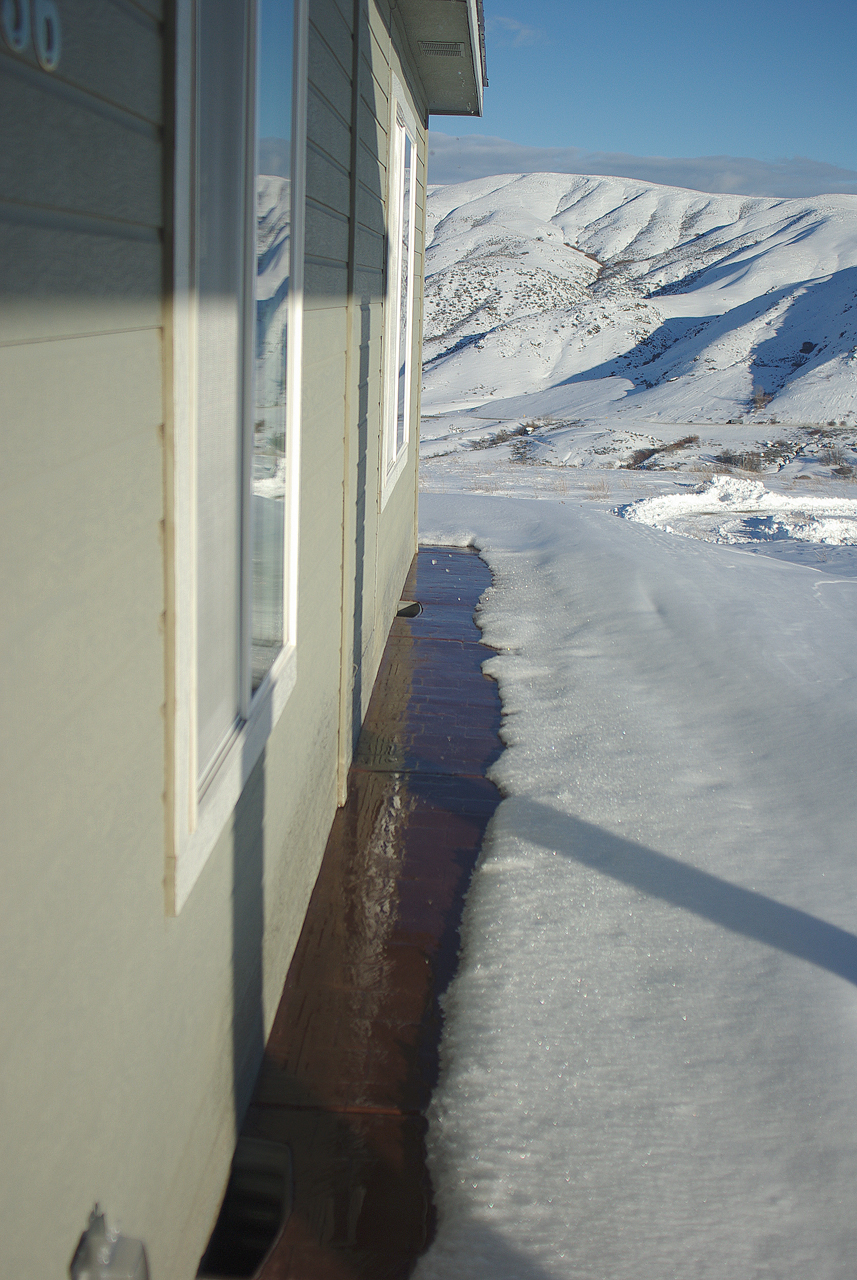
One rather nice surprise today is something that I had not planned on, but it has worked out rather well. All of this concrete that was originally supposed to be Dusty Rose (or whatever color it is that my wife thought was so elegant) came out closer to molasses brown. One benefit of this was that even though it is very cold up here today--it has still not broken 20 degrees--the snow on the concrete facing south has just about cleared off the concrete, and almost as though I had swept it.

Click to enlarge
There a few spots where snow melt from the columns has accumulated on the concrete, but overall, I could not have swept it this clear without enormous effort.

Click to enlarge
It is not hard to figure out why. Once any particular area had enough snow melt away because of sunlight, the concrete underneath absorbed heat--and then transmitted it to the rest of the concrete, accelerating whatever melting was induced by the sunlight hitting the top of the snow. Out on the driveway, you can see this taking place a bit more slowly (probably because it doesn't have the radiant heat from the walls of the house).

Click to enlarge
Over on the east face of the house, where the sunlight was only falling in the morning, you can see the difference.

Click to enlarge
On the north face of the house, where there was no sunlight at all, it is still pretty unaltered.

Click to enlarge
In spite of the temperature outside--it was ten degrees this morning when my wife woke up--the furnace isn't running all that much. The sunlight flooding in the south windows of the house is hitting the tiles, and turning into infared as it bounces. The insulation is doing its job.
I expect in summer, all that concrete around the house is going to get unpleasantly warm by the end of the day--and remain pleasant to bare feet into the early evening hours.
Last house project entry.
It has been several months since the last entry about the house. We are coming up on the one year closing next month, and we've been making sure that any existing warranty issues are taken care of now. For example, the kitchen sink faucet keeps working itself loose, because the window sill sticks out too far. The builder decided to do it right, and recut the window sill so it isn't running into the faucet.
The third bathroom sink (which doesn't get much use) started to leak--because the pipe coming out of the bottom of the sink is the wrong diameter for the rest of the fittings. It is 1 3/8" outside diameter--and the washer that is supposed to seal this is 1 1/2" inside diameter. The builder is nagging the plumber to get up here and fix this properly. How did he not notice this much looseness?
There are a couple of exterior trim pieces that have fallen off the house in our rather startlingly strong winds, so he is replacing these.
We've had a few tiles crack, probably because of settling in the floor joists. No great surprise on that.
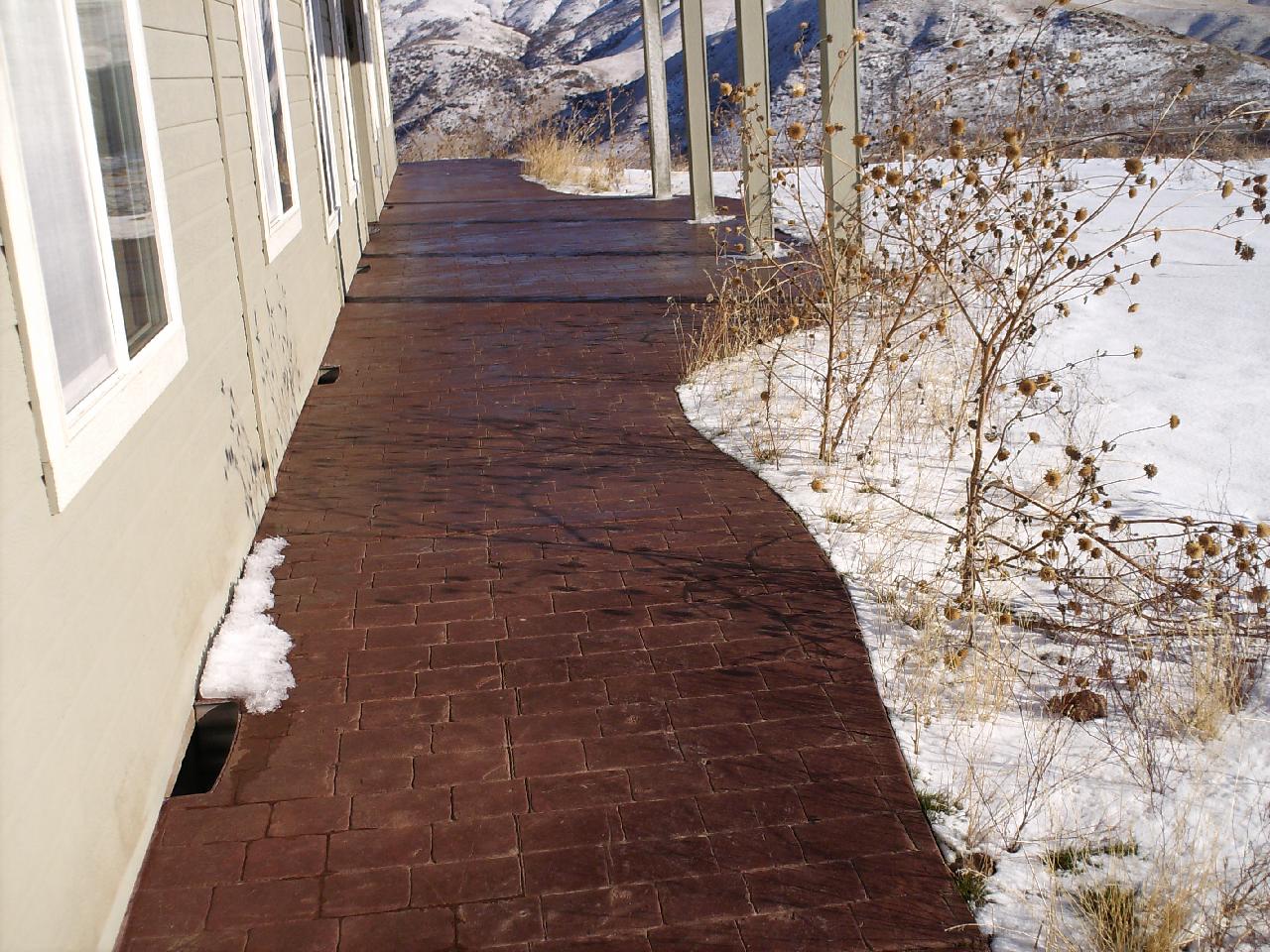
One rather nice surprise today is something that I had not planned on, but it has worked out rather well. All of this concrete that was originally supposed to be Dusty Rose (or whatever color it is that my wife thought was so elegant) came out closer to molasses brown. One benefit of this was that even though it is very cold up here today--it has still not broken 20 degrees--the snow on the concrete facing south has just about cleared off the concrete, and almost as though I had swept it.
Click to enlarge
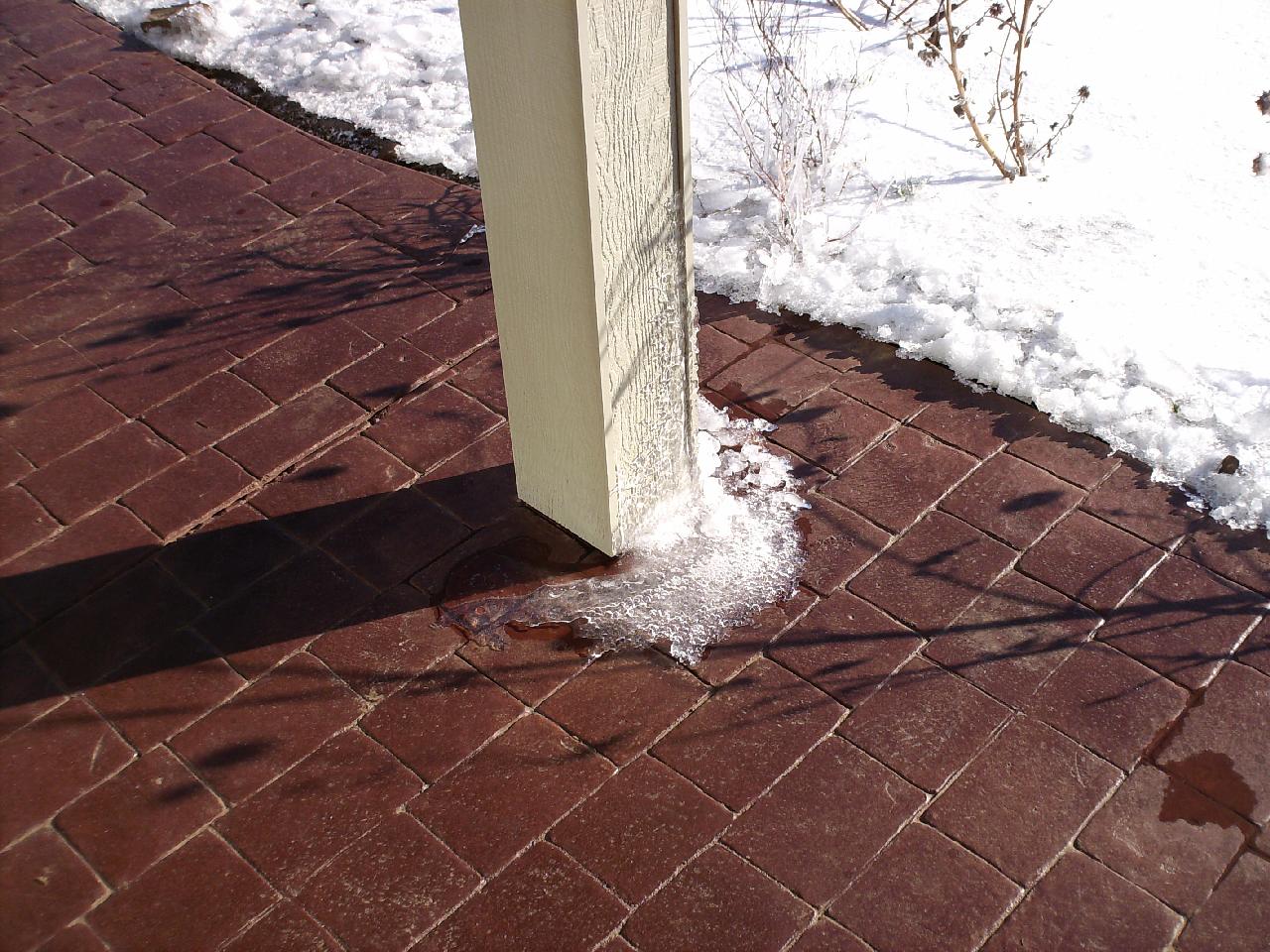
There a few spots where snow melt from the columns has accumulated on the concrete, but overall, I could not have swept it this clear without enormous effort.
Click to enlarge
It is not hard to figure out why. Once any particular area had enough snow melt away because of sunlight, the concrete underneath absorbed heat--and then transmitted it to the rest of the concrete, accelerating whatever melting was induced by the sunlight hitting the top of the snow. Out on the driveway, you can see this taking place a bit more slowly (probably because it doesn't have the radiant heat from the walls of the house).
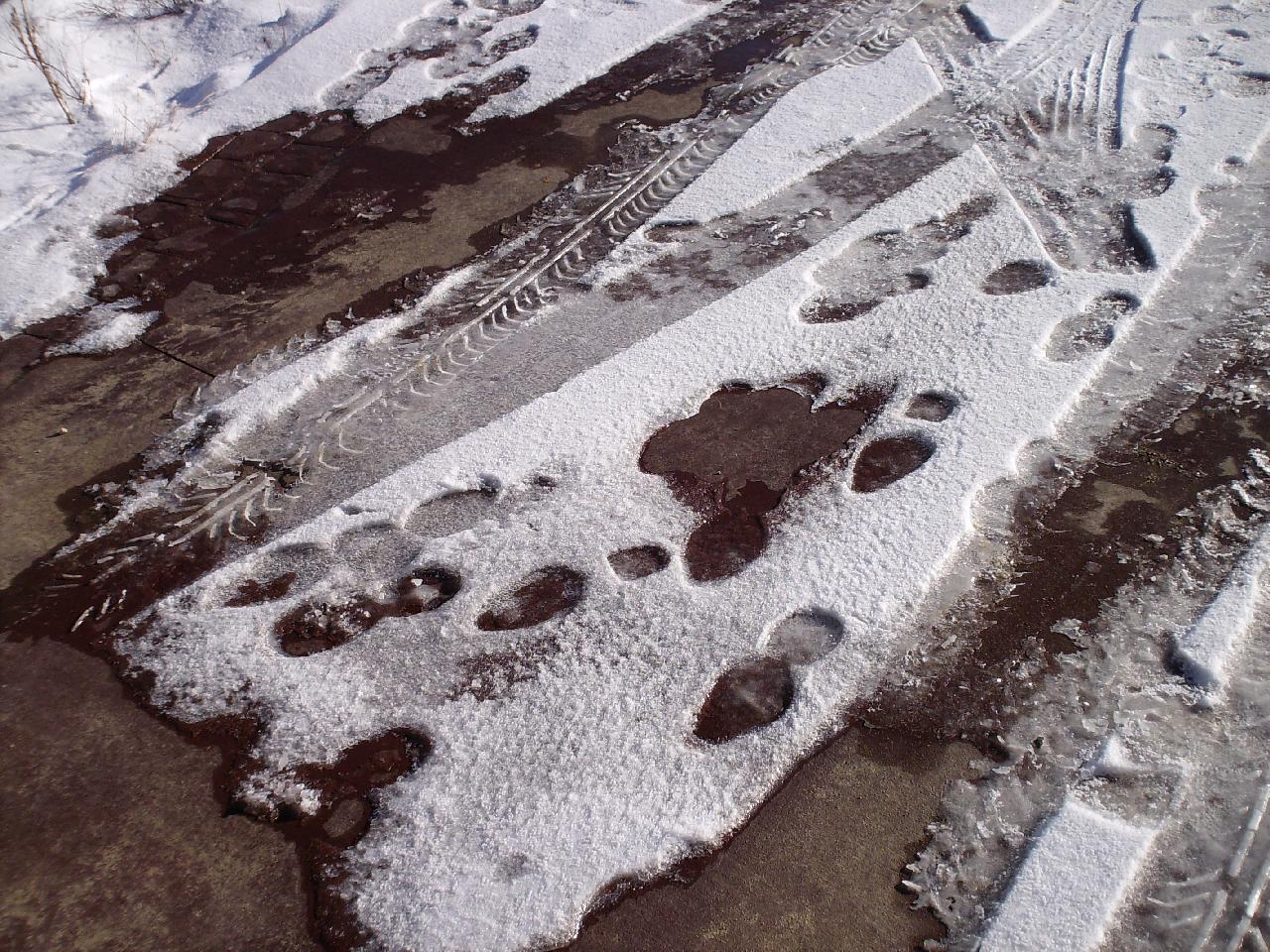
Click to enlarge
Over on the east face of the house, where the sunlight was only falling in the morning, you can see the difference.
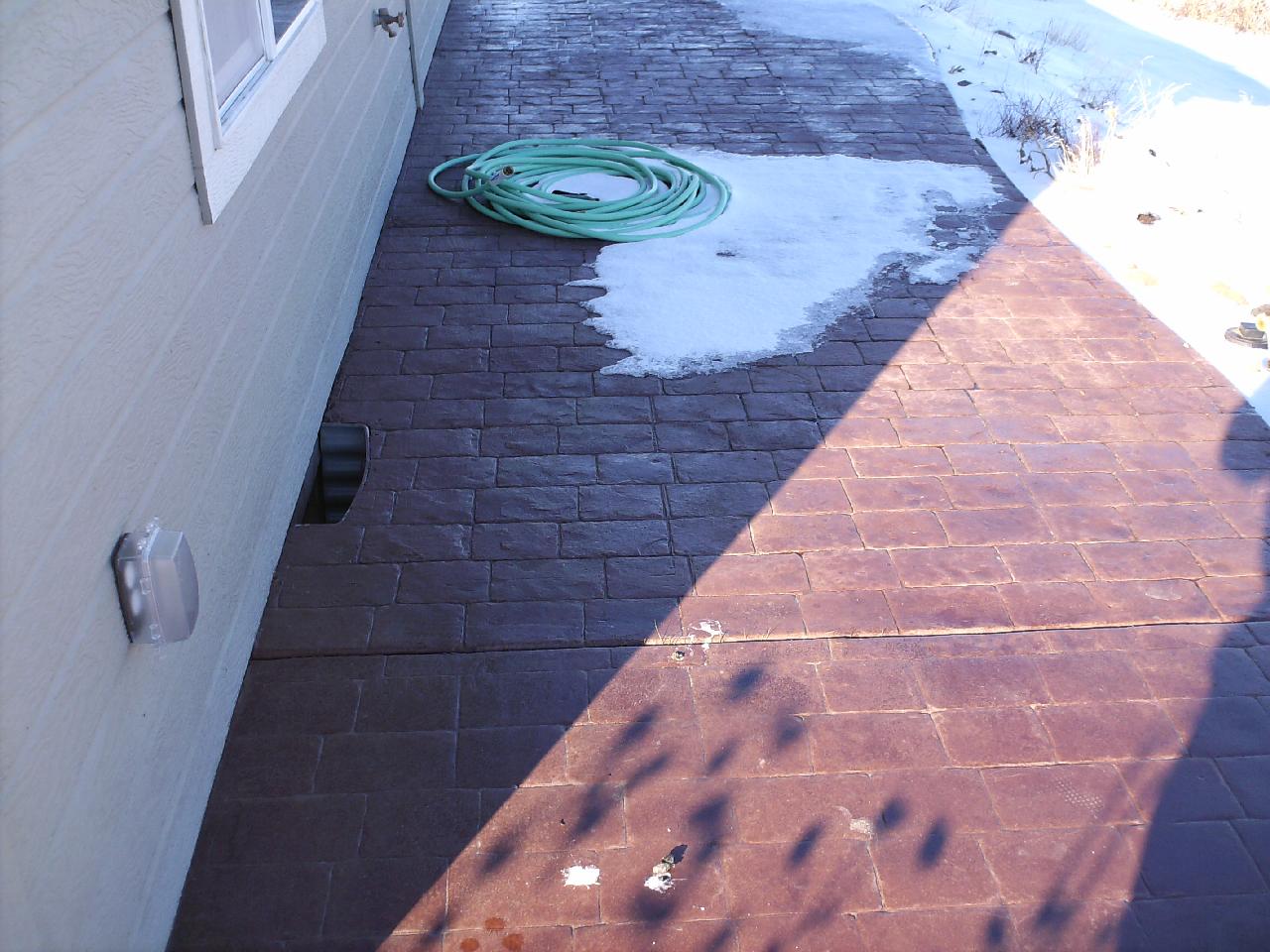
Click to enlarge
On the north face of the house, where there was no sunlight at all, it is still pretty unaltered.
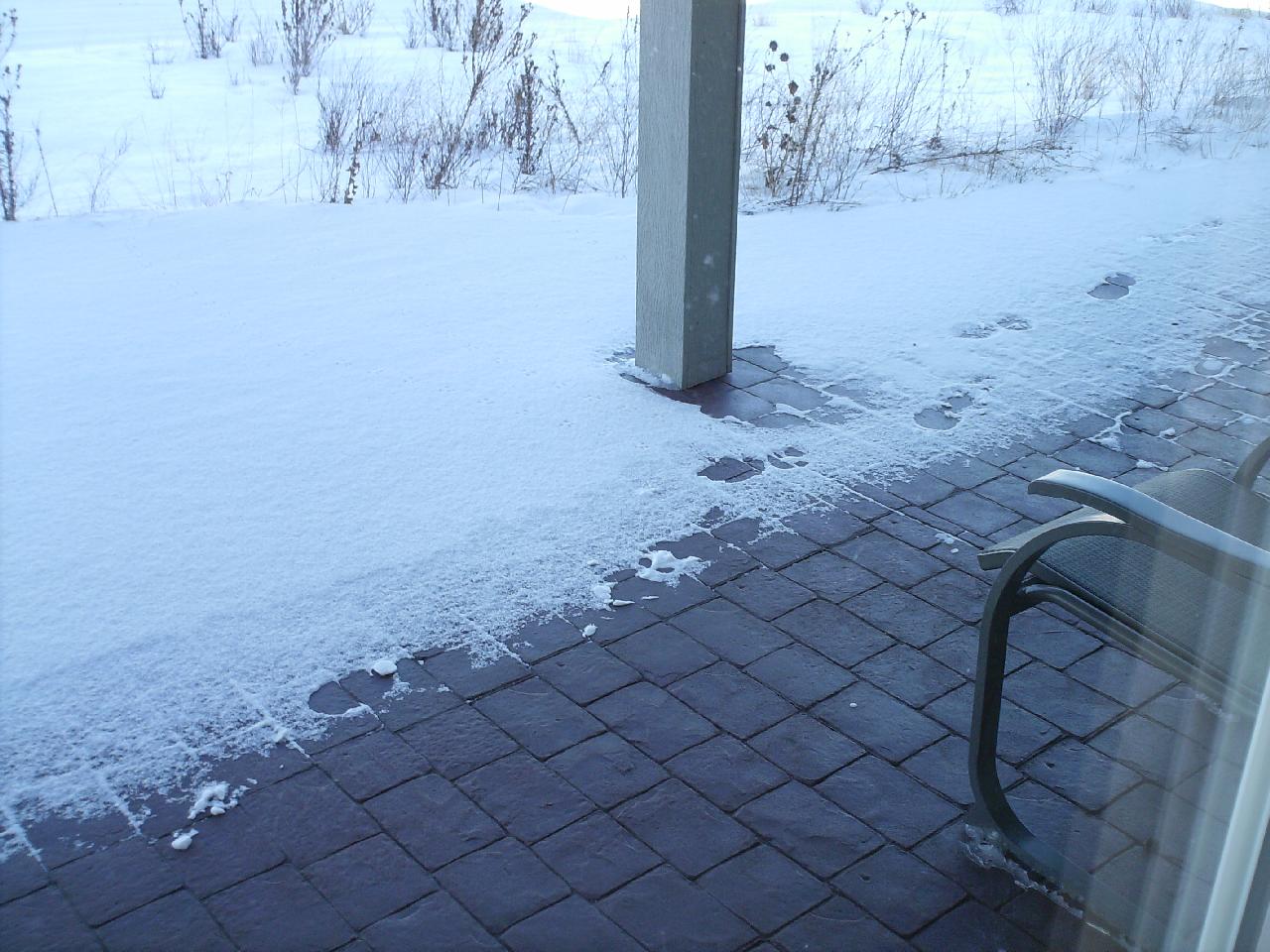
Click to enlarge
In spite of the temperature outside--it was ten degrees this morning when my wife woke up--the furnace isn't running all that much. The sunlight flooding in the south windows of the house is hitting the tiles, and turning into infared as it bounces. The insulation is doing its job.
I expect in summer, all that concrete around the house is going to get unpleasantly warm by the end of the day--and remain pleasant to bare feet into the early evening hours.
Last house project entry.
Tuesday, August 15, 2006
House Project: Enforcing Warranty Compliance
The builder sent an email asking to know when he could pick up the final check. We have been waiting for several months for the plumber to show up to tighten up the kitchen faucet and replace the broken hose bib handle. Amazingly enough, the morning after I told him the check would be available, "after all the warranty work has been finished," the plumber showed up, and did his tasks. (He also removed the very expensive Harmsco stainless steel lead filtration housing. We don't need it; we aren't using it; I'm hoping to find someone who doesn't want to pay $1100 for a new one.)
Anyway, all that is left is one cracked tile (not badly cracked, but still visible) and the screens that need to be redone in aluminum, so the grasshoppers don't continue eating them. With luck, this should be done by Monday.
Last house project entry.
The builder sent an email asking to know when he could pick up the final check. We have been waiting for several months for the plumber to show up to tighten up the kitchen faucet and replace the broken hose bib handle. Amazingly enough, the morning after I told him the check would be available, "after all the warranty work has been finished," the plumber showed up, and did his tasks. (He also removed the very expensive Harmsco stainless steel lead filtration housing. We don't need it; we aren't using it; I'm hoping to find someone who doesn't want to pay $1100 for a new one.)
Anyway, all that is left is one cracked tile (not badly cracked, but still visible) and the screens that need to be redone in aluminum, so the grasshoppers don't continue eating them. With luck, this should be done by Monday.
Last house project entry.
Tuesday, August 8, 2006
House Project: Concrete Color Fixed; Fiberglass Screens Being Eaten
After much struggle, the builder came up here with a representative from Brickform, the makers of the colored stamped concrete that we had done around the house. As regular readers will know, this was a disaster. The builder didn't put in drainage when we first discussed it, and some of the concrete on the rear garage apron cracked. When the concrete guys came in and re-poured it, it was the wrong color. Then they put on the finish that was supposed to be shiny and rose colored--and it didn't hide the gray concrete, and the finish was inconsistent and dark brown. At this point, we gave up getting the color the one that we had been promised--we would have been happy with a consistent color and finish.
Anyway, the first attempt to correct this problem didn't work so well, but by experimentation, the representative from Brickform and our builder found that a combination of the sealer (which makes it shiny and repel water) and xylene would dissolve the existing sealant layer, and produce a fairly consistent color and sheen. It still isn't quite what we had expected from looking at other work, but it's not too bad.
Here are a couple of pictures--and let me point out that we've tracked a bit of dirt across it, which hoses right off because of the finish.

Click to enlarge

Click to enlarge
I mentioned a few months back that we had a problem with woodpeckers punching big holes in the screens on the south side of the house. We have noticed a gradually increasing problem with little holes in the screens mostly on the north side of the house, but a little bit everywhere. It turns out that the screen material is made of fiberglass--not metal. The builder was a little surprised by this, and suggested that we could rescreen them pretty easily. (Of course, he wasn't suggesting that he do it or pay for it.)
Had the problem been birds, I would have cringed at the cost of having it done, or the labor of doing it ourselves, but we finally caught a grasshopper eating the screen. What is the purpose of window screens? To keep out bugs. If the bugs can, and do, eat through the screens, they aren't performing their only function, are they? As far as I am concerned, this is a warranty issue.

Click to enlarge

Click to enlarge
Of course, it might be easier to do just rescreen them ourselves. I bought some aluminum mesh at Home Depot, and two hours later, we discovered why Valley Glass charges about $28 to rescreen--this is a difficult job, and the results (if you don't do this regularly) aren't terribly pretty. There are enough screens involved here that we have told the builder to take care of this. If he delays too long, we'll have Valley Glass do it, and we'll deduct it out of the final check we still owe him for various work that has been done since we closed in December (about $5200).
And yes, I expect to write that check only after all warranty work has been done, and I will issue that check about as rapidly as he has responded to warranty claims. He may see it this year.
Last house project entry.
After much struggle, the builder came up here with a representative from Brickform, the makers of the colored stamped concrete that we had done around the house. As regular readers will know, this was a disaster. The builder didn't put in drainage when we first discussed it, and some of the concrete on the rear garage apron cracked. When the concrete guys came in and re-poured it, it was the wrong color. Then they put on the finish that was supposed to be shiny and rose colored--and it didn't hide the gray concrete, and the finish was inconsistent and dark brown. At this point, we gave up getting the color the one that we had been promised--we would have been happy with a consistent color and finish.
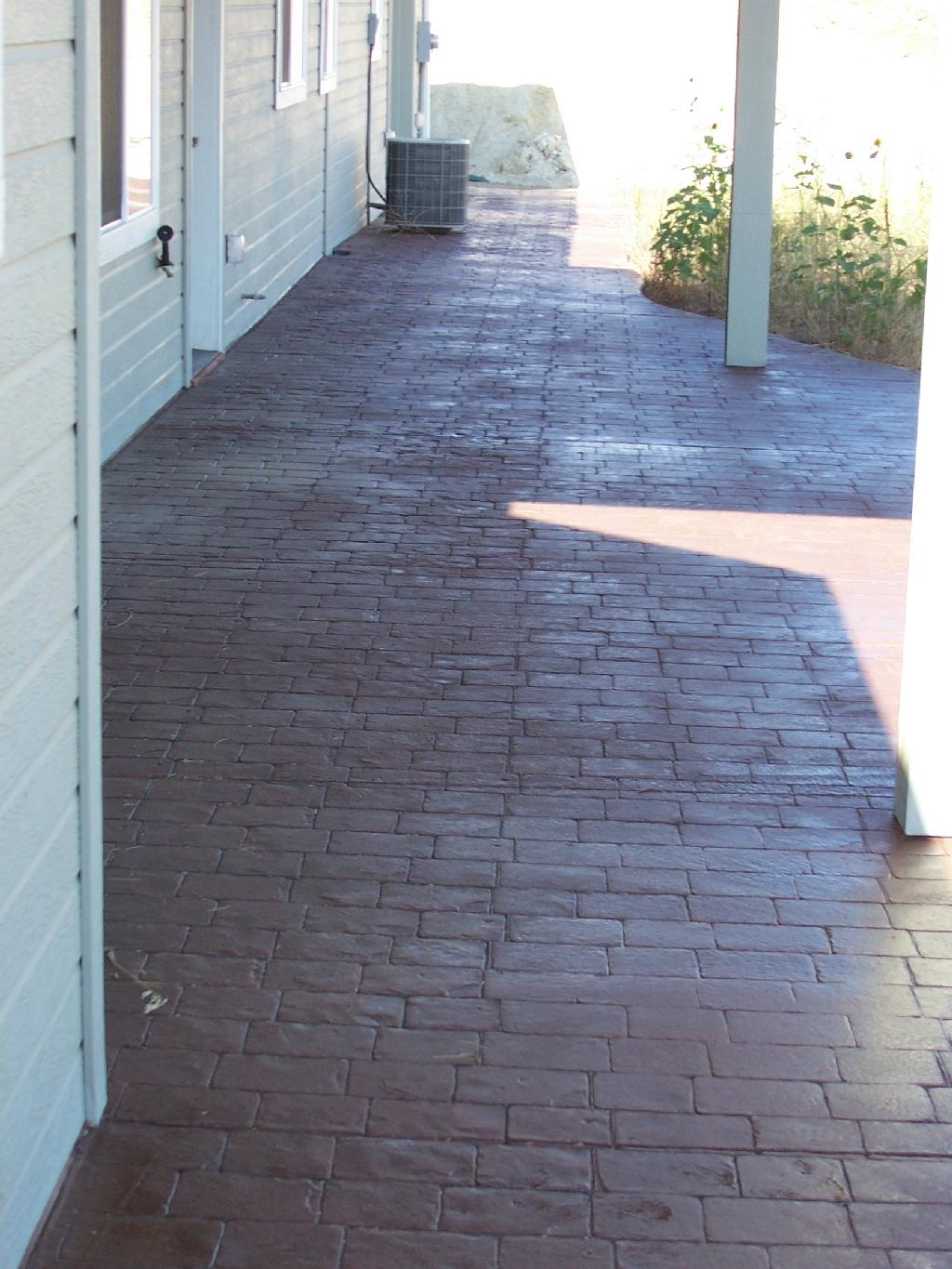
Anyway, the first attempt to correct this problem didn't work so well, but by experimentation, the representative from Brickform and our builder found that a combination of the sealer (which makes it shiny and repel water) and xylene would dissolve the existing sealant layer, and produce a fairly consistent color and sheen. It still isn't quite what we had expected from looking at other work, but it's not too bad.
Here are a couple of pictures--and let me point out that we've tracked a bit of dirt across it, which hoses right off because of the finish.
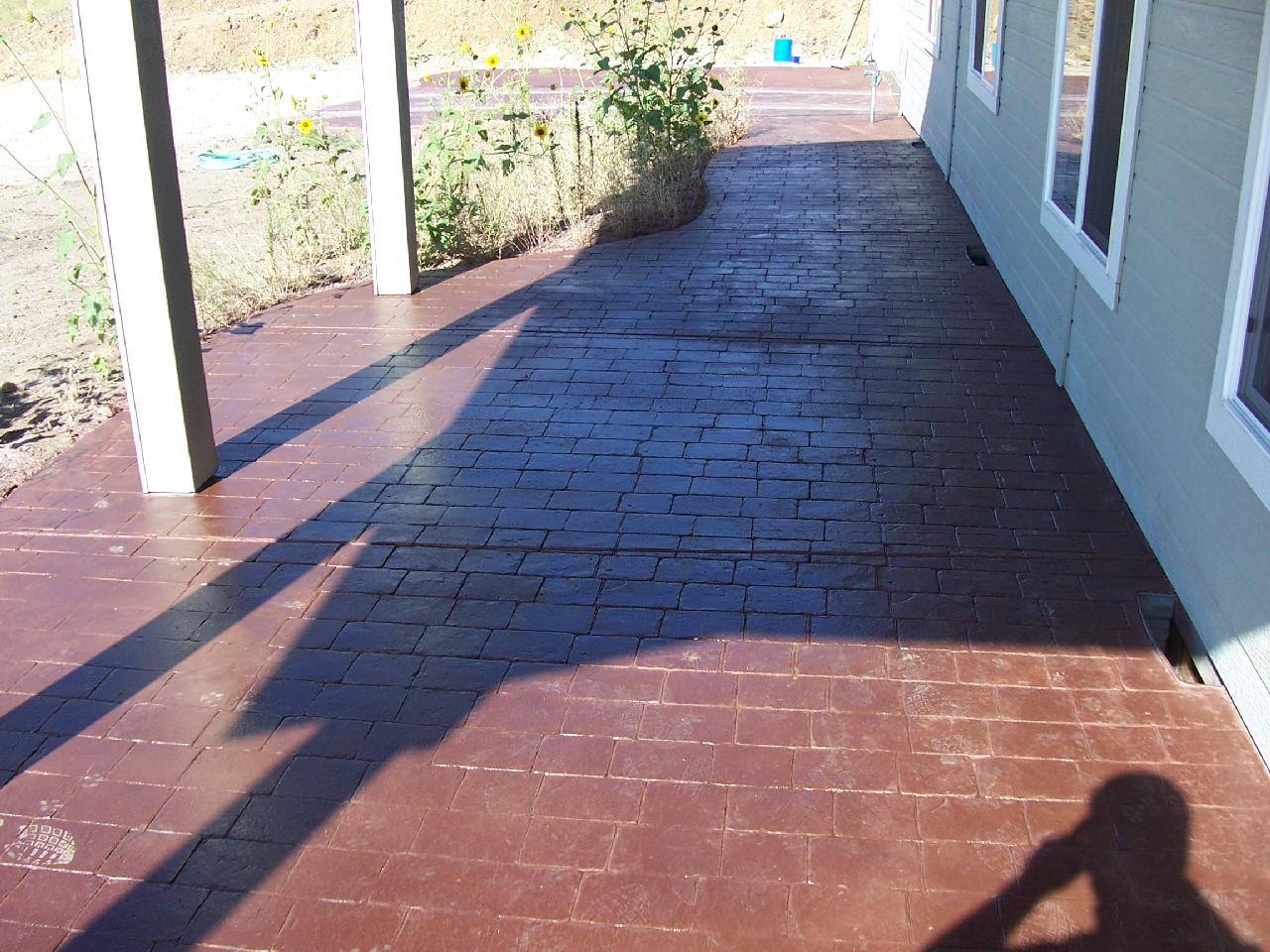
Click to enlarge
Click to enlarge
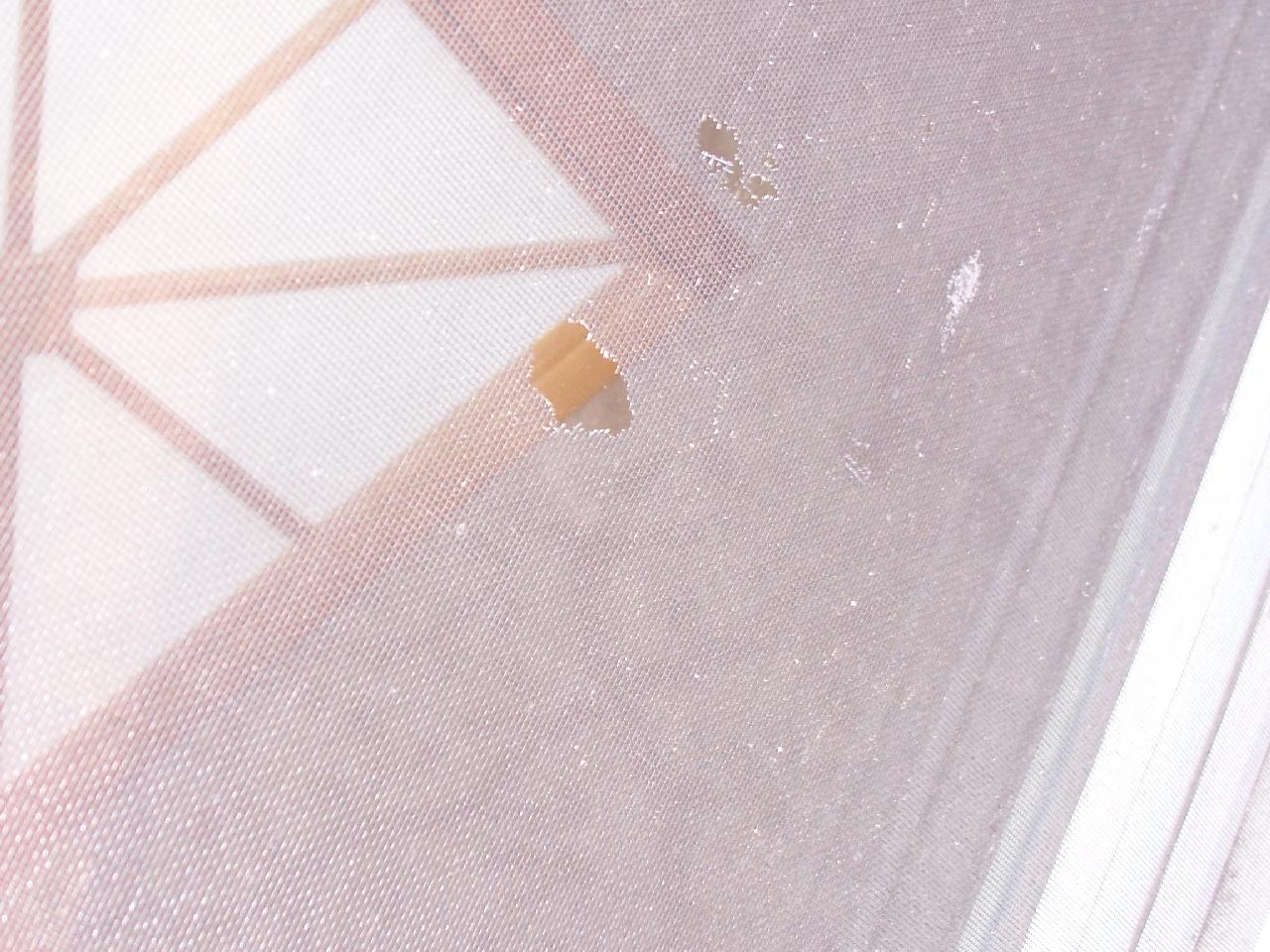
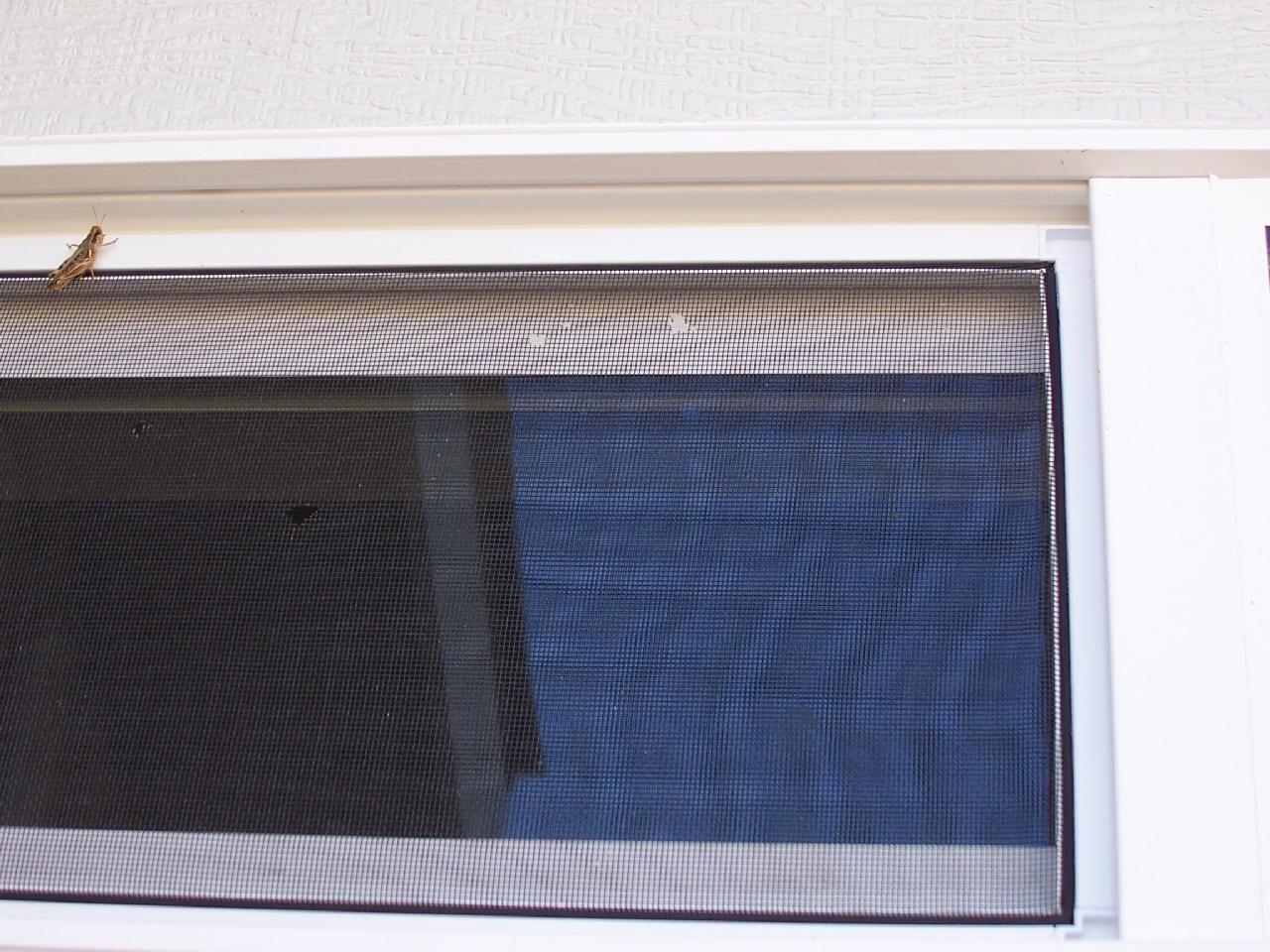
I mentioned a few months back that we had a problem with woodpeckers punching big holes in the screens on the south side of the house. We have noticed a gradually increasing problem with little holes in the screens mostly on the north side of the house, but a little bit everywhere. It turns out that the screen material is made of fiberglass--not metal. The builder was a little surprised by this, and suggested that we could rescreen them pretty easily. (Of course, he wasn't suggesting that he do it or pay for it.)
Had the problem been birds, I would have cringed at the cost of having it done, or the labor of doing it ourselves, but we finally caught a grasshopper eating the screen. What is the purpose of window screens? To keep out bugs. If the bugs can, and do, eat through the screens, they aren't performing their only function, are they? As far as I am concerned, this is a warranty issue.
Click to enlarge
Click to enlarge
Of course, it might be easier to do just rescreen them ourselves. I bought some aluminum mesh at Home Depot, and two hours later, we discovered why Valley Glass charges about $28 to rescreen--this is a difficult job, and the results (if you don't do this regularly) aren't terribly pretty. There are enough screens involved here that we have told the builder to take care of this. If he delays too long, we'll have Valley Glass do it, and we'll deduct it out of the final check we still owe him for various work that has been done since we closed in December (about $5200).
And yes, I expect to write that check only after all warranty work has been done, and I will issue that check about as rapidly as he has responded to warranty claims. He may see it this year.
Last house project entry.
Subscribe to:
Posts (Atom)