Showing posts with label establishment of religion. Show all posts

Monday, June 7, 2010

The Christian Politician

When I saw that a rather prominent politician decided that “separation of church and state” thing was old-fashioned, well, I’m not surprised. She said that government policy must be in keeping with the values of Jesus Christ. Who? Sarah Palin? No, Speaker of the House Nanci Pelosi (D-CA).

Look, there are aspects of liberal thought that do, potentially, line up with the Bible. I can disagree with Pelosi about the details of the Health Care Reform Bill—but if someone argues that a Christian commonwealth has an obligation to its most needy, I will agree. This isn’t a new idea; it goes back for centuries in English law. The Church from the very beginning played a major role in caring for the sick, the needy, and the hopeless. Jesus commanded Christians as individuals to help the poor, and it is not much of a stretch to see that in governments where Christians are a strong majority that the government might take on that role as well. (Whether it is the most efficient provider is another question, of course. And of course, exactly how far the government’s obligation goes is another complex question where decent people can disagree about the details.)

Liberals who want the government to do Christian service are on very strong ground when they make that argument. But where they are not on strong ground is when they say, as Pelosi has, that the government policy must be keeping with the values of Jesus—and then completely and utterly rejects those values when it is inconvenient. From the very beginning, the Christian church utterly rejected abortion and infanticide, “classifying both as murder.” English common law was more forgiving—but Pelosi claims to be following Jesus, remember? Pelosi has been a consistent vote not just for abortion, but for partial-birth abortion—a procedure so horrifying in its brutality that even many pro-choice sorts get a bit green around the gills when they read court decisions such as Gonzales v. Carhart (2007) that discuss exactly what this procedure entails:

Another doctor, for example, squeezes the skull after it has been pierced .so that enough brain tissue exudes to allow the head to pass through… Still other physicians reach into the cervix with their forceps and crush the fetus’ skull. ... Others continue to pull the fetus out of the woman until it disarticulates at the neck, in effect decapitating it. These doctors then grasp the head with forceps, crush it, and remove it.

Ah yes, those are definitely the values of Jesus Christ that Nancy Pelosi is voting for!

And it isn’t just abortion. It’s gay marriage—where Nancy Pelosi hailed the California Supreme Court’s short-lived legalization of marriage between homosexuals. Even when I was young, homosexuality was so generally abhorrent that the notion of homosexual marriage was incomprehensible; homosexual sex between consenting adults in private was still a criminal offense in every American state as late as 1960—and even in California, until 1975. Why? Because there was no serious dispute that homosexuality (along with adultery, and bestiality) was contrary to the laws of God—and for that reason, unlawful.

If Nancy Pelosi is serious about public policy having to be in line with the values of Jesus Christ, great, let’s go for it. Like her, I support efforts to alleviate suffering of the poor. Like her, I believe that the government has some obligation to provide at least some basic level of assistance to those in need. But I am going to insist that if she wants to play the “following Jesus” card on passing of laws, then she needs to be consistent and serious about this—and that means telling her constituents that abortion, except to prevent death of the mother, is wrong, and should be a crime. Ditto for homosexuality. She’s not going to do that—and she knows full well that this picking and choosing from Jesus’ teachings is exactly that—cherry picking, not following Jesus. It is profoundly dishonest.

Sunday, October 11, 2009

The Establishment Clause

The Establishment Clause

PajamasMedia has published my piece on the First Amendment's establishment clause
, citing the very anti-ACLU actions taken by Congress, and Presidents Jefferson and Madison. As you might expect, the atheists are suffering brain meltdowns.

UPDATE: I'm always amused at the ignorance of the atheists intent on proving that they know history better than me. One of the comments on that article says:
“History I believe furnishes no example of a priest-ridden people maintaining a free civil government. This marks the lowest grade of ignorance, of which their political as well as religious leaders will always avail themselves for their own purpose. ”

Oops, how’d that happen? That Jefferson, what a leftist, socialist, pre-Marxist liberal anti-American! Want more? There are tons.
My response:

Suggestion: learn to read in context. Jefferson was referring specifically to the Spanish colonies.

That they will throw off their European dependence I have no doubt; but in what kind of government their revolution will end I am not so certain. History. I believe, furnishes no example of a priest-ridden people maintaining a free civil government. This marks the lowest grade of ignorance, of which their civil as well as religious leaders will always avai1 themselves for their own purposes. The vicinity of New Spain to the United States, and their consequent intercourse, may furnish schools for the higher, and example for the lower classes of their citizens. And Mexico, where we learn from you that men of science are not wanting, may revolutionize itself under better auspices than the Southern provinces. These last. I fear, must end in military despotisms.

Jefferson, like nearly all the Framers, regarded Catholicism with considerable contempt. Hence “priest-ridden" not "clergy-ridden" or "religion-ridden." As another example, John Adams (who became more liberal theologically in his later years) attended Catholic services in Philadelphia when part of the Continental Congress, and described it as superstition.

The atheist zealots (and I recognize that not all atheists are zealots) seem intent on cherry-picking quotes rather than understanding.

Saturday, August 15, 2009

Jail Time For Prayer

Jail Time For Prayer

At least, that's the short (too short) version of what happened. The jail time is actually for defying a court order. But some court orders are so obviously unconstitutional that they deserve to be defied. From the August 14, 2009 Washington Times:

An ACLU official said the school district has allowed "flagrant" violations of the First Amendment for years.

"The defendants all admitted wrongdoing," said Daniel Mach, director of litigation for its freedom of religion program. "For example, the Pace High School teachers handbook asks teachers to 'embrace every opportunity to inculcate, by precept and example, the practice of every Christian virtue.' "

The fight involving the ACLU, the school district and several devout Christian employees began last August when the ACLU sued Santa Rosa County Schools on behalf of two students who had complained privately to the group's Florida affiliate, claiming some teachers and administrators were allowing prayers at school events such as graduations, orchestrating separate religiously themed graduation services, and "proselytizing" students during class and after school.

In January, the Santa Rosa County School District settled out of court with the ACLU, agreeing to several things, including a provision to bar all school employees from promoting or sponsoring prayers during school-sponsored events; holding school events at church venues when a secular alternative was available; or promoting their religious beliefs or attempting to convert students in class or during school-sponsored events.

Mr. Staver said the district also agreed to forbid senior class President Mary Allen from speaking at the school's May 30 graduation ceremony on the chance that the young woman, a known Christian, might say something religious.

"She was the first student body president in 33 years not allowed to speak," he said.

There was a time when the ACLU would have challenged prior restraint on speech. But I guess only if it involves dancing naked with chocolate sauce on your body. The specific circumstances of the prayers that got these people in legal trouble seem especially strong evidence that the ACLU is (again) in the wrong:

The criminal charges, which carry up to a $5,000 fine and a six-month jail term, originated with a Jan. 28 incident in which Mr. Lay, a deacon at a local Baptist church, asked Mr. Freeman to offer mealtime prayers at a lunch for school employees and booster-club members who had helped with a school field-house project.

Mr. Staver said no students were present at the event, which was held on school property but after school hours.

"He wasn't thinking he was violating an order," he said. "Neither did the athletic director. He was asked to pray and so he did."

Mr. Mach said the event was during the school day and that Mr. Lay, the school's principal, has said in writing that students were present.

Even if there were students present, this was lunch. (January 28 was during the week.) No student was required to be present. Certainly, if an imam had come in to pray, the ACLU wouldn't have been upset.

Saturday, June 20, 2009

I'm Used To Christians Not Being Allow To Proselytize in Muslim Countries

I'm Used To Christians Not Being Allow To Proselytize in Muslim Countries

I'm just not used to it being in the United States. From the June 18, 2009 San Jose Mercury-News:

DETROIT — A federal judge today denied an evangelical Christian group's request for permission to hand out literature on sidewalks at an Arab festival in the heart of the Detroit area's Middle Eastern community.

U.S. District Judge Nancy Edmunds denied Anaheim, Calif.-based Arabic Christian Perspective's request for a temporary restraining order.

The group describes itself in its court filing as "a national ministry established for the purpose of proclaiming the Holy Gospel of Jesus Christ to Muslims ... (that) travels around the country attending and distributing Christian literature at Muslim festivals and mosques."

A lawyer for the group said it would seek a permanent injunction against the city of Dearborn.

"It's not over," said Robert J. Muise of the Thomas More Law Center, an Ann Arbor-based Christian rights advocacy group.

Another lawyer on the case said the Dearborn officials action could be part of what he described as a broader Muslim legal attack on critics of Islam in our "Judeo-Christian nation."

"Muslims are using the courts in this country to stop our free speech rights," said William J. Becker Jr., a Los Angeles attorney who has represented a number of prominent critics of Islam.

The 14th annual Dearborn Arab International Festival is expected to draw hundreds of thousands of visitors Friday through Sunday to the city that has the Detroit area's greatest concentration of Arab-Americans.

Wow. How many parts of the First Amendment can this judge violate at once?

1. Public streets can't be used for a protected form of free speech.

2. And this is a violation of the freedom of religious exercise clause, since proselytizing is a fundamental part of the Christian faith.

3. And arguably a violation of religious establishment clause, since it would appear that there is a distinct penalty assessed against a particular religion.

And what makes this especially silly is that even by progressive notions of not offending, this doesn't make sense. A lot of Arab-Americans are Christians; that's one of the reasons that a lot of them came here. I have attended church with Arab-Americans in the past, and I know that they aren't particularly unique.

UPDATE: Professor Volokh in email points out that the restrictions in question are content-neutral; at this point, there is no evidence that Christians are being especially disfavored. I confess that I am a bit sensitive on this subject, simply because Islam is favored by the left (because they have imagined that Bush was making war on Islam), and Christianity an especially disfavored religion for the left (because we won't get with the program on homosexuality, abortion, and Gaea worship).

And while it is true that prohibiting leafleting does not preclude other available means of expressing an opinion--it is also true that the ACLU doesn't seem to ever recognize the validity of this approach when it comes to something like virtual child pornography, where they argued that because the law was overbroad, and therefore might apply to some serious artistic works, that therefore the law was unconstitutional. (There were no alternatives in making a film that wouldn't run afoul of the law?) I mean, you don't have to burn a flag to express your opinion, do you? According to the ACLU, alternate means of expressing an opinion just aren't adequate. (Except, of course, when wearing a T-shirt might offend homosexuals--then you have to shut up--at least, according to Judge Stephen Reinhardt, who is married to the ACLU of Southern California's director.)

I also find the notion that leafleting can be forbidden because of crowd control issues--but going out into the crowd to talk to people isn't--is absurd. Go into a crowd and start talking to people about something as emotional as religion, and I suspect that it is going to produce some pretty heated discussions--which will slow the flow of traffic. Leaflets, on the other hand, get stuffed into a pocket, producing no real change in traffic flow.

This street festival is supposedly different from a public street because there's some sort of public event being carried on. Somehow, I'm hard pressed to see how this makes it equivalent to a courthouse, a legislative body, a jail, or one of the other places where government is ordinarily granted additional power to restrict speech because they are performing a landlord function. Considering that the Supreme Court ruled in the Pruneyard decision that a private property owner may not exclude persons gathering signatures in a shopping center, because this is a form of public forum, it is hard to see how the government has authority to prohibit leafleting on public streets.

Monday, May 4, 2009

A Bad Decision Leads to a Good Decision

A Bad Decision Leads to a Good Decision

Back when I taught Constitutional History, I had occasion to carefully read the Supreme Court decision Lemon v. Kurtzman (1971), which underlies a lot of the Court's really broken establishment clause decisions. The objection that I have to Lemon is that it too broadly construed the prohibition on establishment of religion into a general prohibition on any governmental assistance to a program carried out by a religious entity. In that case, a Rhode Island school district was providing funding to private sectarian school teachers.

There are some good policy arguments for such a policy, of which the strongest is that kids in private schools aren't attending public schools--even though their parents are paying taxes to support those public schools. There are some good policy arguments against it, too, I suppose. I just don't buy that there is a First Amendment problem with such a policy, unless the school district gave these subsidies to schools associated with some religions, but not others, or gave subsidies only to non-religious schools. (Rhode Island's law apparently allowed such subsidies to all private schools, but only the Catholic Church schools had taken advantage of this opportunity--no great surprise, when you consider Rhode Island's population.)

Anyway, Professor Volokh points to a recent U.S. district court decision, C.F. v. Capistrano Unified School District (C.D. Cal. 2009), which uses Lemon to deal with a teacher who called Creationism "superstitious nonsense." Now, regardless of what you think of the scientific merits of Creationism, this is not generally at the top of the list of effective strategies for persuading students (and their parents) on to your side. It is, however, an effective way to get a lawsuit filed.

If the Court actually followed what the Framers apparently intended--a prohibition on federal establishment of religion in 1791, and the state laws in 1868, when Congress passed the Fourteenth Amendment, incorporating the First Amendment against the states--this wouldn't be an issue. Establishment meant legal recognition, preference, or advantage to a particular denomination. As I mentioned a while back, Supreme Court Justice Joseph Story, a widely respected and cited authority on early Constitutional law, pointed out what the religion clauses meant:
The real object of the amendment was not to countenance, much less to advance, Mahometanism, or Judaism, or infidelity, by prostrating Christianity; but to exclude all rivalry among Christian sects, and to prevent any national ecclesiastical establishment which should give to a hierarchy the exclusive patronage of the national government. It thus cuts off the means of religious persecution (the vice and pest of former ages), and of the subversion of the rights of conscience in matters of religion, which had been trampled upon almost from the days of the Apostles to the present age. [Joseph Story, Commentaries on the Constitution of the United States, 5th ed. (Boston: Hilliard, Gray & Co., 1833), 701]
However offensive this teacher's remarks are, under an original intent understanding of the establishment clause, calling an idea that some Christians hold "superstitious nonsense" is not a violation of the First Amendment. But using the Lemon decision, which is historically inaccurate, those remarks really are unconstitutional!

Lemon needs to be overturned by the courts, and U.S. jurisprudence returned to an original intent understanding of the clause: no legal preference or disability for any particular Christian denomination. If it is too offensive to modern intellectuals to acknowledge that Justice Story was correct that the objective was not to require a level playing field to all religions, fine. Even putting all religions on an equal legal basis would be closer to original intent than the Lemon decision--and would give science teachers with no manners or sense the freedom to express their opinions without running afoul of the First Amendment.

Thursday, August 14, 2008

Religion, Education, & Standards

Religion, Education, & Standards

The August 14, 2008 Inside Higher Education has an article about the lawsuit concerning University of California's standards for recognizing private high school classes:
If you look at the admissions requirements of most colleges, you’ll find
listings of high school courses: specified numbers of years of mathematics, science, English and so forth. Frequently, there are references to the courses being college preparatory, not just any course in the subject area. And that begs a question: Who gets to decide what is college preparatory?

A federal judge’s ruling has upheld the right of the University of California to make its own evaluations of high school courses,
provided that the university demonstrated a “rational basis” for its decisions, and that the decisions were not based on animus toward any group or faith. And Judge S. James Otero found that the university’s decisions to reject certain high school courses at some Christian schools met that test.

Christian groups are appealing the decision to the U.S. Court of
Appeals for the Ninth Circuit, so the dispute is far from over. The groups suing say that the case is about religious freedom, but university officials say it is about academic standards. Outside California, admissions officials have been watching carefully because colleges must often evaluate the quality of high school courses — at religious or secular schools — and many feared that their ability to do so would be jeopardized if the university lost the case.
I'm actually somewhat sympathetic to the admissions officials. There are a lot of private schools in the U.S. Some of them are really outstanding; some of them are pretty mediocre. (Of course, that also describes a lot of public schools, also.)

I can appreciate the concern that the University of California has about this. A teacher I know taught 7th and 8th graders in a private Christian school in California. The biology textbook had a definite fundamentalist streak to it, but was still pretty decent with respect to description, how systems work, and so on--until the subject of evolution came up. The book didn't even make a serious attempt to discuss evolutionary theory, its basis, or its weaknesses--it was simply childish insults.

Not surprisingly, the teacher didn't use that part of the book. Instead, she and I worked together on producing a useful discussion of evolutionary theory, its origins, the philosophy and purposes of science. I'm sure that the kids ended up with at least as complete an understanding of evolutionary theory as they would have received in a public middle school--perhaps better.

At the same time, there is a very serious issue involved here. If a state school treats certain positions as "wrong" or intellectually inadequate, and the state school's position is on something like evolution vs. creation, there is a serious question as to whether their actions run afoul of the First Amendment's establishment clause--or at least, if you interpret the establishment clause as broadly as the ACLU does when it comes to a Ten Commandments monument in a city park.

In both cases, strictly speaking, the government is not recognizing an establishment of religion in the sense that the Framers meant. The Framers meant that the government should not pass a law that did anything relative to a particular religious body. (Hence that word "respecting"--meaning having any reference to, positive or negative.) No special tax break for Baptist churches--but if all religious institutions enjoyed a tax break, no problem. No special legal protection for Congregationalist churches--but a law that prohibited disrupting religious services would be perfectly lawful, as long as it protected all churches, synagogues, temples, and mosques (although that would have startled the Framers). No punishment of a particular church's method of worship--but a law that prohibited polygamy, as long as it applied to everyone, regardless of their reasons, would be Constitutional.

The ACLU's notion that anytime government says something positive about religion, or encourages religious worship or belief, that it violates the First Amendment--that's an absurd stretch. The evidence is just not there that the Framers understood the First Amendment this broadly. But for those who insist on that reading--this case involving the University of California is perilously close. If they put students who attend private religious schools at a disadvantage because the values that those classes promote are religious--even if the objections aren't phrased in antireligious terms--then the government is saying that the values associated with some religious (Unitarians, Episcopalians) are acceptable, while the values associated with more fundamentalist religions are not. That's a pretty clear hostility towards the values of some religious establishments--in the same way that getting all twitterpated about a Ten Commandments monument on public property is expressing hostility towards the religious values of at least 2/3 of Americans (the percentage who regularly indicate that they have no problem with such displays).

Still, some of U.C.'s concerns make me wonder if they have any idea what goes on in a lot of public schools who they doubtless consider orthodox:
The judge’s decision goes through the various rejected courses and finds that the university’s rationale meets the “rational basis” test, and rejects arguments that there was evidence of religious bias. For example, one of the courses was an English course called “Christianity and Morality in American Literature.” The university noted that the text used “insists on specific interpretations” of various literary works, rather than allowing students to engage in critical thinking about them.
Wow! A textbook that behaves like a few university professors that I've had! What a shocker! I wonder what their reaction would be to a biology textbook that "insists on specific interpretations" of the fossil record concerning evolution, or a science textbook that "insists on specific interpretations" of the motions of the planets with respect to the law of gravity.

UPDATE: After I posted this, I was reminded of the situation in eighteenth and nineteenth century England, where Oxford and Cambridge required you to be Anglican to be student or faculty. One consequence was that Dissenters (essentially, all Christians who had disagreements with the Anglican Church) had to either lie, or attend the Dissenter colleges--which had the advantage that they were starting from scratch, and ended up for a while being well ahead of Oxford and Cambridge in practical subjects such as engineering. One consequence was that Dissenters ended up dominating Victorian industry.

If it wasn't for the enormous subsidies that public schools enjoy that private schools do not, I suspect that something similar could happen here and now. If you think about it, with the exception of biology and cosmology, there would be no intrinsic disadvantage that evangelical Christian school preparation would suffer relative to public institutions.

Friday, April 18, 2008

Another Loss for the ACLU

Another Loss for the ACLU

I mentioned several months back my surprise at seeing an Indiana license plate with "In God We Trust" on it--and that I was surprised that the ACLU hadn't filed suit. There is nothing quite as predictable as the ACLU's willingness to file suits over trivial matters. From the April 18, 2008 Indianapolis Star:

A judge has halted a lawsuit over Indiana's popular "In God We Trust" license plate, ruling the state can sell it without charging an extra $15 fee.

The American Civil Liberties Union of Indiana argued that without the fee, the plate was elevated above others bearing messages supporting the environment, education and other causes.

Introduced last year by state law, the "In God We Trust" plate is carried by more than 1.6 million vehicles.

Marion Superior Court Judge Gary Miller's ruling, issued Wednesday, says the plate is different from special group recognition plates that carry the administrative fee. Those often require a contribution to a group or university and require special handling by the Bureau of Motor Vehicles.

The "In God We Trust" plate, the ruling says, "was designed by a process similar to the Standard Plate, mass-produced like the Standard Plate, and widely distributed like the Standard Plate based on consistently high sales."
Aside from the points that the judge made, I would also point out that if the ACLU chose to sue on the basis that "In God We Trust" doesn't belong on state license plates because it shows a preference for religion, they have a somewhat larger problem in their wallet.

As I have pointed out before, the First Amendment's establishment clause was intended to prevent special preference given to a particular church or denomination. There is simply no historical basis for believing that the intention was to create a separation of church and state, and the evidence is clear that the goal was not to put religion and irreligion on an equal footing.

Wednesday, April 9, 2008

Where's The ACLU?


A publicly funded school that has extended the school day for prayer--and apparently not voluntary prayer. Teachers assist students in religious rituals. And the ACLU isn't suing. Do you wonder why? From the April 9, 2008 Minneapolis Star-Tribune:
Recently, I wrote about Tarek ibn Ziyad Academy (TIZA), a K-8 charter school in Inver Grove Heights. Charter schools are public schools and by law must not endorse or promote religion.

...

TIZA has many characteristics that suggest a religious school. It shares the headquarters building of the Muslim American Society of Minnesota, whose mission is "establishing Islam in Minnesota." The building also houses a mosque. TIZA's executive director, Asad Zaman, is a Muslim imam, or religious leader, and its sponsor is an organization called Islamic Relief.
Students pray daily, the cafeteria serves halal food - permissible under Islamic law -- and "Islamic Studies" is offered at the end of the school day.
Zaman maintains that TIZA is not a religious school. He declined, however, to allow me to visit the school to see for myself, "due to the hectic schedule for statewide testing." But after I e-mailed him that the Minnesota Department of Education had told me that testing would not begin for several weeks, Zaman did not respond -- even to urgent calls and e-mails seeking comment before my first column on TIZA.
Now, however, an eyewitness has stepped forward. Amanda Getz of Bloomington is a substitute teacher. She worked as a substitute in two fifth-grade classrooms at TIZA on Friday, March 14. Her experience suggests that school-sponsored religious activity plays an integral role at TIZA.
Arriving on a Friday, the Muslim holy day, she says she was told that the day's schedule included a "school assembly" in the gym after lunch.
Before the assembly, she says she was told, her duties would include taking her fifth-grade students to the bathroom, four at a time, to perform "their ritual washing."
Afterward, Getz said, "teachers led the kids into the gym, where a man dressed in white with a white cap, who had been at the school all day," was preparing to lead prayer. Beside him, another man "was prostrating himself in prayer on a carpet as the students entered."
"The prayer I saw was not voluntary," Getz said. "The kids were corralled by adults and required to go to the assembly where prayer occurred."
Islamic Studies was also incorporated into the school day. "When I arrived, I was told 'after school we have Islamic Studies,' and I might have to stay for hall duty," Getz said. "The teachers had written assignments on the blackboard for classes like math and social studies. Islamic Studies was the last one -- the board said the kids were studying the Qu'ran. The students were told to copy it into their planner, along with everything else. That gave me the impression that Islamic Studies was a subject like any other."
After school, Getz's fifth-graders stayed in their classroom and the man in white who had led prayer in the gym came in to teach Islamic Studies. TIZA has in effect extended the school day -- buses leave only after Islamic Studies is over.
If this was being done by Christians, the ACLU would have had this school shut down--or defunded--years ago, because the state department of education was warned about this in 2004.

The ACLU should stop pretending that they are genuinely concerned about preference for one religion over another, or of religion over irreligion. They really are the Anti-Christian Litigation Unit.

Wednesday, March 12, 2008

The Establishment of Religion Clause

The Establishment of Religion Clause

I don't normally respond to the childish insults from 43rd State Blues. Along with being strictly petty, junior high insults, the language is usually quite vulgar. If this bunch, which calls its blog "Democracy for Idaho" is indicative of the Democratic Party here, I can see why Republicans dominate this state's politics.

Here is an actual substantive issue that they raise--and it provides a useful opportunity to discuss an important question. They have decided to accuse Bryan Fischer of violating the establishment of religion clause for speaking in a public school classroom at the request of a teacher:
I'd like to know where I can bring up charges of violating the Separation of Church and State against Bryan Fischer:
I had the privilege last week to spend two hours with accelerated biology students at a Treasure Valley public school, invited by an open-minded science teacher. I reviewed with these students the evidence for intelligent design and against the theory of evolution.
Along the way, I pointed out the dramatic differences that occur in society if we believe that man is merely an advanced ape rather than someone created in the image of God. Surely Planned Parenthood’s racism is one of the logical consequences of the embrace of evolution by our cultural elites.
I would also like for someone to point me to the school or the teacher him/herself that violated the trust of the public.
They are excitedly talking about suing Fischer for this--which just shows how little they really understand about this matter.

1. Fischer is not a governmental official. Even accepting their claim that Fischer presenting an alternative point of view is improper, Fischer, being a private citizen, did not violate the establishment clause. At most, someone who asked him to speak might have violated the establishment clause, but Fischer clearly did not.

Even aside from the legal question, it says quite a bit about where liberals stand that they object to students hearing more than one side of an issue. If public schools taught a conservative perspective in government class, and a teacher decided to have a liberal come in and challenge those assumptions, 43rd State Blues would be praising the teacher for giving the students the chance to hear a diverse range of ideas. If you really think that hearing Intelligent Design espoused for a couple of hours is going to damage the ability of these students to make up their own minds, it really shows a contempt for the students--and a lack of confidence that the orthodox teachings of evolution are clearly right.

2. The basis for their claim that having Fischer speak in a science class is a violation of the establishment clause is Kitzmiller v. Dover Area School District, a suit in which the school board had directed that biology teachers include discussion of Intelligent Design. The school board, as a governmental body, directed that this discussion take place. Unless 43rd State Blues can find some evidence that Fischer was speaking to that science class because some school board or other governmental agency directed it, there is no establishment violation.

3. The idea that presenting a religious point of view in a public classroom is an establishment clause violation is a position that would have been unimaginable to the Framers. As I point out here, religion and government were joined at the hip throughout the Revolutionary period. Presidents Thomas Jefferson (among the most freethinking of the Framers) and James Madison (the primary draftsman of the Bill of Rights, including the establishment clause) both regularly attended church services that were held in the Hall of Representatives in Washington, D.C. Government buildings were regularly used for church services during their terms. Congress set aside section 29 of every township in the Ohio Territory for the support of whatever church the majority of the township selected.

The establishment clause had a narrow purpose: to prohibit any particular religious institution or denomination from receiving preferential (or dispreferential) treatment from Congress:
Congress shall make no law respecting an establishment of religion,
The word "respecting" doesn't mean in the positive sense of "Give me some respect" but in the sense of "having anything to do with." Congress could make laws that generally supported religion (as they did throughout the Revolutionary, Constitutional, and early Republic periods) as long as no particular "establishment of religion" enjoyed any special benefits. As Supreme Court Justice and Harvard law professor Joseph Story pointed out:
The real object of the amendment was not to countenance, much less to advance, Mahometanism, or Judaism, or infidelity, by prostrating Christianity; but to exclude all rivalry among Christian sects, and to prevent any national ecclesiastical establishment which should give to a hierarchy the exclusive patronage of the national government. It thus cuts off the means of religious persecution (the vice and pest of former ages), and of the subversion of the rights of conscience in matters of religion, which had been trampled upon almost from the days of the Apostles to the present age. [Joseph Story, Commentaries on the Constitution of the United States, 5th ed. (Boston: Hilliard, Gray & Co., 1833), 701]
They were assuming Christianity, since for practical purposes, this was an entirely Christian nation. There were small numbers of Jews (who could not hold public office in many states), and a few Muslims among the enslaved black population, but this was a Christian nation. Some of the Framers held what were fairly liberal ideas about religion at the time (e.g., Ben Franklin, Thomas Paine, Thomas Jefferson, John Adams in his later years), although most still thought of themselves as Christians. Consider this 1790 letter from Ben Franklin to Ezra Stiles, shortly before Franklin's death:
I believe in one God, creator of the universe. That he governs it by his Providence. That he ought to be worshiped. That the most acceptable service we render to him is doing good to his other children. That the soul of man is immortal, and will be treated with justice in another life respecting its conduct in this. These I take to be the fundamental principles of all sound religion, and I regard them as you do in whatever sect I meet with them.
As to Jesus of Nazareth, my opinion of whom you particularly desire, I think the system of morals, and his religion, as he left them to us, the best the world ever saw, or is likely to see; but I apprehend it has received various corrupting changes, and I have, with most of the present dissenters in England some doubts as to his divinity; tho' it is a question I do not dogmatize upon, having never studied it, and think it needless to busy myself with it now, when I expect soon an opportunity of knowing the truth with less trouble. I see no harm, however, in its being believed, if that belief has the good consequence, as it probably has, of making his doctrines more respected and better observed; especially as I do not perceive that the Supreme takes it amiss, by distinguishing the unbelievers in his government of the world with any particular marks of his displeasure.

But even freethinkers like Franklin tended to be pretty reticent about their beliefs, because they knew that they were out of the mainstream--and it would not be good for their reputations if they revealed this:
P.S.... I confide that you will not expose me to criticism and censure by publishing any part of this communication to you. I have ever let others enjoy their religious sentiments, without reflecting on them for those that appeared to me unsupportable and even absurd. All sects here, and we have a great variety, have experienced my good will in assisting them with subscriptions for building their new places of worship; and as I have never opposed any of their doctrines, I hope to go out of the world in peace with them all.
The Supreme Court has made a pretty serious botch of the establishment clause, partly because they were looking for a way to remove religion from the public square, and partly because at one point they were trying to stomp out the Mormon practice of polygamy without admitting that the problem with it was that it was anti-Christian.

I expect that 43rd State Blues will again return to calling me an ignorant yahoo. For those in doubt, compare the quality of the material here and there.

Saturday, February 9, 2008

Disestablishing Scientology

I've mentioned in the past the bizarre situation where one particular religion enjoys a special tax status under U.S. law. People paying Scientology for their bogus training on the way to "Theta Clear" have been allowed to deduct these expenses as charitable contributions--even though they are clearly payment for services. There has been a case working its way up through the federal courts challenging this special treatment that Scientology gets. (Why? Probably because Scientology is the religion of Hollywood, and this special treatment decision was reached during the Clinton Administration.)

In this case, a couple named Sklar are arguing that Scientology is allowed to do this, then should be allowed to treat Jewish school tuition the same way. If the courts actually treat the Sklars' case the same way as Scientology, then they will effectively create a religious school tuition tax deduction. This article from the February 8, 2008 New York Sun tells what happened at the appellate court hearings:
During arguments on the case this week, three judges who ride the 9th Circuit Court of Appeals expressed deep skepticism of the IRS's position that the way the agency treats Scientologists is irrelevant to the deductions the Orthodox Jews, Michael and Marla Sklar, took for part of their children's day school tuition and for after-school classes in Jewish law.

"The view of the IRS is it can unconstitutionally violate the Constitution by establishing religion, by treating one religion more favorably than other religions in terms of what is allowed as deductions, and there can never be any judicial review of that?" Judge Kim Wardlaw asked at the court session Monday in Pasadena, Calif.

"That is not at all what I said," a Justice Department lawyer representing the IRS, Ellen Delsole, said.

"That's the bottom line," Judge Wardlaw and a colleague on the panel, Harry Pregerson, both replied. "This does intrude into the Establishment Clause," Judge Wardlaw added.

The case stems from an agreement the IRS reached with the Church of Scientology in 1993 to end more than a decade of lawsuits, audits, and other enforcement actions involving the tax agency, Scientology entities, and church leaders. The church paid $12.5 million, while the IRS agreed to drop arguments that Scientology, which was founded by L. Ron Hubbard, was not a bona fide religion.

This isn't as good for those who put their kids in private religious schools as a tuition tax credit (since it only reduces your adjusted gross income by the tuition amount, not the taxes you pay), but it would certainly create some real competition for public schools.

I happen to think that the right solution is to scrap Scientology's special treatment--not expand it. Something like this should come from a legislature--not imposed by the judiciary.

Tuesday, October 9, 2007

Bumper Stickers & License Plates

Bumper Stickers & License Plates

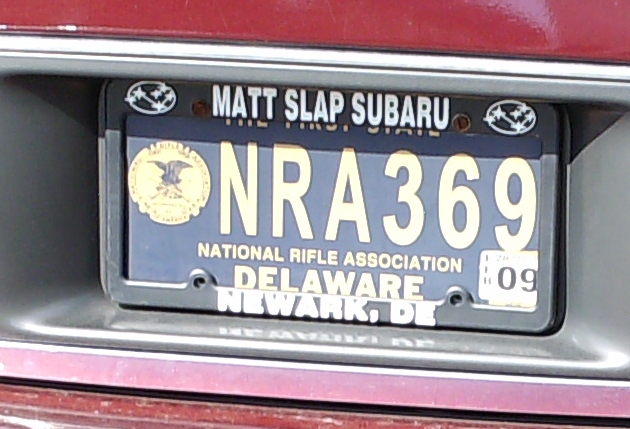
As you might expect, the bumper stickers at Gun Rights Policy Conference ranged from humorous to infuriating. This particular truck had a collection that I got a good laugh from, and I suspect that the driver and I would have gotten along quite well!


Click to enlarge


While I don't have a picture that came out well, I saw a rather surprising specialty license plate issued by the state of Indiana that I am surprised hasn't generated an ACLU lawsuit yet: "In God We Trust."

While not likely to produce a lawsuit from ACLU, I was slightly surprised to see this specialty plate:


Click to enlarge

Friday, August 31, 2007

Imagine if the University of Michigan Were Building Christian Chapels...

Here we have an example of a public school spending money on a facility that is only for members of one religion. While it is conceivable that a non-Muslim might use these footwashing areas, it is unlikely. From the August 29, 2007 Washington Times:
DEARBORN, Mich. — Plans to construct two foot-washing stations continue at the University of Michigan at Dearborn amid concerns that such action would constitute an establishment of religion by the public university.

The 8,700-student school near Detroit, which begins fall classes Tuesday, came under criticism in June when it announced that it would spend about $25,000 on the two foot-washing areas that were requested as an accommodation by a Muslim Student Association's task force. The foot baths come while the state is in a budget crisis and tuition and fees have risen at all of the state's public universities, up 7.9 percent at the Dearborn campus alone.

Data from a study of entering freshmen suggest that about 10 percent of students at the university are Muslim, and many have in the past used bathroom sinks for the foot washing, called an ablution, which Islam requires as a purity ritual before its five-times-daily prayers.

The cleansing practice prompted concerns from other students and administrators that it was not only unsanitary but also created a safety hazard by making the lavatory floors wet. The new foot-washing stations, built at ground level, are part of a renovation project at two locations on campus and will be paid for with money from the school's general fund.

The foot baths, while benefiting Muslim students, are open for use by all students and will be located in two new unisex bathrooms that will be renovated on campus.
I'm sure the ACLU has already filed suit for something that would be clearly an establishment of religion, if it was done on behalf of Christians:
So far, the school has not lost money from donors and, as far as he knows, no one has challenged the foot baths legally.
Oh. Where's the ACLU? Or does their commitment to "separation of church and state" not extend to "separation of mosque and state"?

Tuesday, July 3, 2007

Prayer Time in Public School

There's a public school that provides 15 minutes during class time for students to pray. Where's the ACLU? Oh yes, it's for Muslims, so the rules are different:
Carver Elementary in Oak Park added Arabic to its curriculum in September when it suddenly absorbed more than 100 students from a defunct charter school that had served mostly Somali Muslims.

After subbing at Carver, the teacher claimed that religious indoctrination was taking place and said that a school aide had led Muslim students in prayer.

An investigation by the San Diego Unified School District failed to substantiate the allegations. But critics continue to assail Carver for providing a 15-minute break in the classroom each afternoon to accommodate Muslim students who wish to pray. (Those who don't pray can read or write during that non-instructional time.)
I don't mind accommodating the religious beliefs of students--but I object to giving different treatment to some religions, and I especially object to treating Islam as legally superior to Christianity. You can make a strong case based on Founding Era statutes that the First Amendment's establishment clause was consistent with giving preference to Christianity (although not any particular denomination) over other religions and over non-belief. (This doesn't mean that we are required to do so today, but that there is nothing contrary to the Constitution in giving such preference.) But to give special preference for Islam is crazy.

Monday, June 25, 2007

Oh Horrors! Religious Imagery!

This decision by the U.S. Supreme Court involves the question of whether individual taxpayers may sue for violations of the religious establishment clause. As the Court's decision explains:
It has long been established,however,that the payment of taxes is generally not enough to establish standing to challenge an action taken by the Federal Government. In light of the size of the federal budget,it is a complete fiction to argue that an unconstitutional federal expenditure causes an individual federal taxpayer any measurable economic harm. And if every federal taxpayer could sue to challenge any Government expenditure, the federal courts would cease to function as courts of law and would be cast in the role of general complaint bureaus.
What was the specific complaint here? Did the government give special favored status to a particular church? Did they provide funding to a church to propagate the Gospel? No:
This is a lawsuit in which it was claimed that conferences held as part of the President ’s Faith-Based and Community Initiatives program violated the Establishment Clause of the First Amendment because, among other things, President Bush and former Secretary of Education Paige gave speeches that used “religious imagery” and praised the efficacy of faith-based programs in delivering social services.
Oh yes, clearly, the Framers would have strongly objected to the use of "religious imagery." To quote from the Second Contintental Congress:
The Congress, therefore, considering the warlike preparations of the British Ministry to subvert our invaluable rights and priviledges, and to reduce us by fire and sword, by the savages of the wilderness, and our own domestics, to the most abject and ignominious bondage: Desirous, at the same time, to have people of all ranks and degrees duly impressed with a solemn sense of God's superintending providence, and of their duty, devoutly to rely, in all their lawful enterprizes, on his aid and direction, Do earnestly recommend, that Friday, the Seventeenth day of May next, be observed by the said colonies as a day of humiliation, fasting, and prayer; that we may, with united hearts, confess and bewail our manifold sins and transgressions, and, by a sincere repentance and amendment of life, appease his righteous displeasure, and, through the merits and mediation of Jesus Christ, obtain his pardon and forgiveness; humbly imploring his assistance to frustrate the cruel purposes of our unnatural enemies; and by inclining their hearts to justice and benevolence, prevent the further effusion of kindred blood. [Journals of the Continental Congress, 1774-1789, Saturday, March 16, 1776, pp. 208-209]
Unsurprisingly, the left end of the Court, Justices Souter, Stevens, Ginsburg, and Breyer, disagreed, and managed to demonstrate their inability to read what they wrote:

We held in Flast, and repeated just last Term, that the “‘injury’ alleged in Establishment Clause challenges to federal spending ” is “the very ‘extract[ion] and spen[ding]’ of ‘tax money’ in aid of religion..” ... As the Court said in Flast, the importance of that type of injury has deep historical roots going back to the ideal of religious liberty in James Madison’s Memorial and Remonstrance Against Religious Assessments,that the government in a free society may not “force a citizen to contribute three pence only of his property for the support of any one establishment” of religion.
They seem to have missed something: Madison was writing against tax funding of establishments of religion:
Who does not see that the same authority which can establish Christianity, in exclusion of all other Religions, may establish with the same ease any particular sect of Christians, in exclusion of all other Sects? that the same authority which can force a citizen to contribute three pence only of his property for the support of any one establishment, may force him to conform to any other establishment in all cases whatsoever?
The use of religions imagery and praise for religiously based social programs is hardly funding of establishments of religion.

Even worse--even if the claim that this support of faith-based social programs (which liberals love if these programs are operated by say, the Urban League or the NAACP) is funding religion in some way were true, the dissenting opinion is historically wrong:
Here, there is no dispute that taxpayer money in identifiable amounts is funding conferences, and these are alleged to have the purpose of promoting religion. Cf. Doremus v. Board of Ed. of Hawthorne, 342 U.S.429, 434 (1952). The taxpayers therefore seek not to “extend” Flast, ante ,at 24 (plurality opinion), but merely to apply it. When executive agencies spend identifiable sums of tax money for religious purposes, no less than when Congress authorizes the same thing, taxpayers suffer injury.
As I point out here, early Congressional actions demonstrate that they didn't see the First Amendment as a barrier to direct federal support of religion--even funding religious establishments on a township by township level. Congress reserved section 29 of each township in Ohio for the support of religion. See American State Papers, House of Representatives, 11th Congress, 3rd Session, Public Lands: Volume 2, p. 220, document 187:
It appears to the committee, by the statement of the petitioners, that the third township of the eighth range in the Ohio Company's purchase is a fractional township, being intersected near the centre by the boundary line that separates the track purchased from the donation tract conveyed to the said company; that the said fractional township does not contain the section No. 29, set apart for the support of religion in the several townships in the said purchase, whereby the inhabitants are deprived of the benefit of the ministerial lands.
As late as 1833, you find Congressional bills that make reference to this, such as HR 653, 22nd Cong., 2nd sess.
To authorize the Legislature of the State of Ohio to sell the land reserved for the support of religion in the Ohio Company....
This seems to be the bill that created this, from Journal of the Senate of the United States of America, 1789-1873, December 30, 1801:
Mr. Tracy gave notice that he should, to-morrow, ask leave to bring in a bill to carry into effect the appropriations of lands in the purchase of the Ohio company, in the northwestern territory, for the support of schools and religion, and for other purposes.
From what I have read, each township would vote on which denomination was to receive the benefits of sales of land from section 29, so majority will, within the township, effectively created an establishment of religion.

Thursday, May 24, 2007

Get Out the Magnifying Glass! Someone Might Be Offended!

Adam Graham points to this demand that the incredibly tiny cross on a church on the Canyon County, Idaho seal must be removed:
Now, if you squint, you'll notice that a church with a cross on top depicted on the seal of one of Idaho's most religious counties. If you can't see the cross, get out a magnifying glass.
The Idaho Press-Tribune has the story of someone with too much time on his hands:
CANYON COUNTY — Canyon County’s official seal depicts a Christian cross on top of a church and steeple. And the religious symbol has drawn criticism from a Caldwell man and others who say it excludes people of other religious faiths and non-believers.

The county’s spokeswoman said the seal reflects the county’s values and that no one complained about the seal when officials presented it to the public and later adopted it in 2005.

County commissioners approved the new seal in November of that year, hoping it would represent modern-day Canyon County. The cross is too small to be visible in many uses of the seal, such as on county letterhead. But it is plainly visible on several larger seals displayed in the County Courthouse.

The seal depicts a scene with a river, hills, livestock, buildings and other items.

“To bring up religion at all is a violation of the Constitution,” Caldwell resident Randy Hooban said. “It’s the wrong mindset for government.”

...

Hooban noticed the Canyon County seal earlier this year at a Canyon County Democratic Central Committee meeting. He said he contacted the ACLU of Idaho in Boise about the seal and brought the issue up with Canyon County Commissioner Steve Rule.

Now, county attorneys are making sure they have their “ducks in a row,” spokeswoman Angie Sillonis said, in case they have to defend the seal. But she said the county has not heard from the ACLU.
Yes, count on a Democrat to make a mountain out of a molehill. I guess there's no other issues that might be a better use of his time.

If there was a naked woman on the seal, this idiot would be demanding that it stay there.

Thursday, January 12, 2006

What Causes ACLU Derangement Syndrome?

The positions that the ACLU takes.

About twenty years ago, I had a certain admiration for the ACLU. I didn't agree with everything that they did, but for the most part, they were still primarily a civil liberties union--defending individuals from governmental abuse of power. I was disappointed that they pretended the Second Amendment wasn't an individual right, but much of what they did, even on behalf of sleazy clients (such as the Skokie neo-Nazi march) represented clear examples of civil liberties being denied.

Now, there are people out there who make claims about the ACLU that turn out to be wrong. I've blogged in the past about claims that float around that don't seem credible--and that no one can provide evidence that shows the ACLU did these things.

But the ACLU has clearly lost its way--perhaps because they ran out of traditional civil liberties problems to pursue?

Like arguing that behavioral screening--looking for odd behavior, such as "heavy clothes on a hot day, loiterers without luggage, anyone observing security methods" is Constitutionally suspect. Let's see, they can't search based on race--that would be discriminatory. They can't search based on behavior--that might be racist.

They fight with every atom of breath to prevent the state from executing those convicted of murder--after a lengthy review of evidence, leaving no stone unturned to look for clear proof of guilt, has been completed--but they are prepared to sue to allow starving someone to death on the word of one person--her husband, who had a financial interest in seeing her die--while other relatives disputed his claim.

And complaining that students were boycotting classes to express disapproval.

And arguing in court that a provision of the Nebraska Constitution defining marriage is a "bill of attainder" and therefore unconstitutional. Even Professor Volokh, who described me as suffering from ACLU Derangement Syndrome, agreed that the ACLU's argument was wrong:
The court reasons that "Section 29 does not just withhold a benefit; it actually prohibits same-sex relationship couples from working to obtain governmental benefits" ("working" meaning "working effectively through the legislative process" -- obviously they can still work through proposing a constitutional amendment). But all constitutional constraints operate this way.
And a radio ad that they ran, attempting to rally opposition to an anti-terrorism data mining program by suggesting that this information would be provided to pizza delivery companies.

And the ACLU's concern about privacy? Whoops! It doesn't apply to their actions.

And the ACLU gets caught lying by Professor Orin Kerr (another member of the Volokh Conspiracy). And yet another example, again from Professor Kerr, where the ACLU puts out a deceptive press release--and the mainstream media just go ahead and run with it, not bothering to check for factual accuracy. (Gee, Professor Kerr calls the ACLU's statements deceptive at least twice--he must also be suffering from ACLU Derangement Syndrome.)

The ACLU believes in freedom of speech--unless you are a child who gives another child a pencil that says "Jesus loves little children." Here's the decision where a school district prohibited a child from handing out these pencils at a class party. And here's a case where the ACLU stepped in to protect a child from being disciplined for saying that he had two Mommies. Oh, and this kid wore a T-shirt to school calling Bush an international terrorist; the ACLU thinks that's protected free speech (which it is). Some forms of free speech are protected by the ACLU; others are not (and oddly enough, those are the Christians whose speech is not protected).

The ACLU used to argue privacy as a basis for striking down sodomy laws. I don't particularly buy the broad definition of "privacy," but that's at least plausible. But then, when the prosecution involves sex in a bookstore (hardly a place with an expectation of privacy), they argue that Lawrence strikes down the law:
The indictments issued July 21 followed a three-month investigation of public sodomy and solicitation to commit sodomy at an adult bookstore in Harrisonburg.

...

Kent Willis, executive director of the American Civil Liberties Union of Virginia, told the Roanoke Times, "Our interpretation is that any charges under the sodomy law are invalid at this point." Other misdemeanor charges were available to the police, he said, including lewd and lascivious cohabitation, obscene exhibitions and indecent exposure.

Dyana Mason, executive director of Equality Virginia, a homosexual rights organization, suggested that the indictments reflect the underlying discriminatory nature of the statute. "My concern [is] that this law can still be used to harass and intimidate gay men," she told the paper.
Oh yeah, it is definitely harassment and intimidation to expect them to go home to have anonymous sex.

The ACLU seems to think that there are no limits to freedom of speech--including displaying your penis on television while telling jokes. Ditto for live sex shows in Oregon.

The ACLU, for all its concern about "establishment of religion" violations, simply never took any action on something that is more clearly a violation than handing out pencils with Jesus's name on them--but because it benefitted non-Christians--well, that's okay.

And here's an example of something that is both a cultural and a religious event in a public school--rather like a creche in front of city hall is both cultural and religious--but you won't find the ACLU pursuing it. It isn't Christian, so it must be okay.

Here's another case that the ACLU should have pursued--special tax treatment for members of one church--the Church of Scientology. But they aren't Christians, and they are important in Hollywood, so I guess both the "establishment of religion" and "equal protection" clauses just disappear.

Convicted child molesters, for example. The ACLU has fought Megan's Law all over America, arguing that it violates the privacy of registered sex offenders. Cathy Seipp--who Professor Volokh hasn't accused of suffering from ACLU Derangement Syndrome--points out that the ACLU and its homosexual legislative allies in California have created a Catch-22 for landords:
Not only are California landlords banned from using the state's Megan's Law database to decline renting their properties to sex offenders, they're not even allowed to warn other tenants that these paroled criminals are now their neighbors. If they do the first, they can be fined $25,000 for housing discrimination. But if they don't do the second, they can be sued for failing to protect tenants against a known danger.
Freedom of conscience? Sorry, but homosexuality is more important. The ACLU filed suit--and won--against a printing company because they declined to print same-sex wedding announcements. And Professor Volokh is how I found out about this outrageous interference in the right of conscience.

The ACLU promotes lying--unless, of course, they are representing vampires. The plaintiff alleges injury caused by the sight of a cross:
Buono is deeply offended by the cross display on public land in an area that is not open to others to put up whatever symbols they choose. A practicing Roman Catholic, Buono does not find a cross itself objectionable, but stated that the presence of the cross is objectionable to him as a religious symbol because it rests on federal land.
While not an ACLU case, it reminds me of the claim of "physical pain" caused by seeing the Ten Commandments in a public park--and the morons that sit on the bench accepted this obvious perjury, and ruled in her favor.

I could go on for many more pages. The ACLU's own actions cause "ACLU Derangement Syndrome." Arguing that minors have a "due process liberty interest" in sex with adults--when an adult (with previous convictions for this) was being prosecuted for pursuing sex with a 14 year old who said to stop. Defending NAMBLA in a civil suit by the parents of a little boy who NAMBLA members raped and murdered. These are the reminders of what an evil and hypocritical organization the ACLU--a group with a proud past--has become. Those who defend the ACLU must either be blind to ACLU's dishonesty and evil, or have decided that they can live with it, as long as they the age of consent laws abolished, freedom of association abolished (at least for the Boy Scouts), and detestable groups like NAMBLA free to give detailed instructions on the raping of children.

UPDATE: I've replaced a link to Orin Kerr castigating a Slate columnist with another case of the ACLU engaging in deceptive press releases. Just so that those with reading disabilities understand me: there are a number of cases above where the ACLU, if they were still in the civil liberties business, would have at least filed a brief--such as the pencil case. If you want to argue that they don't have the resources to be involved in every case, well, I can believe that. But they have the resources not just to file a brief in the Curley suit against NAMBLA--they are actively defending NAMBLA. The pencil case involved two different protections of the First Amendment: freedom of speech and freedom of religious exercise. The NAMBLA case involves what is, at best, an extreme edge of legal free speech--and yet ACLU finds the resources for this.