Monday, January 21, 2008

The Mirror Cell Is In The Tube

The Mirror Cell Is In The Tube

After repeatedly running the base plate through the sander, the mirror cell now slides into the tube. It is a tight fit--but not so tight that I can't loosen the bolts in the flanges and slide the entire mirror cell back and forth.


Click to enlarge


I took off only as much of the base plate as I needed to barely fit into the tube. For that reason, the tube, which was delivered somewhat out of round, is now close enough to round for my purposes.

Unfortunately, I can't use the same trick for the upper tube assembly. The spider legs were designed to be light, and to hold the diagonal mirror holder in position under tension. But because the upper tube assembly is so far out of round (even more so than the lower tube assembly), I don't have any easy way to get the diagonal mirror holder exactly centered using the tensioned legs approach.

I am thinking of replacing the .050" carbon steel legs with something a bit thicker and stiffer--perhaps .100" carbon steel. These might be stiff enough to actually force the tube walls closer to circular. In this case, they aren't held in tension, but add rigidity to the upper tube assembly.

I wish that there was some way to force the upper tube to be round, but the aluminum is just stiff enough that while I can bend it to round, it won't stay there once I remove the clamp. I can't imagine a technique for applying that force that won't obstruct the diameter. I thought about applying an epoxy coat to the outside of the tube, while I have it clamped to round--but once the clamp comes off, I expect the tube's desire to return to its natural state will crack the epoxy.

Where The "Bear Arms" Paper Went

I mentioned a couple of days ago that "What Does Bear Arms Imply?" had been accepted by a law review you might have even heard of, but we were holding the name until we had this nailed down. It is now nailed down. Georgetown Journal of Law & Public Policy will be publishing it.

Attorney's Fees & Idaho S.1283

One area of civil litigation that I think is terribly destructive is that, unlike Britain, we do not have a consistent "loser pays" rule about attorney fees. What this means is that if Ms. A sues Mr. B for $500,000,000 because Mr. B said something that hurt Ms. A's feelings, Mr. B will spend thousands of dollars on an attorney to defend a suit that has no merit. Even if the judge looks at the evidence, and decides that Ms. A had absolutely no legitimate basis for the suit, Mr. B is out his attorney's fees. In theory, judges have the authority to order Ms. A to pay Mr. B's fees if it is apparent that there was no legitimate basis for the suit, but in practice, it isn't all that common.

Let me tell you a little story. Back in the late 1970s, my friend Eric and I jointly owned a 1973 Chevrolet Caprice station wagon, which we used for transporting furniture on those occasions when either of us moved. We lent the station wagon to Eric's brother Allan one day.

So Allan is driving down the street somewhere in Los Angeles, and ahead of him, he sees a Ford Mustang smash into a streetlight post. Allan comes to a stop, slightly tapping the Mustang's bumper. The driver of the Mustang is taken to the hospital by ambulance, where she is DOA.

The police officer investigating the crash puts in the police report that the Mustang was a one car accident--that Allan crashed our station wagon into the Mustang after it had already come to a complete stop, and the collision was so slow that there was no damage to either the station wagon or the Mustang from it. The autopsy on the Mustang driver shows that she had a .23% blood alcohol level; only an idiot would fail to see that she probably passed out at the wheel.

So, about six months later, the driver's father-in-law files suit on behalf of the driver's husband. (Father-in-law and husband are both attorneys, of course.) The suit demands $15,000 in damages from Allan (he was driving), myself and Eric (we owned the car), and 20 other people who were either driving cars, or owned cars, that were in the intersection, claiming that we "jointly and severally conspired" to force the Mustang into the post, thus causing the driver's death.

The complaint itself was embarrassingly bad: not just typos, but consistent misspellings, sentence fragments, and so on. Pretty obviously, the California Bar Exam couldn't be that difficult, or perhaps they gave special treatment to these lawyers because English wasn't their native language.

So I take this over to my insurance company, and ask them what they are going to do about it. I was outraged that such an obvious attempt at extortion had been filed. My insurance agent got back to me a few days later and said, "Ordinarily, we'll settle a suit like this for $500 just to make it go away, because it costs us too much to go and litigate it, but this is probably the most ridiculous suit our lawyers have seen this year, so we're probably going to fight it."

Probably? Suits like this that are extortion under color of law. There was simply no legitimate reason for this suit, and even if the grieving husband didn't want to see that the cause of the accident was that his wife was so drunk that she probably passed out, the lawyer who filed the suit should have refused to file it. The cost to my insurance company of going to court was high enough--and the judge was simply not going to impose any penalty on the plaintiff, by requiring him to pay the attorney's fees--that the lawyer had no incentive to tell the husband, "I'm not going to do this." After all: maybe the insurance company would be willing to settle for $500 out of court.

I recognize that a strict application of "loser pays" would prevent many legitimate suits from being filed, especially where the plaintiff is poor, and the defendant has deep pockets. But there does seem to be a point where a suit is so absurd that judges should impose "loser pays" as a way to discourage such suits. Pretty clearly, this suit in which I was a victim demonstrates that there were no penalties for filing absurd lawsuits in Los Angeles at the time. Some of the lawsuits that I have seen filed over the years (such as a multibillion dollar suit against International House of Pancakes by an irate customer who couldn't get the advertised special served to her) tell me that the problem hasn't been fixed.

Now, Idaho's legislature is considering a revision to our state law. The bill is S.1283, and it adds one line to the current statute that lists the available remedies for employment discrimination:
(f) An order for reasonable attorney's fees.
Why is anyone proposing to add this? Well, last year, the Idaho Supreme Court ruled in Stout v. Key Training Corporation, 144 Idaho 195, 158 P.3d 971 (2007) that even though federal law provides for someone who wins a suit for unlawful employment discrimination to receive "reasonable attorney's fees" (are there such things?), Idaho law does not have any specific provision granting this.

I don't know what the merits of the underlying suit were. Stout claimed discrimination because she got pregnant. The defendant, Key Training Corporation, apparently trains linemen--and I can see how someone might foolishly have thought that it was a bad idea to have a pregnant woman up on top of high voltage lines.

Regardless of the merits of the case, I can see why Stout, having won the case, thought that she should receive attorney's fees. I actually don't have a problem with this change in the law--but I'm a bit funny in one respect--I think that the law should apply equally on both sides. The way that I read the statute that S.1283 would change, the plaintiff is entitled to "reasonable attorney's fees" if he wins, but the defendant isn't entitled to "reasonable attorney's fees" if he wins.

I can support S.1283 if the winner, on either side, gets to collect attorney's fees from the loser. I can't support something this one-sided, because it creates an incentive to file discrimination suits, with no costs to the plaintiff for questionable or even completely bogus claims.

Sunday, January 20, 2008

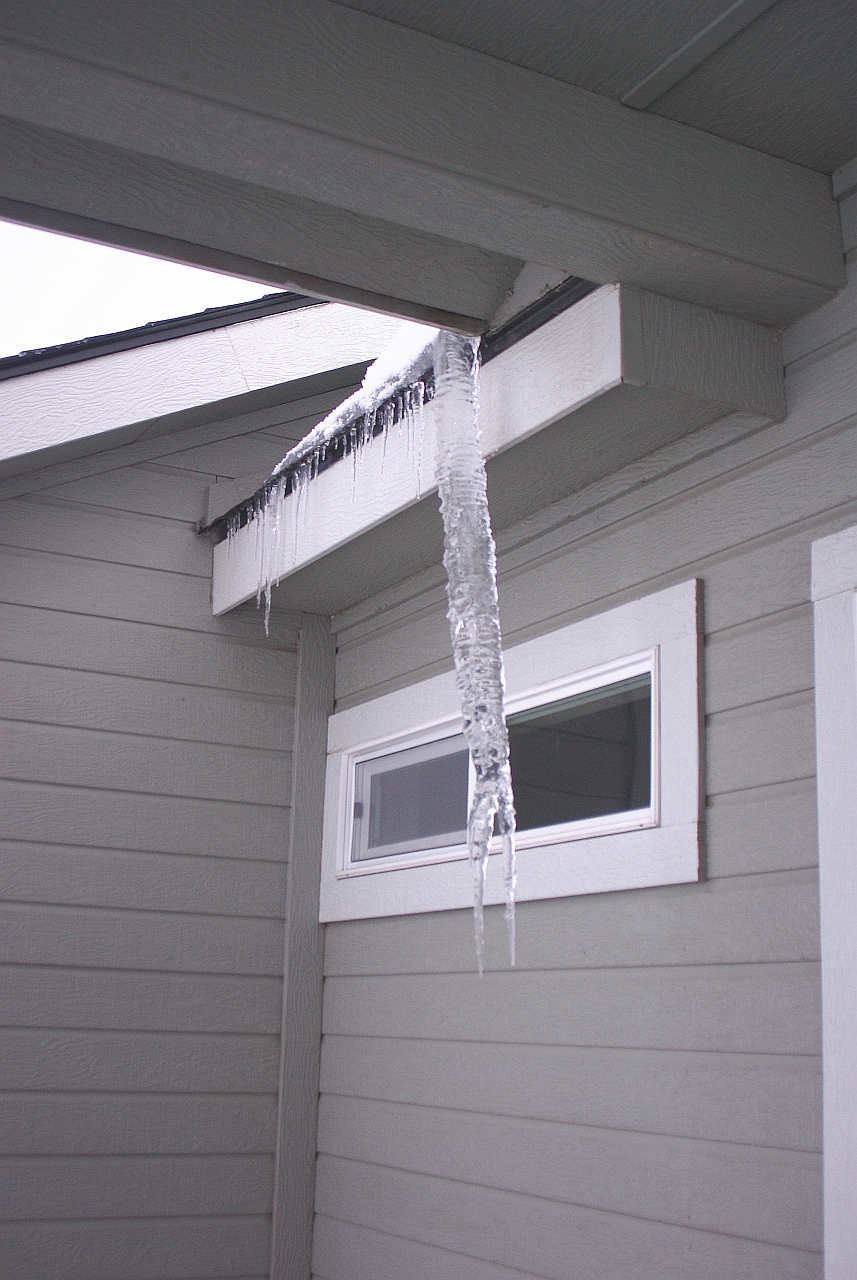
Icicles So Big You Can Use Them As Swords!

Icicles So Big You Can Use Them As Swords!

This is a harsh winter--and these icicles hanging off the roof and the table of the back porch are pretty astonishing:


Click to enlarge


Click to enlarge

Saturday, January 19, 2008

Forthcoming Papers

Forthcoming Papers

The paper "Pistols, Crime, and Public Safety in Early America" has been accepted by the Willamette Law Review, so it is now available to cite as forthcoming.

The other paper "What Does Bear Arms Imply?" has also been accepted by a law review that you may have actually heard of, but I'm waiting until Sunday when my co-author Professor Joe Olson tells me that it is safe to announce. We actually turned down a higher prestige law review that suggested a bunch of actually pretty good improvements (although nothing that changed the fundamental nature of the paper)--but more than we have time to do within the constraints the Heller case is putting on us.

Second Snowiest Winter Ever in Madison, Wisconsin

Second Snowiest Winter Ever in Madison, Wisconsin

At least, that's what this article from the January 16, 2008 Salt Lake City Tribune says:
After the second snowiest December on record in the state capital - and with temperatures hovering around 20 degrees Tuesday - the Legislature abolished a statewide ban on heated sidewalks, stairs, entrances and pedestrian walkways.

The bill, which cleared the state Assembly in October and was approved unanimously Tuesday by the state Senate, overturns a law passed in 1980s in response to the energy crisis of the 1970s. Wisconsin is the only state that had such a prohibition in the books.
Gee, how liberal they were!

Friday, January 18, 2008

Global Warming Again

In Siberia:

Moscow, Russia (AHN) - Russians are bracing for temperatures of as low as minus 55 degrees Celsius (minus 67 degrees Fahrenheit) in Siberia as Russia's emergencies ministry warns on Wednesday of its impending dangers in the coming weeks.
Government agencies were placed on high alert, reports AFP. The ministry ordered local administration officials to prepare for the extreme chill expected to last until Jan. 21.
The ministry warned that the unusually cold weather could kill, cause frost-bite, conk heaters and cut electricity to homes, disrupt transport, increase the rate of car accidents and even destroy buildings across Siberia.
The freezing temperatures have already caused overloading of electricity grids and power interruptions in the regions of Irkutsk and Tomsk because of overused heaters in homes. Two people have already died and more than 30 others hospitalized with forst-bite in Irkutsk, reports AFP citing state media.
Bloomberg reports that worst hit will be the Siberian region of Evenkiya, while neighbor Georgia, whose climate is subtropical, already plunged to as low as minus 35 degrees Celsius. Lake Paliastomi in the western Georgia froze for the first time in 50 years, reports Rustavi-2 television.
Average temperatures in large Siberian cities in January usually range between minus 15 degrees Celsius and minus 39 degrees Celsius, according to data from weatherbase.com. Schools have been closed down in at least four regions because of the cold.

In Cyprus (you know, that island nation in the Mediterranean):
Plummeting temperatures and cold blasts of wind mean few will escape the cold in Cyprus this weekend.

The Met Office have forecast temperatures of 0oC again in Nicosia tonight and -6oC in the mountains.

The cold weather front is blowing in from Siberia.

Frost is forecast inland and on the coasts and there is a chance of snow in the Troodos mountains.

The resorts of Ayia Napa and Protaras will feel unusually cold temperatures tonight with the mercury hitting just 2oC.
In New Mexico:

This week's frigidly cold temperatures — well below freezing and dipping below zero with wind chill factored in — are cause for plenty of teeth-chattering concern for local residents.
Don't forget during the next few days to bundle yourself and your children in layers, keep hats and gloves handy and bring pets in at night.
It's cold, and it's going to stay that way for a few days.
"It's not unusual, but we will come close to record temperatures," said National Weather Service Senior Meteorologist Dan Porter from the Albuquerque office. "People here are sure not used to below-zero temperatures."
Porter predicted that Wednesday night would be the coldest of this latest freeze, predicting overnight air temperatures from 0 to 5 degrees, dipping to minus 5 to minus 10 degrees with the wind chill.
And a few days ago in Bulgaria:
Recent heavy snowfalls and temperatures as low as minus 30 degrees Celsius claimed yet another life in Bulgaria, taking the cold snap death toll up to seven.

...

Record-low temperatures were recorded in the Danubian Plain on Saturday, the mercury falling to minus 31.6 degrees Celsius in the town of Sevlievo, Central Bulgaria.

Several towns reported temperatures breaking the records set in 1993 - Knezha (minus 27 degrees Celsius), Veliko Turnovo (minus 20.2 degrees Celsius) and Lovech (minus 19.5 degrees Celsius).
UPDATE: Oh yeah--and it snowed in Baghdad recently for the first time in at least decades:
BAGHDAD -- The flakes melted quickly. But the smiles, wonder and excited story-swapping went on throughout the day: It snowed in Baghdad.

The morning flurry Friday was the first in memory in the heart of the Iraqi capital. Perhaps more significant, however, was the rare ripple of delight through a city snarled by army checkpoints, divided by concrete walls and ravaged by sectarian killings.

"For the first time in my life I saw a snow-rain like this falling in Baghdad," said Mohammed Abdul-Hussein, a 63-year-old retiree from the New Baghdad area.

"When I was young, I heard from my father that such rain had fallen in the early '40s on the outskirts of northern Baghdad," Abdul-Hussein said, referring to snow as a type of rain. "But snow falling in Baghdad in such a magnificent scene was beyond my imagination."