Rimfire Cartridges Just Aren't That Well Sealed
Over the years, the only problems I have had with factory ammo failing to fire have been .22 LR. One batch I had kept in the trunk of my car--and appears that they got wet. Yesterday, I took some friends out to familiarize them with handguns--and the only failures to fire were .22 LR in magazines that I sometimes carry in my pocket. About half the cartridges would not fire, even with repeated strikes. (The American Arms PX-22, being a PPK clone, has a double action trigger.)
I'm guessing that sweat from carrying them in my pocket had neutralized them. While this was a good drill for teaching my friends how to clear failures, it was a sobering reminder that any .22 LR pistol that you carry as a backup gun should be fired every month--so that you always have fresh ammunition in your gun.
There's a school of thought that says .25 ACP makes no sense, because it has about the same power as .22 LR, but costs 10x as much. The difference is that .25 ACP, being a centerfire cartridge, is probably much better sealed.
Showing posts with label gun technology. Show all posts
Showing posts with label gun technology. Show all posts
Sunday, May 16, 2010


Monday, May 3, 2010
British Sniper Takes Out Two Taliban From 8120 Feet
From the May 2, 2010 Daily Mail:
An army sniper has earned a place in military history by killing two Taliban machine gunners from more than a mile and a half away.
Craig Harrison's record breaking shots felled the insurgents with consecutive bullets - even though they were 3,200ft beyond the official range of his rifle.
The Household Cavalry veteran's kills from a distance of 8,120ft beat the previous record by 150ft.
He was using the British-built L115A3 Long Range Rifle, the Army's most powerful sniper weapon.
Read more: http://www.dailymail.co.uk/news/article-1270414/British-sniper-sets-new-sharpshooting-record-1-54-mile-double-Taliban-kill.html#ixzz0mvafsS4D
Sunday, June 21, 2009
Microstamping
Microstamping
One of the new hot stupid ideas is "microstamping": a change to the firing pin that puts a unique mark on ammunition that enables police to trace a gun based on the markings on the brass left at the scene of a crime. I've pointed out in the past that this won't do any good for:
1. Revolvers.
2. Semiautos with brass catchers.
3. Stolen guns.
4. Guns so old that they were made before microstamping.
5. Guns intentionally altered so that the microstamping marks have been damaged.
6. Guns that get fired a lot--because the microstamping part will eventually wear. (It might take a while, of course.)
Along with all these problems, Arizona Rifleman reminds you exactly how easy it is to replace a Glock's firing pin (which contains the microstamping part). It's a very short video. (Other handguns aren't quite so quick.)
Of course, firing pins are astonishingly simple. Here's an example of an M1911 firing pin. I would expect that just about everyone with half a brain, not too much conscience, and a lathe would be machining replacement firing pins (not called that, of course, but "unique metal doodads") in short order for the criminal trade. My guess is that it would take me about three hours to get really good at machining these, and once I did, it would take about ten minutes, maximum, even with my little Sherline, to make one of these.

Saturday, April 11, 2009
Some Surprises At The Gun Show Today
Some Surprises At The Gun Show Today
I used to attend gun shows with some regularity, long, long ago. Not so much the last ten years. This is the first one that I have attended since Gun Salesman of the Year was elected--and what a change! There was actually a line to get in--and the place was so busy that it was difficult to get through the aisles without bumping into people. Ammunition was far more expensive than I remember it, from the last time that I was buying any large quantities.
One of the surprises is that I have always assumed that not terribly many people read this blog, since the SiteMeter down in the lower left corner suggests that I only get about 1000-1100 readers a day, worldwide. Yet an employee of the gun shop running the food drive/rifle raffle I mentioned a couple of weeks back, tells me that after I mentioned this on my blog, he estimated that about half a ton of food was donated by people identifying me as the source of their knowledge that Alpha Omega was doing this.
There has long been some question as to how accurately SiteMeter measures hits--with some reason to think that it underestimates low end operations, and overestimates high end operations. If my single mention of a rifle raffle can cause half a ton of food to be donated here in the Boise area, this suggests to me that I'm getting a lot more than 1100 readers a day worldwide. Wow! Thanks! (I must learn to use my power for good, not for evil!)
Another nice aspect to visiting a gun show is that you get a chance to look at a wider range of optics than you might find in a single gun store--or even several gun stores. I looked through the Barska 6-24x50mm scope--and I'm afraid that I wasn't impressed with the crispness of the image above about 20x. (Admittedly, as magnification goes up, the minimum distance that you can focus on declines--but even looking outside I wasn't impressed.)
I also had a chance to look through the Eagle Eye scopes, which if I believe this, use Czech made optics (although it doesn't say where the rest of the riflescope is made). One of them was a 10-40x50mm. Yes, that's right: 40 magnification, and while not as crisp at 40x as it was at 10x, it was still pretty surprising how good it was.
I also looked through some NCStar riflescopes--and one of the tactical scopes, a 6-24x50mm almost made me cough up the money (it was $160). The optics were really impressively sharp, even at the maximum power. Unfortunately, the dealer didn't have the 4-16x50mm in stock.
I had a chance to talk to someone with some knowledge of how the different scopes are made, and more importantly, who wasn't trying to sell me anything. He told me that many riflescopes use a screw and a spring to position the reticle. The screw moves the recticle in tension against the spring. The very best riflescopes, such as the Zeiss and Leupold, use two screws, apparently moving together, and are therefore much more repeatable. I confess, it has been long enough since I shot a rifle that I may not yet be a position to need optics that well made!
Monday, March 23, 2009
More Proof That Knuckle Dragging Gun Nuts Are Smarter Than California Legislators
More Proof That Knuckle Dragging Gun Nuts Are Smarter Than California Legislators
I mentioned the new American made copy of the Steyr AUG; a reader tells me that he saw a couple of them offered for sale at a gun show in California. What? How could that be? To original California assault weapons law adopted in 1989 was defective because it banned most guns not by function, but by name and model. As a result, there was a series of revisions to the law in the 1990s as gun makers made trivial changes to the guns that did not affect functionality--and ended up with guns that were exempt from the ban. The last set of revisions apparently sought to ban guns based on functional characteristics--such as a detachable magazine. This is what California should have done in the first place, if the functional characteristics of the assault weapons were actually a problem, but that would have banned milions of guns that Californians--and some California legislators--owned, such as the Ruger 10/22, the Ruger Mini-14, the Auto-Ordnance M1A1 (the semiauto version of the Tommy Gun).
And what defines "detachable magazine"? One that can be removed without a tool. If there's a button you push, that's a detachable magazine. If you have to use a screwdriver, or even the tip of a bullet to do so, it's not a detachable magazine.
So:
UPDATE: A reader gave me this update, with some warnings to avoid falling afoul of this incredibly stupid law:
I mentioned the new American made copy of the Steyr AUG; a reader tells me that he saw a couple of them offered for sale at a gun show in California. What? How could that be? To original California assault weapons law adopted in 1989 was defective because it banned most guns not by function, but by name and model. As a result, there was a series of revisions to the law in the 1990s as gun makers made trivial changes to the guns that did not affect functionality--and ended up with guns that were exempt from the ban. The last set of revisions apparently sought to ban guns based on functional characteristics--such as a detachable magazine. This is what California should have done in the first place, if the functional characteristics of the assault weapons were actually a problem, but that would have banned milions of guns that Californians--and some California legislators--owned, such as the Ruger 10/22, the Ruger Mini-14, the Auto-Ordnance M1A1 (the semiauto version of the Tommy Gun).
And what defines "detachable magazine"? One that can be removed without a tool. If there's a button you push, that's a detachable magazine. If you have to use a screwdriver, or even the tip of a bullet to do so, it's not a detachable magazine.
So:
Now, here’s the good news: a commonly-accepted definition of a “detachable” magazine is one that can be removed without a tool. And…a tool can be almost anything, even a cartridge for the gun. Enter the Bullet Button from Prince Industries (no web site), a clever invention that honors the law while preserving most of the convenience of a detachable magazine.Apparently AR-15s, Steyr AUG clones, and a variety of other weapons are now being sold in California with this alteration--and thus not violating the California Assault Weapons Control Act. And not surprisingly, it isn't terribly difficult to replace this with the standard parts on short order.
The Bullet Button is just a few small parts that alter the behavior of the magazine release. Parts 1, 2 and 3 in the photo make up the Bullet Button. Part 3 fits inside part 2. Part 4 is the magazine release that comes with an AR-15 parts kit. Parts 5 and 6 are the standard magazine release spring and button; these can be discarded after installation of the Bullet Button.
UPDATE: A reader gave me this update, with some warnings to avoid falling afoul of this incredibly stupid law:
I use these when assembling AR’s with an off-list lower. But, and this is a big but, you must use a magazine that holds no more than 10-rounds.
Here is the relevant provision of the AW Ban.....
Generic Characteristics Defining Assault Weapons:
12276.1 (a) Notwithstanding Penal Code section 12276, “assault weapon” shall also mean the following:
Rifles
(1) A semiautomatic, centerfire rifle that has the capacity to accept a detachable magazine and any one of
the following:
(A) A pistol grip that protrudes conspicuously beneath the action of the weapon.
(B) A thumbhole stock.
(C) A folding or telescoping stock.
(D) A grenade launcher or flare launcher.
(E) A flash suppressor.
(F) A forward pistol grip.
(2) A semiautomatic, centerfire rifle that has a fixed magazine with the capacity to accept more than 10
rounds.
(3) A semiautomatic, centerfire rifle that has an overall length of less than 30 inches.
The controlling clause for off-list weapons utilizing a bullet-button is PC 12276.1(a)(2).
By restricting the fixed magazine to 10-rounds or less, all other characteristics are free; ie, you can have a pistol grip, a thumbhole stock, a telescoping stock, a flash suppressor (I skipped grenade launcher – I wouldn’t want to challenge them on that), and a forward pistol grip.
The key is the fixed, 10-round magazine.
The catch-22 though is, if you remove that magazine, you then have a rifle capable of accepting high-capacity magazines; therefore, an AW. People at public ranges have been busted for this when they removed the magazine to reload, instead of breaking open the AR, and refilling the magazine while it is fixed in the lower receiver. People need to be very careful when they are around people they don’t know.
Saturday, March 21, 2009
The American Steyr AUG
The American Steyr AUG
The Steyr AUG is one of those rifles that looks like something out Star Wars.

And it wasn't just futuristic looking; it was a very clever, very forward looking battle rifle--and one that was extremely compact: only 27" long with a 16" barrel. It turns out that very, very few of them were ever imported into the United States, and at least partly because they were incredibly expensive. This didn't prevent California from including it on the 1989 Roberti-Roos Assault Weapons Control Act list of banned weapons. It is hard to imagine that there had ever been a criminal misuse of one at the time. Since President Bush banned them from import at about that same time, I would even more surprised if there had been any subsequent criminal misuses.
Still, the design was so cool that filmmakers couldn't resist it. I recall seeing one film in which a sniper uses a Steyr AUG because the barrel is easily removed, making the whole package even more compact--enough to fit into a briefcase.
Well, the patents underlying the AUG finally expired--and an American company, Microtech Small Arms Research, is building a somewhat modified version called the STG-556. Peter Kokalis has a review of it in the March 20, 2009 Shotgun News. Among other interesting aspects of it: a 0.6 minute of arc group at 100 meters with the 16" barrel. That's extraordinary for a battle rifle.
The price tag is, as you might expect, absurdly high: $1953.86. But if you are one of those people who always wanted a Steyr AUG for its unique design, and have that kind of money lying around with nothing better to do with it (like some of you AIG executives who are now getting death threats because Senator Dodd wanted to make sure that you weren't suffering), I can think of worse ways to spend it! Here's their website. And here it is being offered at what I guess is the dealer cost of $1645--and as you might expect, out of stock!
The Steyr AUG is one of those rifles that looks like something out Star Wars.
And it wasn't just futuristic looking; it was a very clever, very forward looking battle rifle--and one that was extremely compact: only 27" long with a 16" barrel. It turns out that very, very few of them were ever imported into the United States, and at least partly because they were incredibly expensive. This didn't prevent California from including it on the 1989 Roberti-Roos Assault Weapons Control Act list of banned weapons. It is hard to imagine that there had ever been a criminal misuse of one at the time. Since President Bush banned them from import at about that same time, I would even more surprised if there had been any subsequent criminal misuses.
Still, the design was so cool that filmmakers couldn't resist it. I recall seeing one film in which a sniper uses a Steyr AUG because the barrel is easily removed, making the whole package even more compact--enough to fit into a briefcase.
Well, the patents underlying the AUG finally expired--and an American company, Microtech Small Arms Research, is building a somewhat modified version called the STG-556. Peter Kokalis has a review of it in the March 20, 2009 Shotgun News. Among other interesting aspects of it: a 0.6 minute of arc group at 100 meters with the 16" barrel. That's extraordinary for a battle rifle.
The price tag is, as you might expect, absurdly high: $1953.86. But if you are one of those people who always wanted a Steyr AUG for its unique design, and have that kind of money lying around with nothing better to do with it (like some of you AIG executives who are now getting death threats because Senator Dodd wanted to make sure that you weren't suffering), I can think of worse ways to spend it! Here's their website. And here it is being offered at what I guess is the dealer cost of $1645--and as you might expect, out of stock!
Saturday, December 6, 2008
"You Obviously Watched Goldfinger At An Impressionable Age"
"You Obviously Watched Goldfinger At An Impressionable Age"
A flashlight that turns into a submachine gun, Transformer-style.
A flashlight that turns into a submachine gun, Transformer-style.
Wednesday, December 3, 2008
Can I Get a Prescription For That?
Can I Get a Prescription For That?
And how many refills? Certain gun control crazies have long argued that violence should be considered a medical problem, and treated like one. So will their brains explode when they see this new gadget that FDA has approved as a medical assistance device? Medgadget tells us:
And how many refills? Certain gun control crazies have long argued that violence should be considered a medical problem, and treated like one. So will their brains explode when they see this new gadget that FDA has approved as a medical assistance device? Medgadget tells us:
We recently reported about a new 9mm handgun that was designed for folks suffering from arthritis and other disabilities affecting the hands. Constitution Arms, the manufacturer of the firearm, is reporting that the FDA has formally designated the gun as a medical gadget.Many years ago, I had a friend with severe arthritis in his hands--enough so that he couldn't operate a Colt Government Model without extensive modifications to the operating controls. I suspect that he was not alone!
Sunday, April 13, 2008
Guess Who's Coming To Dinner?
Guess Who's Coming To Dinner?
The only friend that I have who has a history degree brought his full auto Tommie gun over for dinner this evening. Contrary to the bad reputation that they have for being uncontrollable, it was actually quite pleasant. Firing three to four shot bursts was very easy, and easy to keep on target. Recoil was very pleasant. Even holding the trigger back with the 30 round stick magazines was not a problem--very controllable. Only when firing long bursts with the 50 round drum magazine did I find it starting to climb. I can see (along with the reliability issues) why World War II soldiers preferred the stick magazines over the drums.
My other submachine gun experiences have been an M-11 (an evil, hard to control little beast), an Uzi (maybe comparable to the Thompson, or a little easier to control), and an H&K MP5 (which was definitely easier to control than the Thompson--although not by as much as I expected).
Considering the Thompson is firing a somewhat more powerful cartridge and a heavier bullet--and it is far older design--it is surprisingly effective.
Wednesday, March 5, 2008
Exploded Diagrams Are So Twentieth Century
Exploded Diagrams Are So Twentieth Century
Unless you are putting together a M1911 pistol from individual parts, this isn't very useful--but it is so cool, I just had to share it with you. Now, as long as no one does the same for hydrogen bombs, I guess we're okay.
Unless you are putting together a M1911 pistol from individual parts, this isn't very useful--but it is so cool, I just had to share it with you. Now, as long as no one does the same for hydrogen bombs, I guess we're okay.
Monday, February 25, 2008
That Dirty Harry Line
That Dirty Harry Line
Remember the line in Dirty Harry where Sgt. Callahan tells the punk that he's holding a Smith & Wesson .44 Magnum--the most powerful handgun in the world? Well, since then, more powerful handguns have been made--but even they don't really compare with this gem, the Pfeifer-Zeliska .600 Nitro Express Magnum, made in Austria.
The video of it being fired is one of those reminders that there times that engineers come up with solutions to problems that do not yet exist. I suppose that there might be a need for this gun if rampaging elephants herds became a problem in urban areas. But other than that?
This is one of those guns that, if you were mounted on roller skates, would make a tremendously expensive and noisy method of getting yourself up to speed.
Monday, December 31, 2007
Early Repeating Firearms
Early Repeating Firearms
I am astonished at the number of repeating, magazine-fed firearms--sometimes repeating handguns--that appear in the 17th and 18th centuries. Yes, even in the era of flintlocks, there are people making handguns with rotating barrels, and one that is clever enough to automatically load the priming pan with gunpowder when the barrel rotates into position to fire.
These were probably devilishly hard to make, and perhaps not very reliable, but it does show that lots of clever people were working the problem--and apparently with some success--more than a century before Samuel Colt--and more than a century before the Second Amendment.
Monday, September 10, 2007
The First Environmentalists & the .50 BMG
The First Environmentalists & the .50 BMG
There's a strong tendency in environmentalist circles to imagine the Indians as the first environmentalists, living in harmony with nature. It isn't true. The Indians of what is now the U.S. didn't get a chance to destroy their environment (except for the really big herbivores that disappeared about the same time the Indians arrived), because they lived at a very, very low technology level, and there weren't many of them here.
I used to joke that I wasn't quite sure what the civilian need for rifles chambered in .50 BMG was--"in case blue whales come back on land?" For that reason, I find this item over at Snowflakes in Hell about how the Makah tribe hunts whales with a .50 BMG rifle quite amusing. It turns out that this wasn't a casual decision:
The Tribe was interested in substituting the traditional killing lance for a large calbier rifle both to eliminate a prolonged pursuit and because the use of the killing lance would be considered inhumane by modern standards. The Tribe contracted a veterinarian with a background in ballistics and together investigated the performance of several high caliber firearms including the Winchester.458 Magnum, the Weatherby .460 Magnum, the .50BMG, and the .577 A-Square Tyrannosaur. The Tribe found that all of these weapons to be adequate, but the .50BMG and .577 A-Square Tyrannosaur to be the most potent combination. The .577 A-Square Tyrannosaur was selected for the 1999 hunt since it was a substantially lighter rifle (14 pounds versus 20 pounds for a .50BMG) and because it had a 3-round capacity (one cartridge in the chamber, two cartridges in the magazine) compared to the single-shot .50BMG caliber configurations which were tested.What in the world is a ".577 A-Square Tyrannosaur" cartridge? Has someone been watching Jurassic Park too many times?
Terry Wieland’s On AmmoUPDATE: A reader tells me:
The .577 Tyrannosaur: A-Square’s Behemoth Fills A Need. Sort Of.
The .577 Tyrannosaur is not one of the classic nitro-express cartridges. In fact, designed in 1993, it is barely a dozen years old. It was created by Art Alphin, then-owner of A-Square, at the specific request of some of his Zimbabwean professional-hunter friends.
Although only a few score Tyrannosaur rifles have been made in that time, the cartridge is worthy of attention for several reasons:
First, it delivers power like very few others and, second, it does so at a fraction the price of anything else in its class. Finally, it offers rifle-lovers of reasonable means the opportunity to play with one of the most interesting of all bullet diameters - the .577.
The original .577 Nitro Express is a rimmed cartridge that has been around for more than a century. One can still buy a .577 double rifle from H&H or Rigby, but it will cost big bucks, and used .577s also command a premium price. This is a problem for the PH of modest means whose work involves elephants, because the .577 NE is an elephant cartridge par excellence, renowned for its penetration and knockdown power.
As Art tells it, he was approached in 1993 by two Zimbabwe PHs who had experienced serious problems with elephants while armed with .458 Winchesters. They wanted something bigger - much bigger. Could Art build his Hannibal dangerous-game rifle in .577 or even .600 NE?
I saw your post on rifle calibers for whale hunting, which reminded me of contemporary TV footage that showed the Makah tribe pursuing and finally killing a 30' grey whale in May of 1999.The September 9, 2007 Seattle Times confirms that there was a rifle hunt in 1999 by the Makah tribe of a gray whale.
Googling the event now showed the media coverage evidently had been cleaned up for posterity, the gruesome spectacle I remember showed a power boat running alongside, several 'braves' firing AK-47 style rifles into the whale, apparently over 300 [!] rounds of 7.62 x 39 were pumped into the whale's right side, while the power boat on the left had the harpoonist and the gunner with the .50 calibre rifle who finally finished the animal off.
Since none of 'whalers' had done this before, they did not realize the whale would sink when it died. When the .50 calibre gunner shot and killed it, it began to sink.
A fishing trawler was standing off, either fishing or watching this marine circus, he came in and used his derrick and a big net to prevent the dead whale from sinking.
The whale was towed to the beach and partially butchered, the tribe's people did not like the taste of the meat, and the rest of the dead whale and guts [quite a lot of it] were left on the beach.
The US government agents who financed and encouraged this, had to clean up the beach and haul the carcass of the dead whale out to sea and let it sink in deep water.
Our tax dollars at work!
Sunday, August 19, 2007
Gun Stuff
A friend brought over some of his toys this evening. I haven't shot a rifle in some years now (more by being too busy than anything else). One of them was a Century International Arms copy of the H&K 91. This uses a U.S. made receiver and a number of imported parts to get around the import ban on assault weapons that President George Bush I put in effect back in 1990. I've always heard very good things about the H&K 91, and it does seem to be a well-made rifle.
There are a few quirks of the design that I don't know if I dislike them because they are different from what I am used to in battle rifles, or because it is genuinely a poor idea. For example, the H&K 91 has what seems to me to be an excessively complex charging handle compared to the M1 Garand, M14, M16--just too many moving parts for something that is just forcing the bolt back against the recoil spring.
Another H&K quirk (at least until quite recently) is that there is no bolt hold open on the last shot. When you have fired the last shot from the magazine, the bolt closes again, and you get only a "click" when you pull the trigger. The owner called this the "dead man click," presumably because if you are in combat, and you hear this click, it tells you that you are out of ammunition, and whoever you are firing at now has you at a disadvantage. The design that I am more used to on combat weapons--where the magazine locks the bolts
open, enabling you to drop the magazine, insert a fresh magazine, release the bolt, and be ready to resume firing--seems much more logical to me.
Yet another H&K quirk is that it seems that you have to cock the bolt in order to remove an empty magazine. At the magazine release is a simple button--definitely more intuitive than an M14 magazine release.
The H&K 94 was a fun little weapon. Since it fires 9mm, the recoil isn't bad at all. I've fired the MP5, which is the full auto version of the H&K 94, and I think highly of it. All the same design quirks that bug me about the H&K 91 apply to the H&K 94 as well.
This is the first time that I have ever fired an M1 Garand. This is really a pretty impressive weapon, considering that it was introduced into service 70 years ago, and has been out of front line U.S. service for 50 years. I still can't get used to the spring clip flying up and out of the gun after the last shot!
Pretty Astonishing Video of an SUV With Minigun
I'm not sure what actual use something like this might have. Presidential motorcade? Only in a comic book, or North Korea.
I'm not sure what actual use something like this might have. Presidential motorcade? Only in a comic book, or North Korea.
Saturday, March 3, 2007
The U.S. Army's Ordnance Museum at Aberdeen Proving Grounds, Maryland
I stopped in there on my way from Philadelphia to Baltimore--and it was well worth the trip. Sorry about the picture quality--I was using the cheap Photosmart E427, and under low light conditions, when you aren't close enough for the flash to fully illuminate the target, the results are something a bit disappointing.
I would have to say that this is the dumbest idea in the history of warfare--the nuclear mortar.

Click to enlarge
Here's the explanatory display:

Click to enlarge
I just love the warning labels on the warhead:

Click to enlarge
Yes, I suppose that you would handle with care!
I think that I have mentioned the Liberator single shot pistol before--one of those ideas that sounds like something out of a gun nut fantasy--drop cheap, single shot pistols over France, and the Resistance will use them to kill a German soldier, take his rifle or submachine gun, and repeat.

Click to enlarge
In practice, it didn't work this way. The barrels weren't rifled, so they were very inaccurate, and the French Resistance was courageous--not stupid! It wasn't easy to get close enough to a single German soldier to kill him with one of these, and if there were two German soldiers, shooting the first just got you killed by the second, while you were frantically trying to reload.
Here's the infamously ugly M3 grease gun. These were made by GM's Guide Lamp Division during World War II because they were largely metal stampings--something that Guide Lamp Division knew how to do well.

Click to enlarge
It isn't apparent from the picture, but one of the barrels is the curved version, intended for shooting around corners, or from inside tanks without sticking your head up. I didn't realize until I saw this display that it wasn't just the Germans who came up with ideas this strange.
This picture looks like a bunch of older rifles, right?

Click to enlarge
Except in person, you can see that these are huge rifles, rather like the Barrett Light .50 of their day.

Click to enlarge
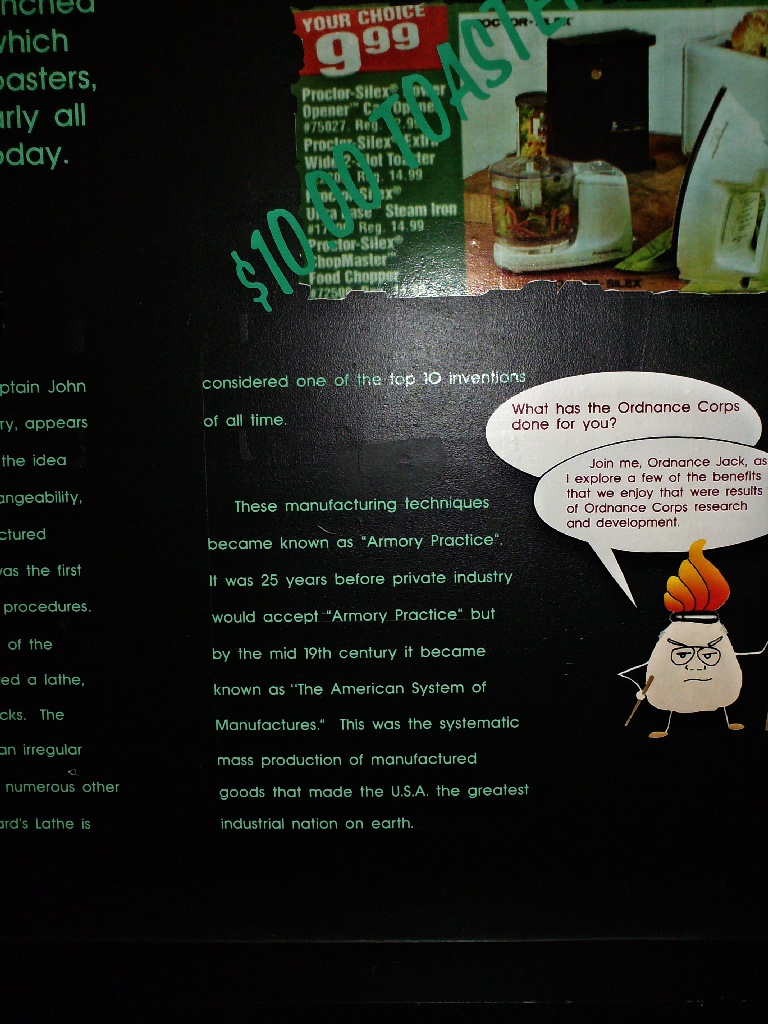
A point that doesn't get made enough is that the American System (as it was known in Britain, ironically, since we only improved on the British System) or sometimes the Armory Practice, plays a major part in creating the modern world of inexpensive, high quality mass produced stuff. I was pleased to see the Ordnance Museum display on this point:

Click to enlarge

Click to enlarge

Click to enlarge
Not quite as silly as the nuclear mortar, is the Atomic Cannon:

Click to enlarge
They have an astonishing number of tanks and similar armored vehicles outside in all directions, but it was cold, covered in snow, and in places, slippery with ice, so I didn't walk out there.

Click to enlarge

Click to enlarge
Oh, and here's the big brother to the Atomic Cannon, and it looks the part:

Click to enlarge
I stopped in there on my way from Philadelphia to Baltimore--and it was well worth the trip. Sorry about the picture quality--I was using the cheap Photosmart E427, and under low light conditions, when you aren't close enough for the flash to fully illuminate the target, the results are something a bit disappointing.
I would have to say that this is the dumbest idea in the history of warfare--the nuclear mortar.

Click to enlarge
Here's the explanatory display:
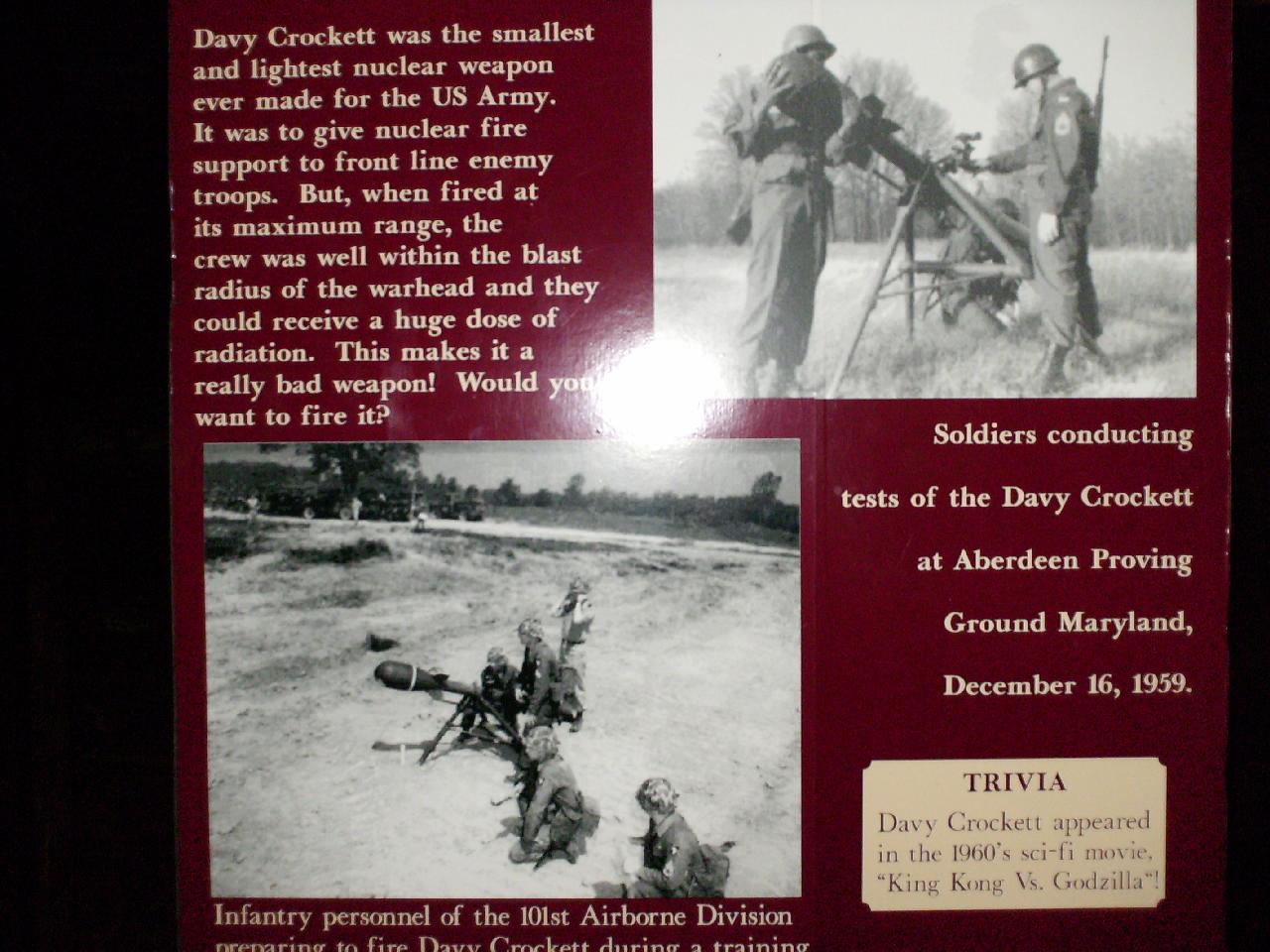
Click to enlarge
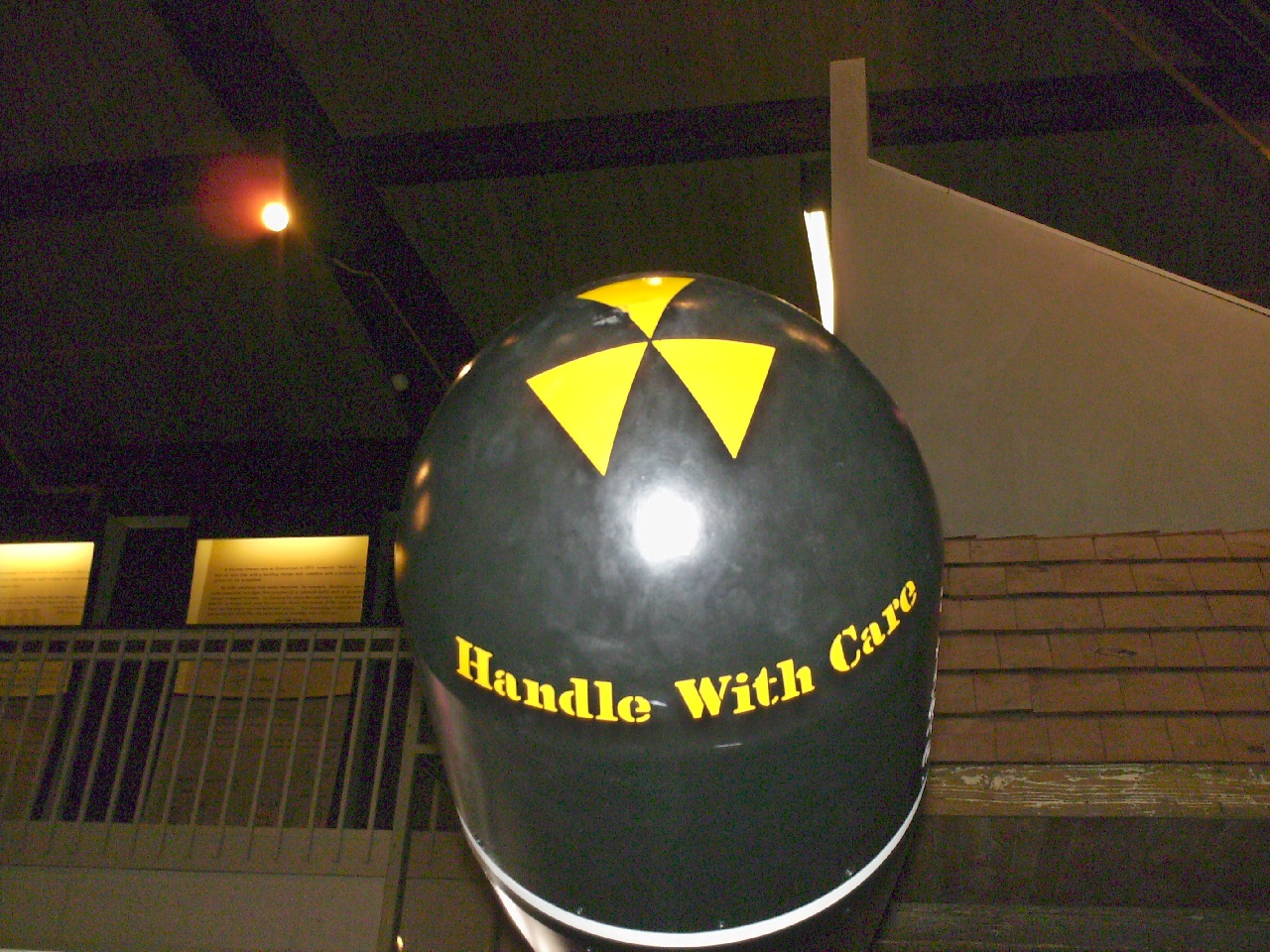
I just love the warning labels on the warhead:
Click to enlarge
Yes, I suppose that you would handle with care!
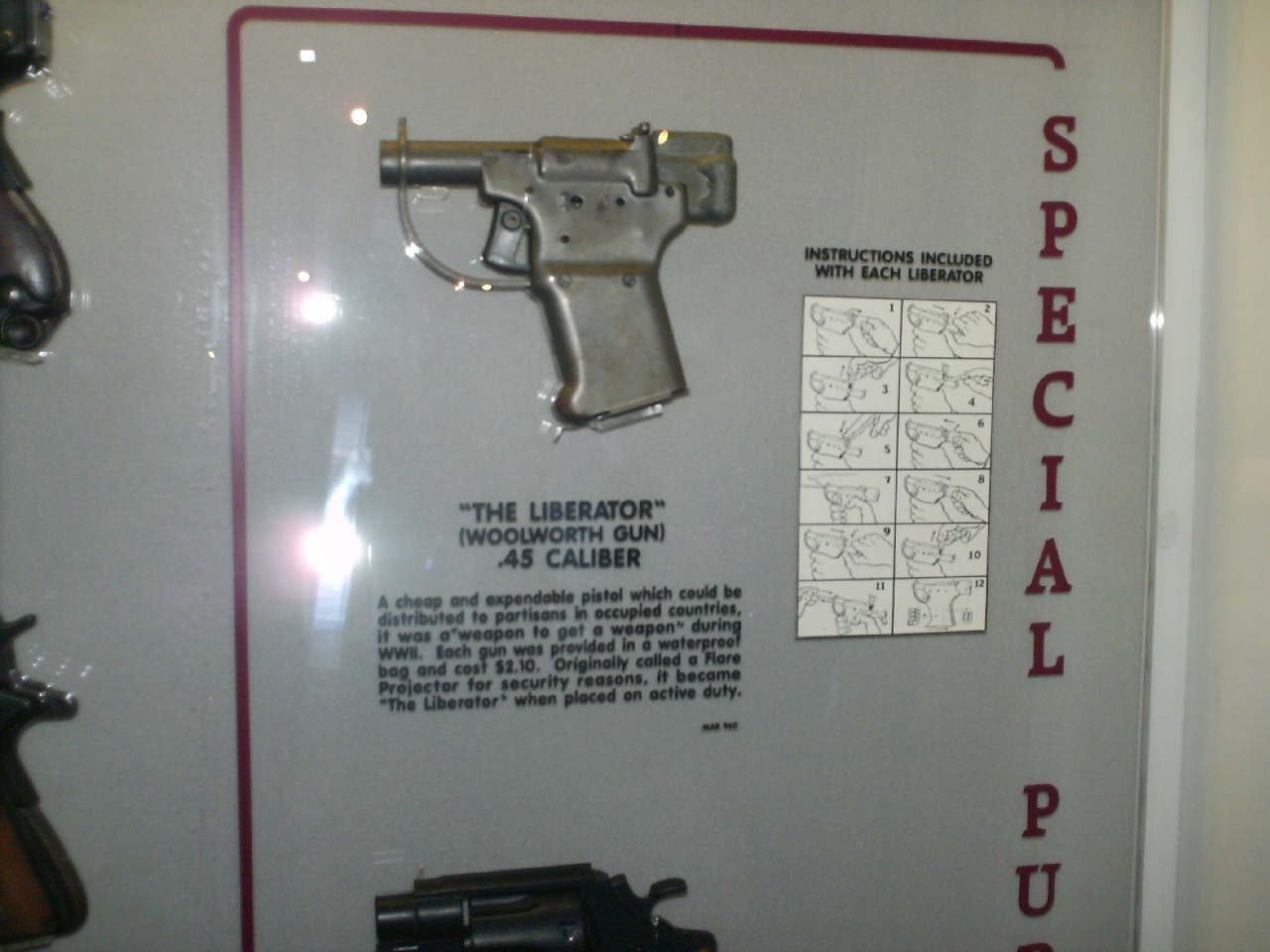
I think that I have mentioned the Liberator single shot pistol before--one of those ideas that sounds like something out of a gun nut fantasy--drop cheap, single shot pistols over France, and the Resistance will use them to kill a German soldier, take his rifle or submachine gun, and repeat.
Click to enlarge
In practice, it didn't work this way. The barrels weren't rifled, so they were very inaccurate, and the French Resistance was courageous--not stupid! It wasn't easy to get close enough to a single German soldier to kill him with one of these, and if there were two German soldiers, shooting the first just got you killed by the second, while you were frantically trying to reload.
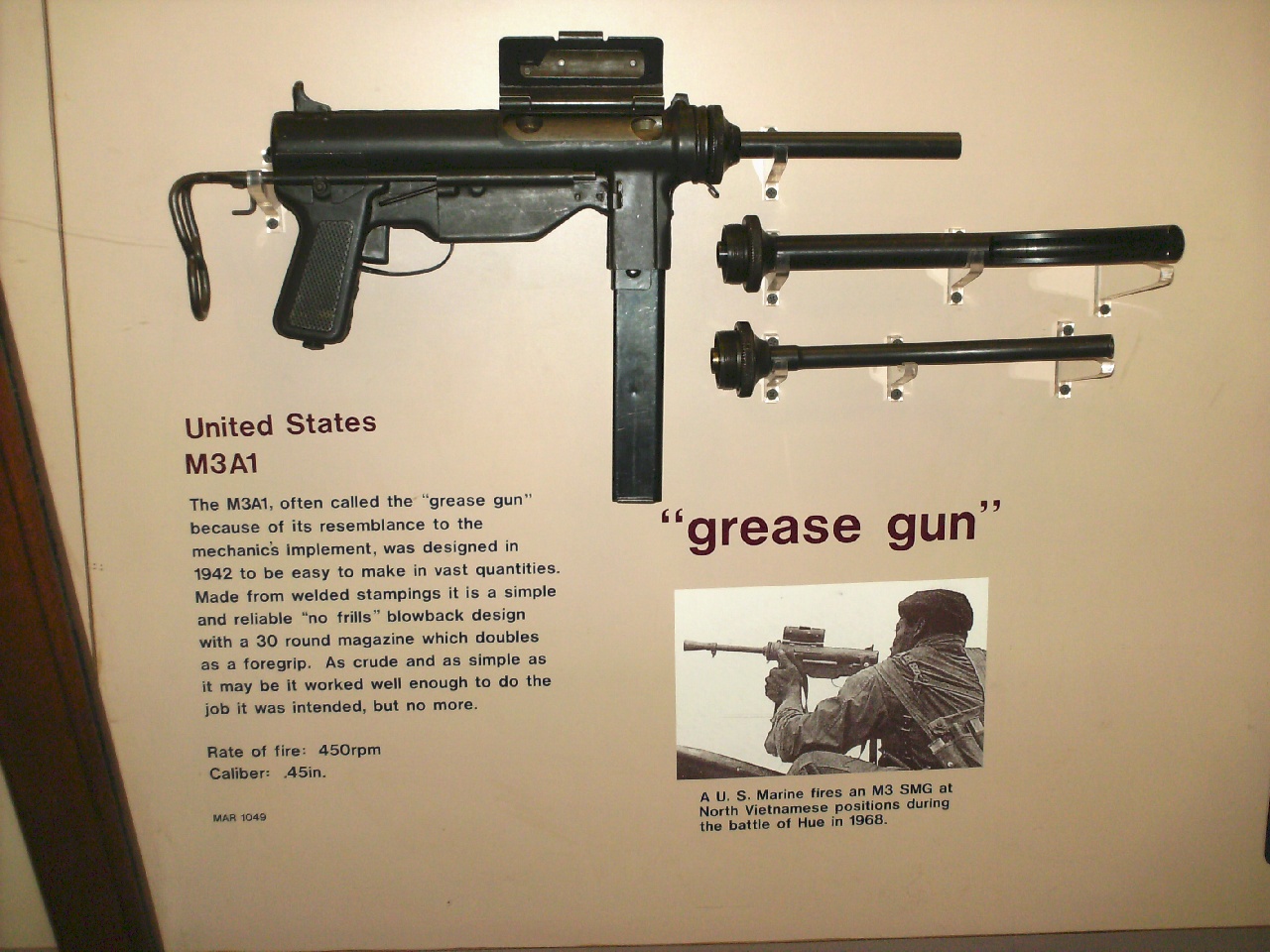
Here's the infamously ugly M3 grease gun. These were made by GM's Guide Lamp Division during World War II because they were largely metal stampings--something that Guide Lamp Division knew how to do well.
Click to enlarge
It isn't apparent from the picture, but one of the barrels is the curved version, intended for shooting around corners, or from inside tanks without sticking your head up. I didn't realize until I saw this display that it wasn't just the Germans who came up with ideas this strange.
This picture looks like a bunch of older rifles, right?
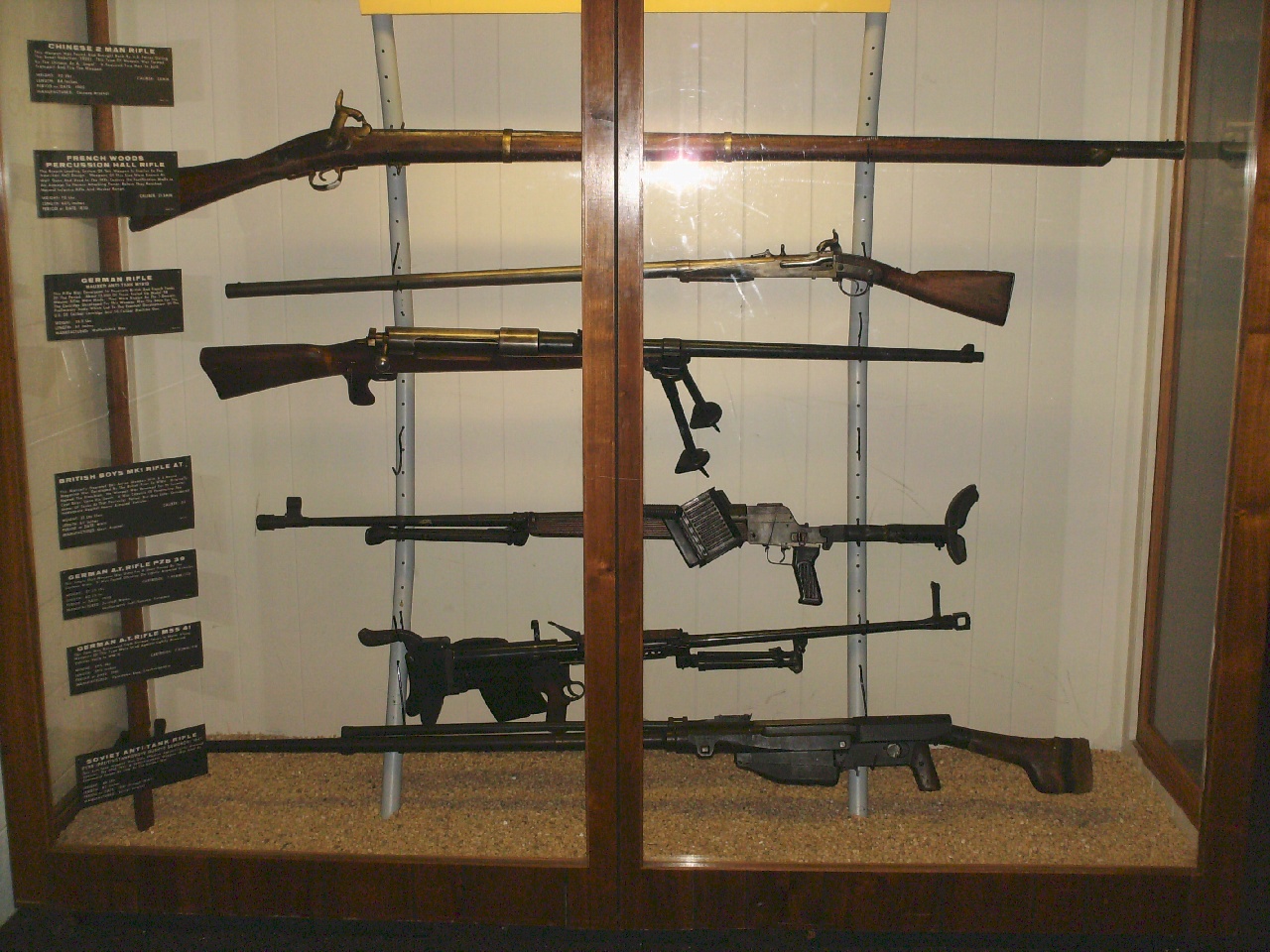
Click to enlarge
Except in person, you can see that these are huge rifles, rather like the Barrett Light .50 of their day.
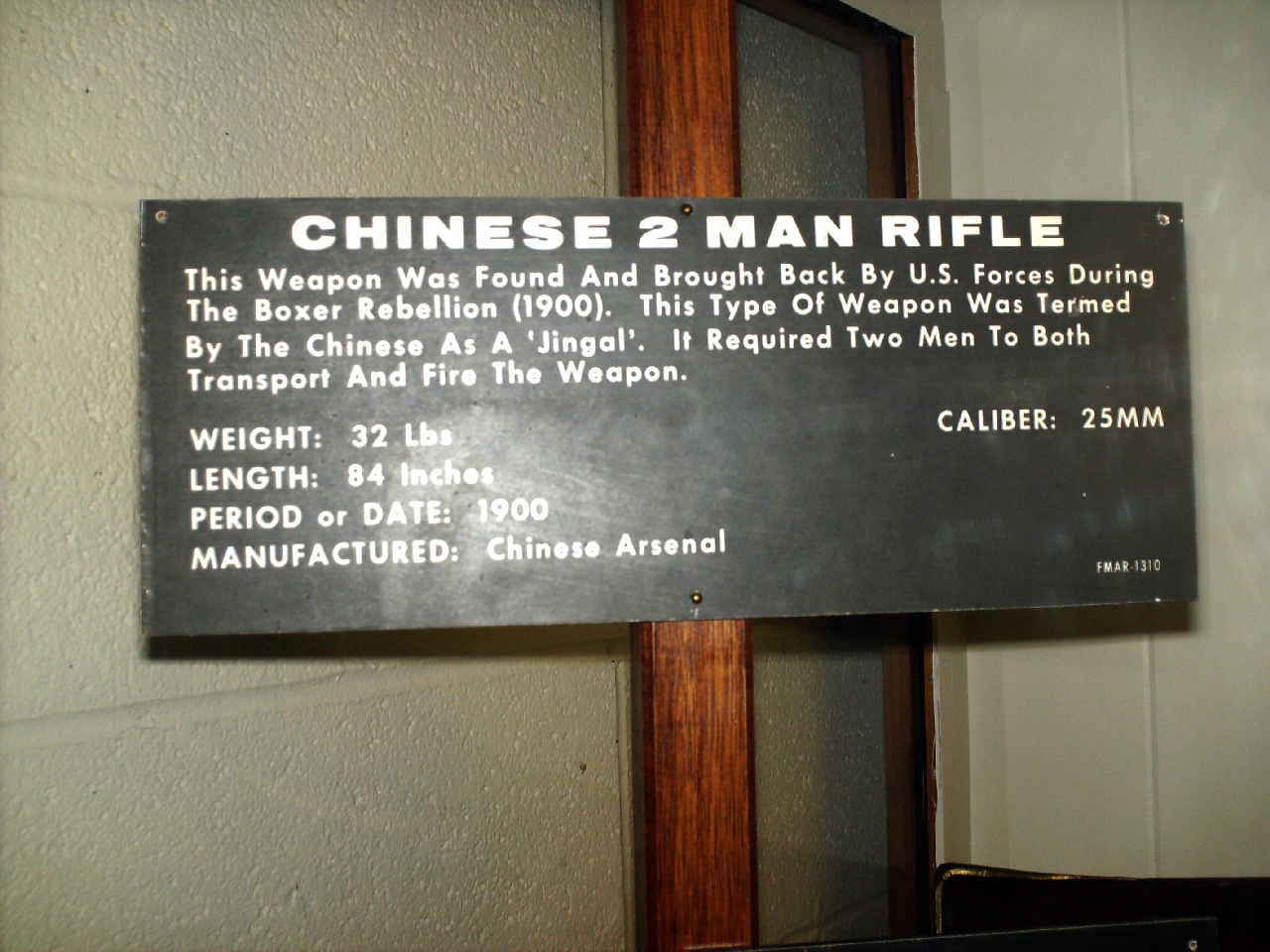
Click to enlarge
A point that doesn't get made enough is that the American System (as it was known in Britain, ironically, since we only improved on the British System) or sometimes the Armory Practice, plays a major part in creating the modern world of inexpensive, high quality mass produced stuff. I was pleased to see the Ordnance Museum display on this point:
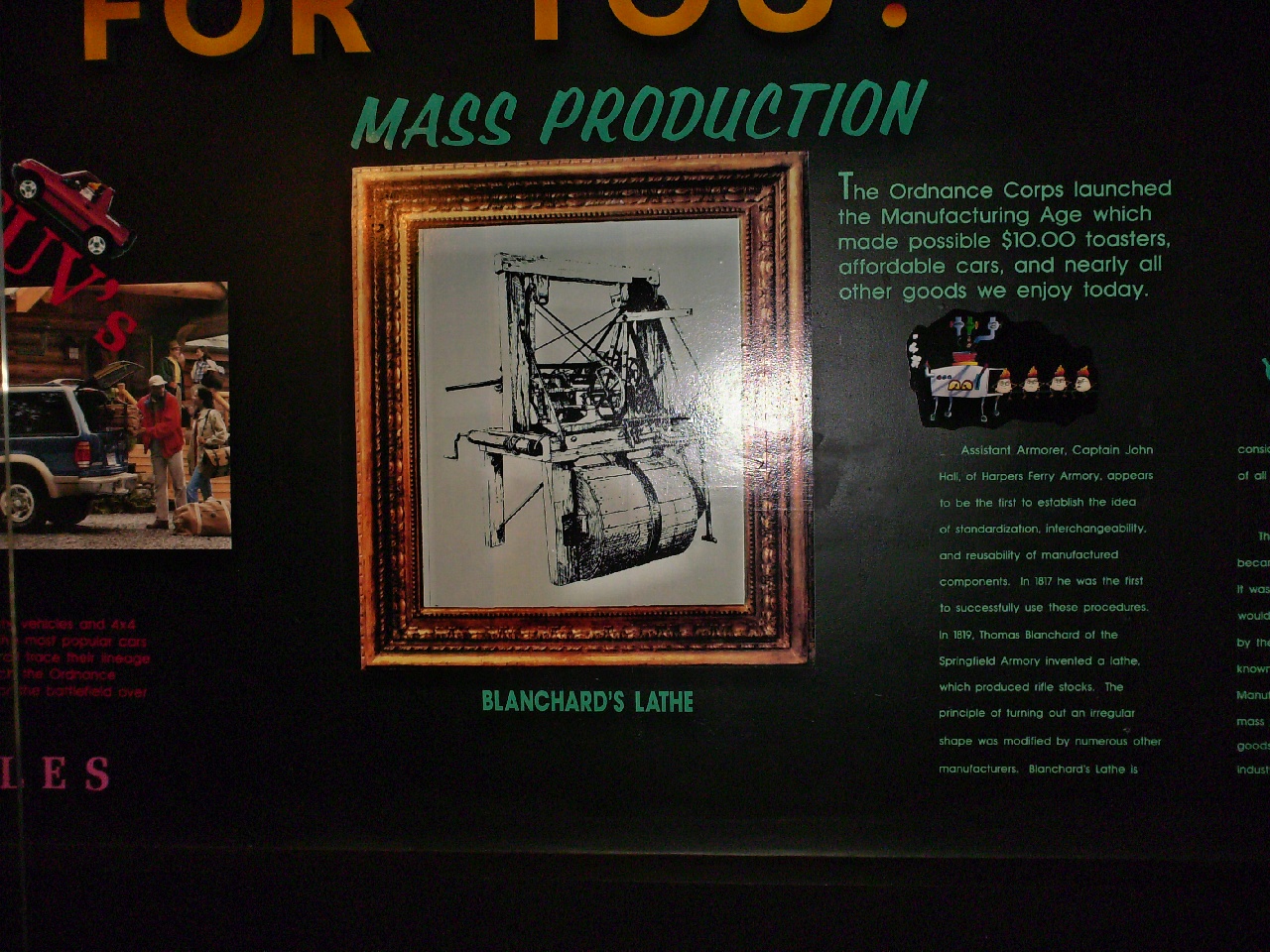
Click to enlarge
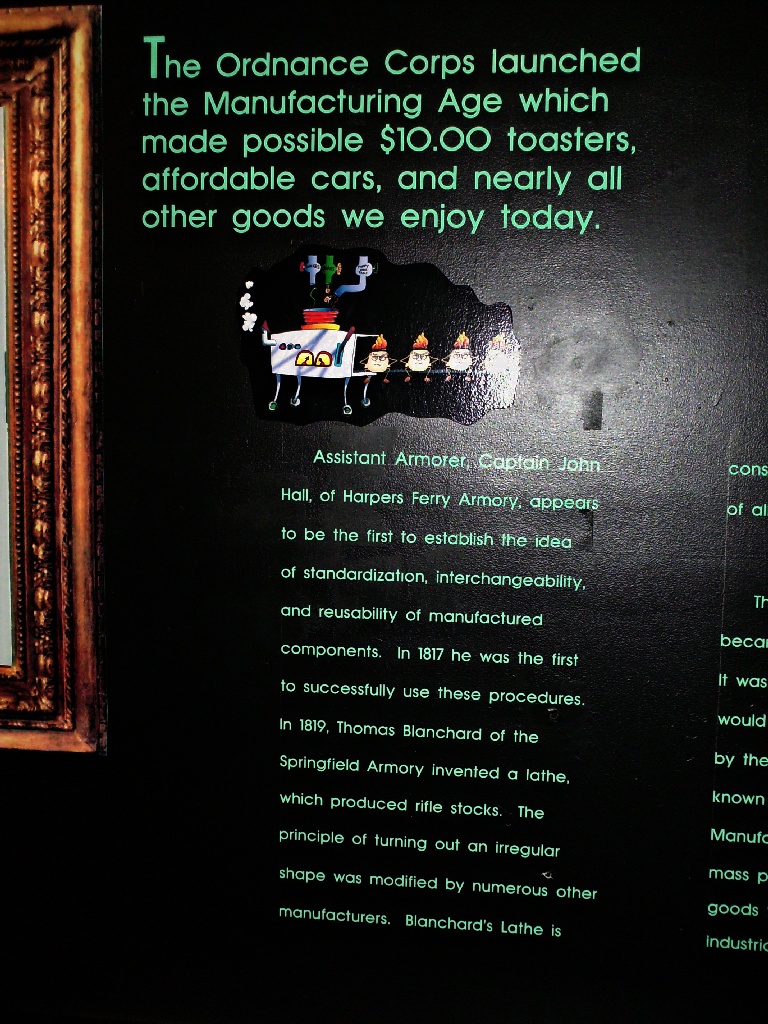
Click to enlarge
Click to enlarge
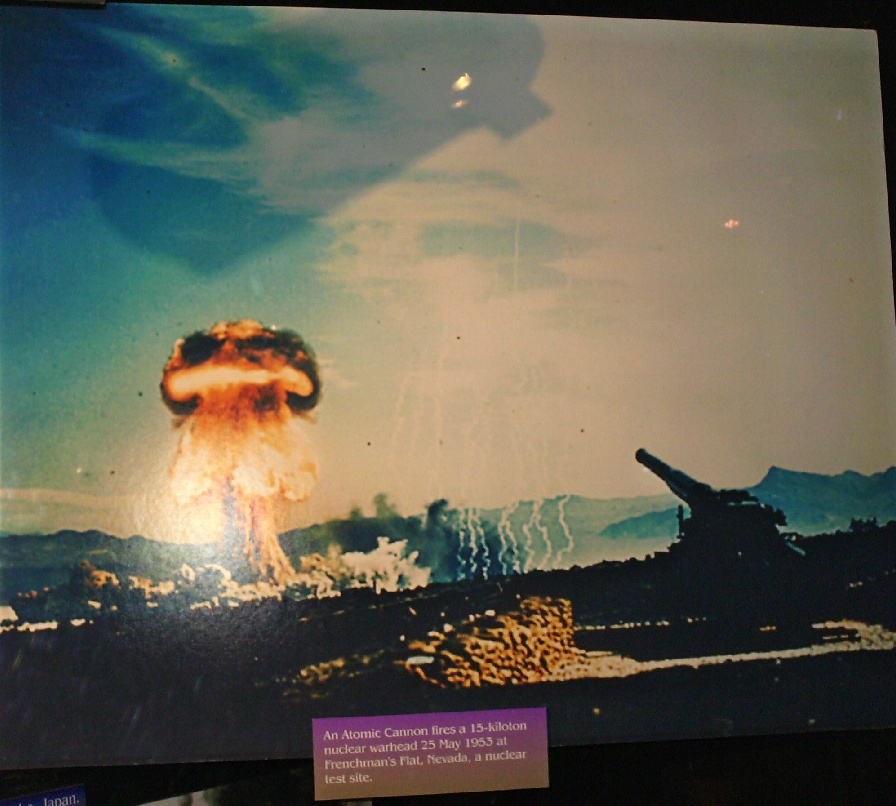
Not quite as silly as the nuclear mortar, is the Atomic Cannon:
Click to enlarge
They have an astonishing number of tanks and similar armored vehicles outside in all directions, but it was cold, covered in snow, and in places, slippery with ice, so I didn't walk out there.

Click to enlarge

Click to enlarge
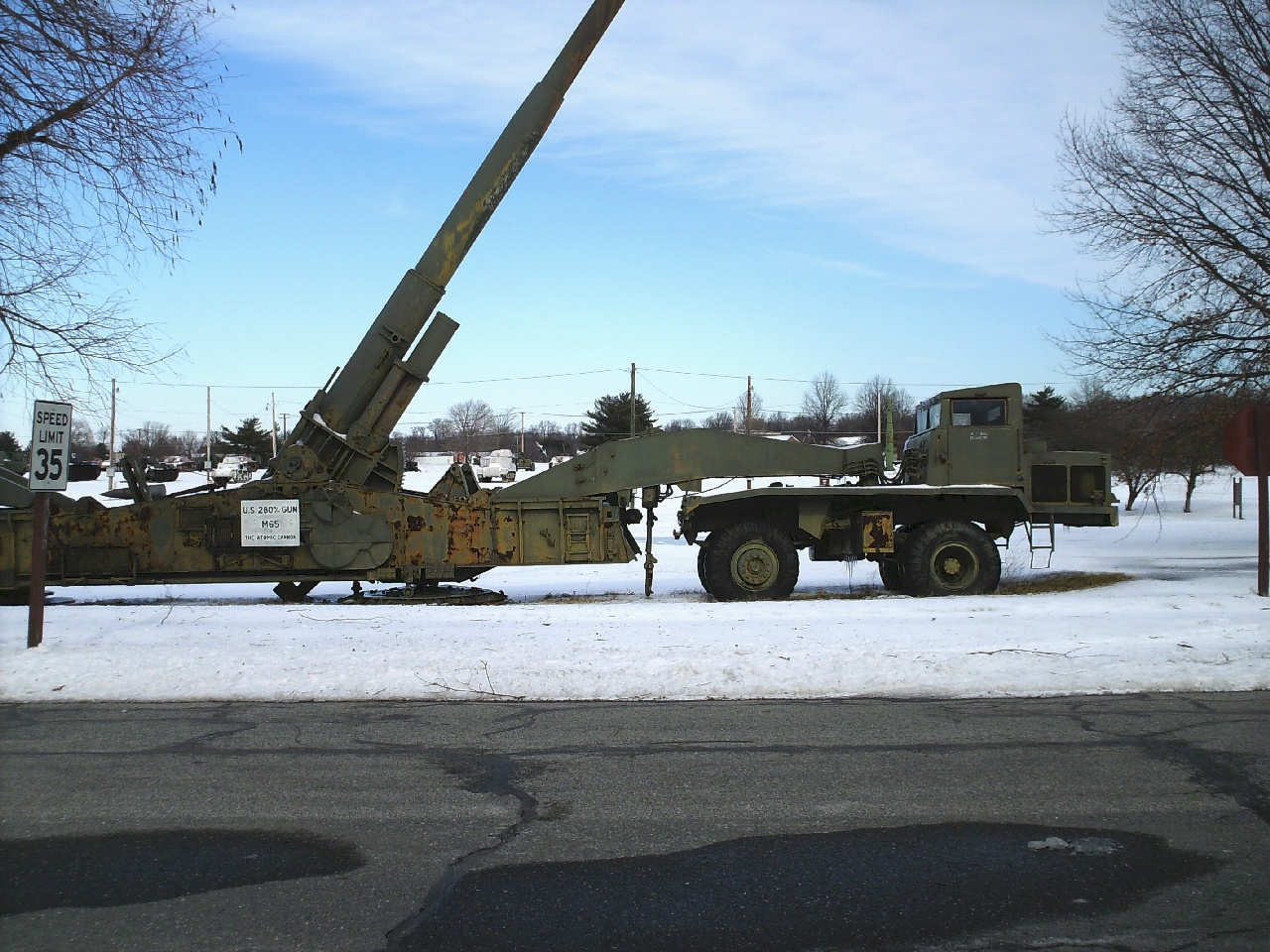
Oh, and here's the big brother to the Atomic Cannon, and it looks the part:
Click to enlarge
Monday, February 26, 2007
Cool Animation Showing How A Semiauto Pistol Works
This is specifically a Glock 17, but the basic principles are the same for most of the Browning-inspired pistol designs, showing how the slide retracts, unlocks and cants the barrel, ejects a shell, resets the hammer, and so on. Make sure you click the transparency controls for various sections of the gun.
This is specifically a Glock 17, but the basic principles are the same for most of the Browning-inspired pistol designs, showing how the slide retracts, unlocks and cants the barrel, ejects a shell, resets the hammer, and so on. Make sure you click the transparency controls for various sections of the gun.
Subscribe to:
Posts (Atom)